

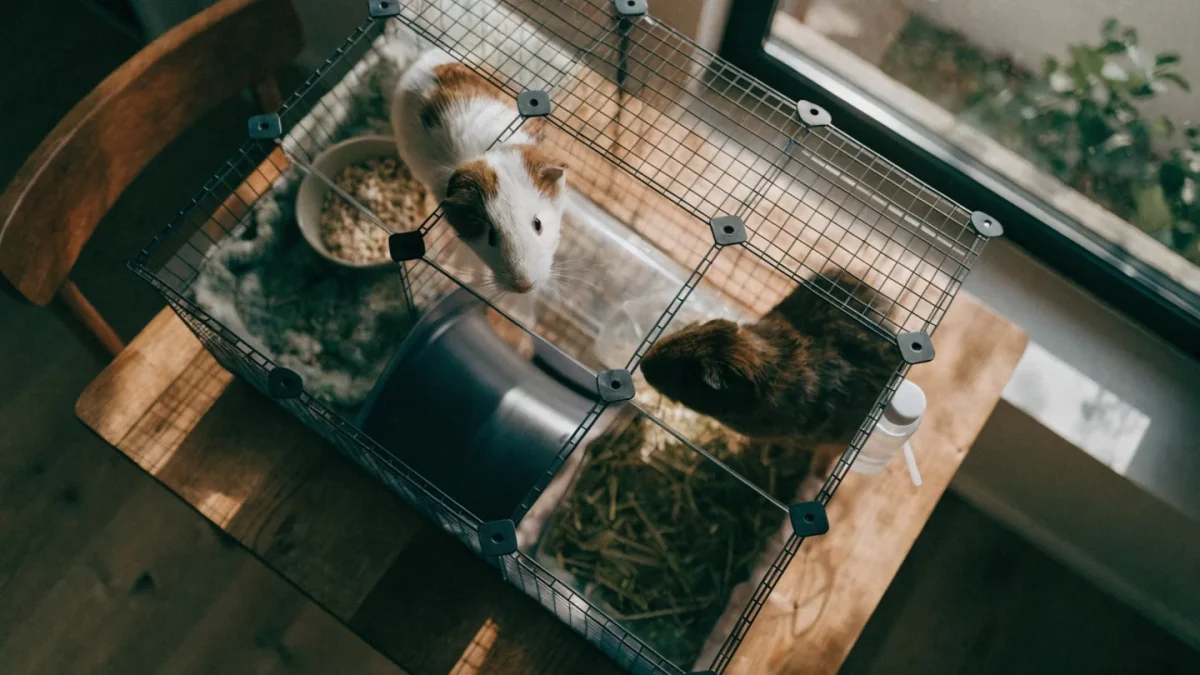
A rescue coordinator I've worked with told me she could predict half of a guinea pig's health problems just by seeing a photo of its cage. Too small, too damp, wrong bedding, no hideouts. After years of taking in surrendered cavies and seeing what they lived in before, I believe her.
Guinea pigs need at minimum 0.7 m² (7.5 sq ft) of unbroken floor space for a pair, housed indoors in a temperature-stable room between 17-24°C (63-75°F), with multiple hiding areas and appropriate bedding. Grid-and-coroplast (C&C) cages are the most practical option for meeting these requirements.
The housing situation is where most new guinea pig owners go wrong — not out of neglect, but because the products marketed as "guinea pig cages" are almost universally too small.
Minimum Size Standards
The minimum floor space recommendations come from animal welfare organizations and veterinary guidelines, and they're consistent across sources — the Humane Society and rescue organizations widely cite 7.5 square feet (roughly 0.7 m²) for one to two guinea pigs, 10.5 square feet (about 1.0 m²) for three, and larger for bigger groups.
Floor space means exactly that — unbroken, single-level floor area. Multi-level cages with ramps don't count the upper levels toward the minimum, because guinea pigs aren't confident climbers. They'll use a gentle ramp to reach a small loft, but they won't treat a second story the way a rat would. The running, popcorning, and zoomies that indicate a happy pig all happen on a flat surface.
I measured every commercially available cage I could find in pet stores a few years back. The largest topped out at about 0.5 m². That's fine for a single hamster. For a pair of guinea pigs, it's roughly two-thirds of the minimum. And since guinea pigs should never be kept alone, the "starter cage" you see on the shelf is already inadequate before you get it home.
Building a C&C Cage
C&C cages — storage cube grids zip-tied together with a coroplast (corrugated plastic) base — became the community standard because they solved every problem at once. They're inexpensive, infinitely customizable, easy to clean, and you can build one to fit whatever space you have.
A basic 2×4 grid cage (roughly 77 cm × 148 cm / 30" × 58") hits the minimum for two pigs. The build takes about thirty minutes.
The grid panels need spacing narrow enough that a pig can't wedge its head through. Standard storage cube grids work — the ones with wider spacing used for shelving units do not. A young or small guinea pig can push through a gap that seems too narrow, and a pig stuck halfway through a grid panel is a genuine emergency.
Coroplast forms the base and walls. Cut the base to size, score fold lines for 15 cm (6") walls, and fold up. Some keepers add a second layer on the floor for rigidity. The walls prevent bedding scatter and keep pigs from chewing on the grids — though most pigs lose interest in the grids quickly.
For a deeper dive into the general principles behind small animal enclosures — ventilation, material safety, temperature management — the article on enclosure design principles covers the cross-species basics.
Placement Matters
Indoor only. Guinea pigs can't handle temperature swings, and outdoor housing exposes them to predators, parasites, and weather that will shorten their lives.
Keep the cage away from windows that get direct afternoon sun — a sunny spot in January becomes an oven in July. Avoid placing it near radiators, air conditioning vents, or drafty doorways. I lost a pig years ago to a respiratory infection that I'm fairly certain started because the cage was near an exterior door that got opened constantly in winter.
Elevation helps. A cage on a table or stand keeps pigs away from floor drafts and makes cleaning vastly easier on your back. It also helps if you have other pets — a dog can't reach into a cage that's at counter height.
Noise matters too. Guinea pigs startle easily. A cage next to a home theater system or a slamming door creates chronic low-level stress you might not notice, but the pigs do.
Hideouts and Enrichment
Each guinea pig needs its own hiding spot. This is non-negotiable.
Guinea pigs are prey animals with a hardwired need for cover. Without it, they sit frozen in corners, which looks calm but is actually sustained terror. I've seen pigs go from "never moves, barely eats" to active and vocal within a day of adding adequate hiding spaces — that transformation tells you everything about what was missing.
The hideouts should have at least two exits. A tunnel or an arch works better than a box with one opening, because a single-entrance hide becomes a trap during social disputes. The subordinate pig needs an escape route.
Beyond hides, add hay racks (keeps hay off the bedding), tunnels, and foraging opportunities — scatter pellets or tuck vegetable pieces into hay piles so the pigs have to work for them. A paper bag stuffed with hay is free enrichment that most pigs love.
Temperature and Environment
The comfort range is 17-24°C (63-75°F). Guinea pigs handle mild cold better than heat. Temperatures above 26°C (79°F) put them at risk of heatstroke, and they can't pant or sweat effectively. If your home gets hot in summer and you don't have air conditioning, frozen water bottles wrapped in cloth or ceramic tiles placed in the cage provide cooling surfaces, but they're temporary fixes.
Humidity should stay moderate — persistent dampness promotes respiratory infections and fungal skin conditions. Good airflow matters, but direct drafts don't. The distinction is subtle but real: air should circulate through the room, not blast across the cage.
As part of your overall guinea pig care routine, check the temperature at cage level, not room level. Heat rises, so a cage on the floor may be cooler than your thermostat suggests, and a cage on a high shelf may be warmer.
FAQ
Can I keep guinea pigs in a glass aquarium?
No. Aquariums have terrible ventilation. Ammonia from urine builds up at floor level — exactly where the pigs are breathing — and the glass walls trap heat. I've seen guinea pigs come out of aquarium setups with chronic eye irritation and respiratory problems that cleared up within weeks of moving to a properly ventilated enclosure.
How often should I clean the cage?
Spot-clean daily — remove soiled bedding, uneaten vegetables, and any wet patches. Full bedding change depends on the type: disposable bedding every 5-7 days, fleece liners every 3-4 days (with daily sweeping of droppings). The cage shouldn't smell. If it does, you're cleaning too infrequently or the cage is too small for the number of pigs.
Can guinea pigs live outdoors?
Some keepers in mild climates house guinea pigs outdoors in predator-proof hutches. I don't recommend it. Temperature swings, predator stress (even if the predator can't get in, the pig knows it's there), flies, parasites, and weather all create risks that don't exist indoors. Every outdoor-housed guinea pig I've personally encountered had more health issues than its indoor counterparts.