

A veiled chameleon I took in as a rescue three years ago had a jaw so soft you could feel it flex when the animal tried to eat. The previous owner had been feeding gut-loaded crickets every day — doing the insect part right — but had never once dusted with calcium. No UVB lamp either, just a plant grow light they'd found at a hardware store. The chameleon was eight months old and already had irreversible skeletal damage.
Calcium vitamin supplements for reptiles prevent metabolic bone disease and a host of other deficiency-related problems. Insectivorous species need calcium powder on every insect feeding, a multivitamin once or twice weekly, and vitamin D3 either from UVB exposure or supplemental powder — but not both at high levels. Herbivorous reptiles need calcium dusted on greens several times per week. The specifics vary by species, but the principle is universal: captive reptile diets are nutritionally incomplete without supplementation.
Why Captive Reptiles Need Supplementation at All
Wild reptiles don't take supplements. They get calcium from the bones of prey, mineral-rich soil, varied wild insects that have themselves eaten diverse diets, and hours of unfiltered sunlight. Captive reptiles get commercially raised feeder insects that ate wheat bran in a plastic tub, and a UVB bulb that degrades over months. The gap between wild nutrition and captive nutrition is enormous, and supplements bridge it.
The critical relationship is between calcium, phosphorus, and vitamin D3. Calcium absorption requires adequate D3. D3 is synthesized through UVB exposure in the skin — or provided directly as a supplement. But too much D3 causes hypervitaminosis, which deposits calcium in organs where it doesn't belong. So the balance matters.
Most feeder insects have inverted calcium-to-phosphorus ratios. Crickets run about 1:9 calcium to phosphorus. Your reptile needs roughly 2:1 in the other direction. Without dusting, you're feeding a calcium-deficient diet every single time.
Calcium Powder: The Daily Foundation
Pure calcium carbonate without D3 is your everyday supplement for any reptile with proper UVB lighting. Dust feeder insects at every feeding for insectivores — young bearded dragons, leopard geckos, chameleons, anoles. For herbivorous species like iguanas and uromastyx, a light dusting on salad greens three to four times a week covers the baseline.
I keep two containers in my reptile room: one labeled "calcium" and one labeled "calcium + D3." The pure calcium gets used constantly. The D3 version comes out on a schedule.
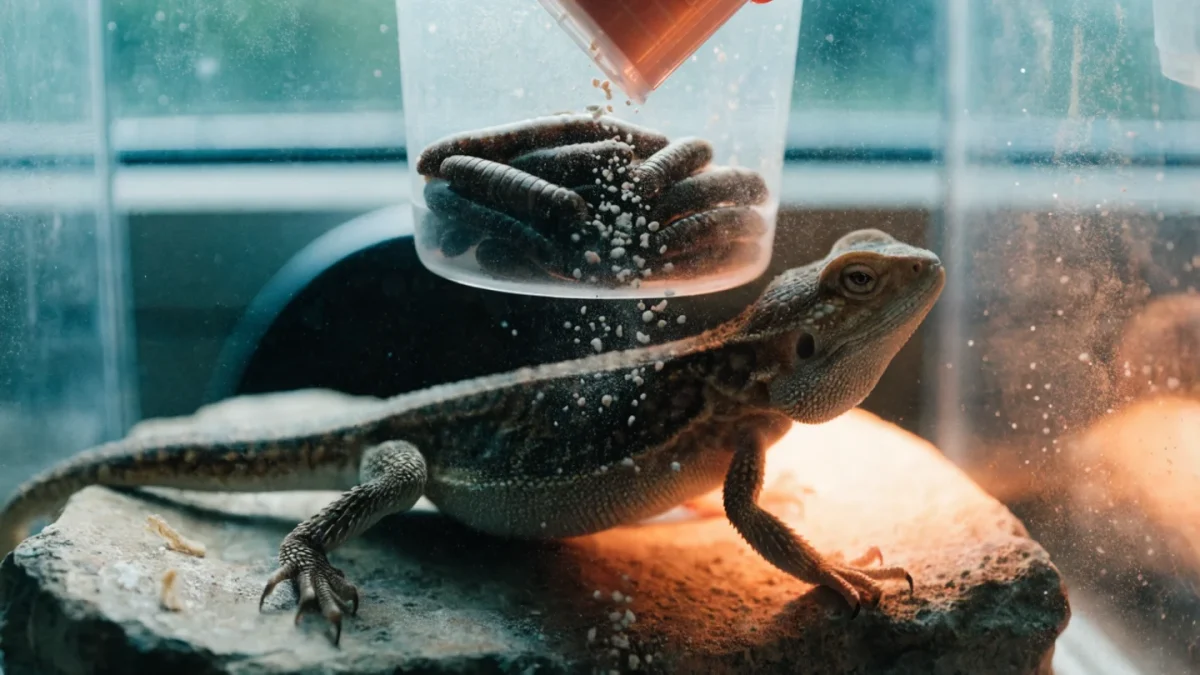
The dusting technique matters more than people think. Toss insects in a bag or cup with a pinch of powder — just enough that they look lightly coated, not caked. Heavily coated insects sometimes get rejected, especially by chameleons and smaller geckos who are particular about texture. I've watched a panther chameleon tongue-strike a cricket, taste the excess powder, and spit it out. Twice in a row.
For species that eat from a dish — leopard geckos, young beardies — you can dust the insects in the dish directly. For free-range feeders released into the enclosure, dust right before release because the powder falls off within minutes.
Vitamin D3: The UVB Question
This is where supplementation gets genuinely complicated, because the answer depends entirely on your lighting setup.
If your reptile has a high-quality UVB tube — correct percentage for the species, mounted at the right distance, replaced every six months — then they're synthesizing their own D3. In that case, supplementing with a calcium + D3 powder once a week is a safety margin, not a primary source. Some keepers skip the D3 powder entirely when UVB is dialed in. I still use it once weekly as insurance because UVB output is invisible and I've been surprised by dead bulbs before.
If your UVB situation is suboptimal — wrong percentage, mounted too far away, overdue for replacement, or blocked by a mesh screen — then D3 supplementation becomes more critical. Calcium + D3 powder at every other feeding is a common recommendation for keepers who can't guarantee their UVB quality.
But excess D3 is toxic. Hypervitaminosis D causes mineralization of soft tissues — kidneys, blood vessels, organs calcifying from the inside. I've seen it once in a crested gecko whose owner was dusting with calcium + D3 at every feeding and had a UVB lamp running. The gecko developed kidney issues at two years old. Cresties don't even need high UVB. That was a case of doing too much rather than too little.
The honest answer: get your UVB right and use D3 sparingly. That's the safer approach for almost every species.
Multivitamins: The Weekly Addition
A reptile-specific multivitamin powder covers vitamin A, B vitamins, and trace minerals that calcium alone doesn't address. Most keepers — myself included — use a multivitamin dust once or twice a week, on a different feeding than the D3 calcium.
A typical weekly schedule for an insectivorous reptile eating daily:
- Monday through Friday: plain calcium dust on insects
- Saturday: calcium + D3 dust
- Sunday: multivitamin dust
That's a simplified version. Juveniles growing fast might get the multivitamin twice weekly. Species with lower metabolism — like crested geckos or gargoyle geckos eating a prepared diet — need less frequent supplementation because their commercial diet already contains vitamins.
Vitamin A deserves a specific mention. Reptile supplements contain either preformed vitamin A (retinol) or beta-carotene. Preformed A is more bioavailable but also more dangerous in excess. Beta-carotene is safer because the body converts only what it needs, but some species — chameleons in particular — may not convert it well at all. And here's the honest part: nobody's actually nailed this down. A 2018 review in Clinician's Brief put it plainly — whether insectivorous lizards can synthesize vitamin A from dietary carotenoids in the first place is still unknown.
I tend toward supplements with beta-carotene for most species and add a small amount of preformed vitamin A for chameleons specifically, but I won't pretend the science is perfectly settled here.
Species-Specific Adjustments
Not every reptile follows the same protocol. Here's where the details diverge from the general advice laid out in the species-specific diet fundamentals guide.
Leopard geckos are nocturnal and don't get significant UVB in most setups (though providing low-level UVB is increasingly recommended). They rely more heavily on dietary D3. Calcium + D3 at every other feeding is standard, with plain calcium on alternating feeds.
Chameleons need careful vitamin A management on top of the usual calcium and D3 protocol. Vitamin A deficiency causes eye problems — swollen, sealed eyelids, inability to tongue-strike accurately. I've seen it more often in veileds and panthers than people expect.
Bearded dragons are the most straightforward. Solid UVB, calcium at every insect feeding, D3 once a week, multivitamin once a week. Their tolerance range is wider than many species, which is part of why they're recommended for beginners.
Tortoises and herbivorous lizards get calcium sprinkled on greens rather than dusted on insects. Cuttlebone left in the enclosure provides supplemental calcium that many tortoises will gnaw on voluntarily — and it's a good indicator of demand. If your tortoise is demolishing cuttlebone, they may need more dietary calcium than they're currently getting.
Signs You're Getting It Wrong
Calcium deficiency shows up first as lethargy, then muscle tremors, then visible skeletal deformities — rubbery jaw, kinked spine, limbs that bend wrong. By the time you see the skeleton changing, damage has already occurred.
D3 excess is harder to spot. Lethargy, loss of appetite, swelling around the limbs or throat. Blood work is really the only way to catch it early, which is one more reason to build a relationship with an exotic vet before problems arise.
Vitamin A deficiency: swollen eyes, difficulty eating, skin that doesn't shed cleanly. Vitamin A excess: similar to D3 excess, with skin lesions and lethargy added to the mix.
The frustrating reality is that deficiency and excess symptoms overlap enough that supplementation is genuinely a balancing act. Keeping a consistent schedule and not panicking into double-dosing is the most reliable approach I've found.
Frequently Asked Questions
Can I use human calcium supplements for my reptile?
Technically, calcium carbonate is calcium carbonate. But human supplements often contain added ingredients — vitamin D at doses formulated for a 70 kg human, binders, flavorings, sugar coatings — that aren't appropriate for a 50-gram gecko. Reptile-specific powders are formulated for dusting and for the dosing scale of small animals. They cost roughly the same as a bottle of human calcium anyway. Not worth the risk.
My reptile won't eat dusted insects. What do I do?
Lighter dustings. Some animals are genuinely put off by heavily coated feeders — especially arboreal species with good color vision. Use just enough powder that the insects have a light coating rather than looking like they rolled through flour. You can also gut-load feeder insects with calcium-rich vegetables (collard greens, mustard greens) before offering them, which delivers calcium from the inside rather than the outside.
How do I know if my UVB is still producing enough output?
You don't, visually. UVB is invisible to humans. A Solarmeter 6.5R reads UVB index directly and takes the guesswork out — but they cost over $200. The cheaper approach: replace tubes on a strict six-month schedule regardless of whether they still light up. Mark the install date on the fixture with a piece of tape.
Is liquid calcium better than powder for reptiles?
Liquid calcium supplements administered orally are useful for animals already showing deficiency signs — a vet might prescribe oral calcium for a reptile with early MBD. For routine supplementation on healthy animals, powder dusting is simpler, more consistent, and less stressful than prying open a reptile's mouth to deliver liquid. Powder remains the standard for daily use.
I've cycled through various supplement brands and schedules over the years, and the keepers who run into problems almost always fall into one of two camps: the ones who supplement nothing because "wild animals don't take vitamins," and the ones who supplement everything at maximum dose because more must be better. Both approaches end up in the same vet's office. A moderate, consistent schedule adjusted for your species and your UVB setup handles it.