

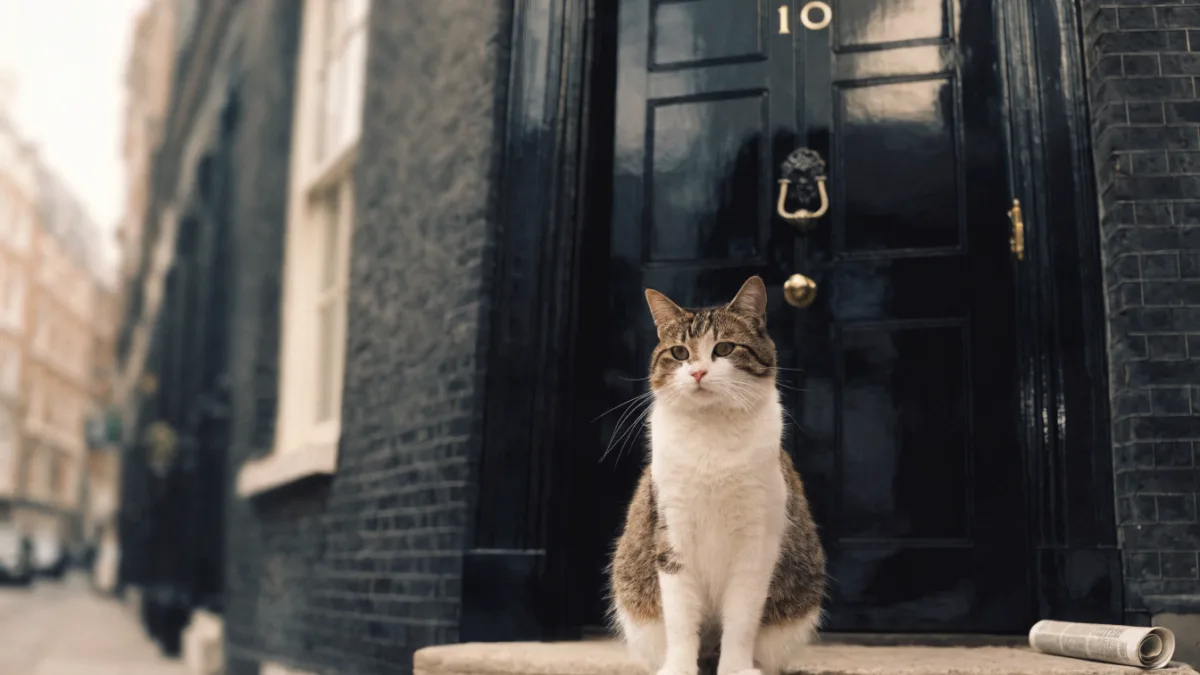
The longest-serving resident of 10 Downing Street is not a politician, a policy wonk, or even a particularly ambitious staffer. It’s a tabby cat named Larry, adopted from a London shelter in 2011, who has now calmly outlasted six British prime ministers. Meanwhile, my cat Mochi’s biggest achievement this week was defeating a shoelace. And honestly? History suggests Mochi is the one following tradition. Most famous pets in history weren’t bred for greatness — they were strays, shelter cats, war orphans, and accidental celebrities who happened to be in the right place at the right moment. Some of them swayed elections. One of them went to space. A few have better job security than any human alive.
Presidential Pets: The Animals Who Actually Won Elections
The tradition starts, as many strange American traditions do, with Abraham Lincoln. His cats, Tabby and Dixie, are widely considered the first famous White House felines — Lincoln reportedly fed Tabby with a gold fork at dinner and declared that Dixie was smarter than his entire cabinet. His dog Fido became the first presidential pet ever photographed, which is lovely right up until you learn that poor Fido, left with friends in Illinois, was killed by a drunk man a year after the assassination. I’ll give you a moment. History is sometimes awful.
After that, the menageries escalated. Theodore Roosevelt packed the White House with more than 30 animals, including a badger, a snake named Emily Spinach, and a pony who once rode the elevator. Calvin Coolidge’s raccoon, Rebecca, was originally mailed to the White House by a supporter to be served at Thanksgiving dinner — the family found her delightful instead and kept her as a pet, which is the most wholesome plot twist in presidential history. Warren Harding’s Airedale, Laddie Boy, had his own chair at cabinet meetings, and newsboys across the country collected roughly 19,000 pennies to build him a commemorative statue. Per the White House Historical Association, more than 400 animals have called the White House home.
The speeches that saved careers
Here’s where it gets politically spicy: pets didn’t just decorate presidencies — they decided elections. In 1944, Franklin Roosevelt deflected attacks by mocking Republican claims that he’d accidentally left his Scottish terrier Fala behind in the Aleutians:
These Republican leaders have not been content with attacks on me, or my wife, or on my sons… they now include my little dog, Fala.
The “Fala Speech” was a masterclass in political jiu-jitsu, and Fala remains the only presidential pet honored with a statue at a presidential memorial. Eight years later, Richard Nixon salvaged his vice presidential candidacy with the Checkers Speech — watched by an estimated 60 million Americans, then the largest political audience ever — by defending, of all things, a cocker spaniel puppy. One dog mention, and a career survived.
The modern era has its own chapters: George H.W. Bush’s springer spaniel Millie “authored” Millie’s Book, a #1 New York Times bestseller, and her puppy Spot later returned to the White House under George W. Bush — the only second-generation First Pet. The Obamas chose Bo, a Portuguese water dog, partly because of Malia’s allergies. Major Biden made history in 2021 as the first shelter rescue dog in the White House, though First Pet life isn’t always a fairy tale — his successor Commander was rehomed in 2024 after a string of biting incidents. And Donald Trump became the first president in more than a century to keep no pets at all, which historians still can’t stop talking about.
War Dogs: Stubby, Chips, Smoky, and the Rin Tin Tin Empire
The wartime record puts most human résumés to shame. Sergeant Stubby, a stray who wandered onto a Yale training field, fought in 17 World War I battles, warned troops of incoming gas attacks, and is credited with capturing a German spy by the seat of his pants. He’s now displayed at the Smithsonian. Chips, a German shepherd mix, charged a machine-gun nest in Sicily during World War II and was awarded the Silver Star and Purple Heart — then had both stripped in 1943 because a new policy deemed animals ineligible for decorations. He finally received the Dickin Medal, the animals’ Victoria Cross, posthumously in 2018. Seventy-five years late is still late, but I’ll take it.
Then there’s Smoky, a four-pound Yorkshire terrier found in a New Guinea foxhole, who survived 150 air raids and visited wounded soldiers in hospitals — many historians credit her as the original therapy dog. And Rin Tin Tin, a puppy rescued from a World War I battlefield in 1918, went on to star in roughly 27 Hollywood films; he’s buried in Paris’s Cimetière des Chiens, where his grave is still one of the most visited. (The legend that he nearly won the first Best Actor Oscar? The Academy denies it. Let it go, internet.)
My one hill to die on: the 1925 Nome serum run. Balto got the statue in Central Park for running the final 55 miles, but Togo covered roughly 264 grueling miles — the hardest leg of the 674-mile relay, completed in 127.5 hours. Togo did the work; Balto got the bronze. At least science caught up: in 2023, researchers sequenced Balto’s genome from his taxidermied remains and found a surprisingly diverse, healthy working dog. You can dig into more of these stories in the.[1]
Famous Cats: A Chief Mouser, a Stationmaster, and the Only Cat in Space
Larry, career civil servant
Larry was adopted from Battersea Dogs & Cats Home in 2011 and became the first cat to hold the official title “Chief Mouser to the Cabinet Office.” He’s served under Cameron, May, Johnson, Truss, Sunak, and Starmer, making him Downing Street’s longest-serving current resident. His mouse-catching record is, generously, inconsistent, and his 2016 turf wars with Palmerston, the Foreign Office cat, made international headlines. In 2025 he went viral again simply by strolling past the cameras during President Zelensky’s arrival at No. 10. He wasn’t fired. He never is. That’s the dream.
Cats have prowled British government buildings for centuries, with official-ish predecessors including:
- Wilberforce (1973–1988), who served under four prime ministers
- Humphrey (1989–1997), whose “retirement” sparked tabloid accusations that Cherie Blair had forced him out — No. 10 denied it
- Sybil (2007), who apparently found the job beneath her and left early
Félicette, the astronaut everyone forgot
On October 18, 1963, France launched a stray tuxedo cat from Paris atop a rocket. Félicette reached about 157 kilometers altitude on a 15-minute flight — the first and only cat in space. She’s far less famous than Laika, the Soviet dog who orbited in 1957 and died within hours, a fact the Soviets concealed for decades. Félicette’s own ending wasn’t kind either: she was euthanized after landing so scientists could study her. For years, memorials even misidentified her as “Félix.” A crowdfunded bronze statue finally honoring her correctly went up in Strasbourg in 2019 — sixty years of obscurity corrected by cat lovers with credit cards. There’s a poetry to that. (One sweet footnote: Strelka, one of the two dogs who survived orbit in 1960, had a puppy named Pushinka who was gifted to JFK’s family — a tiny, actual Cold War thaw.)
The rest of the feline hall of fame
Unsinkable Sam survived three sinkings in World War II — the Bismarck, HMS Cossack, and HMS Ark Royal — and his portrait hangs in Greenwich’s National Maritime Museum. Tama, appointed stationmaster of a rural Japanese railway station in 2007, is credited with bringing roughly 1.1 billion yen a year to the local economy, was deified after her death in 2015, and was succeeded by the equally official Nitama. Towser, the Glenturret Distillery cat, holds the Guinness record with an estimated 28,899 mice caught (Mochi caught a moth once and was insufferable about it for days). And Stubbs served as honorary mayor of Talkeetna, Alaska, for twenty years. You can browse more of these legends in this.[2]
Myths, Reckonings, and What We Owe Them Now
Cat celebrity, it turns out, is ancient. Cats descend solely from the African wildcat and essentially domesticated themselves around Fertile Crescent grain stores some 10,000 years ago; a burial in Cyprus from about 9,500 years ago — a human and a cat interred together — proves the bond predates the pharaohs. The Victorians industrialized the fame when Harrison Weir organized the world’s first cat show at London’s Crystal Palace in 1871. If you want the long arc from wildcat to couch tyrant, [3] covers it well.
But the honest takeaway runs deeper than trivia. Look back at this whole roster: Stubby was a stray. Smoky was found in a foxhole. Rin Tin Tin was a battlefield orphan. Larry came from a shelter. Major came from a shelter. Around six million animals still enter U.S. shelters every year, and the most celebrated animals in human history were mostly nobodies until someone gave them a chance. If that’s not the strongest adoption argument ever assembled, I don’t know what is.
The other honest takeaway: famous cats come with responsibility. Peer-reviewed estimates (Loss et al., 2013, Nature Communications) suggest free-roaming cats in the U.S. kill 1.3 to 4 billion birds and billions of small mammals annually, and cats have contributed to island extinctions — including the Stephens Island wren, wiped out in the 1890s. The fix isn’t loving cats less; it’s loving them indoors, with window perches, puzzle feeders, and yes, the occasional dignity-suspending harness. Larry has a government title and a statue of Félicette stands in Strasbourg, but the best monument any of us can build is a safe cat and a yard still full of birds. Mochi, for the record, will never make history — and that’s fine. Her job is the couch, and she’s excellent at it.
Sources
- ASPCA's roundup of historical dogs and cats — aspcapetinsurance.com
- collection of famous dogs and cats throughout history — cascadekennels.com
- this history of cats and dogs — youtube.com