

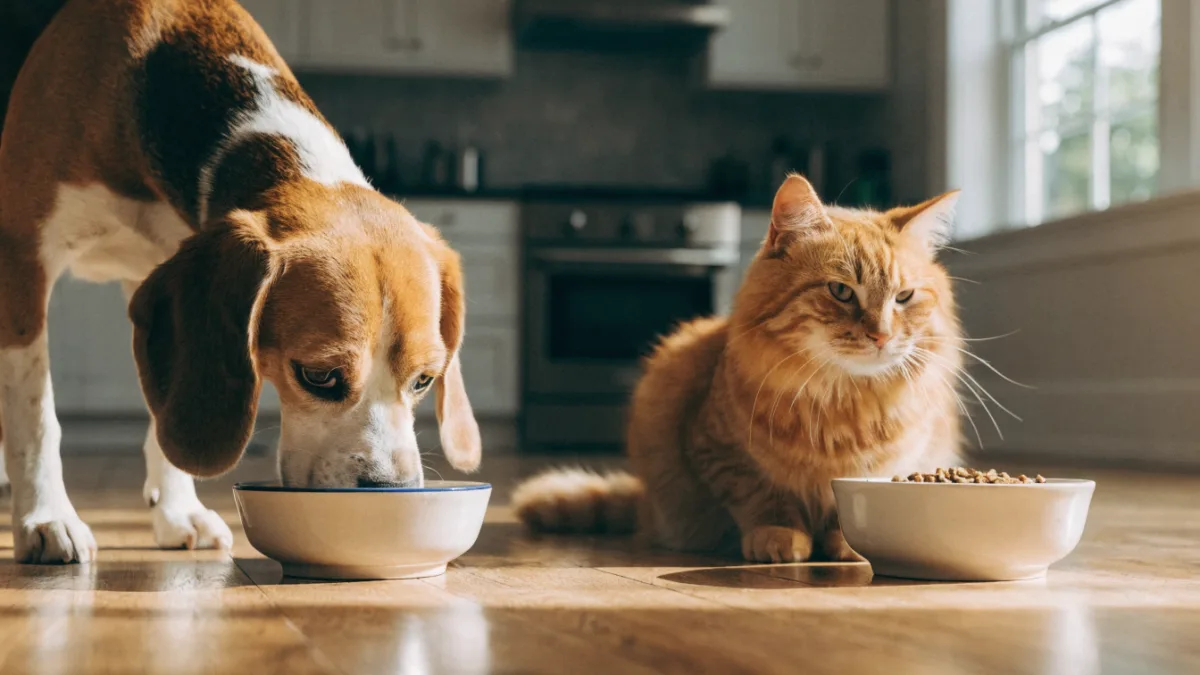
Dinner time in my house used to sound like a vacuum cleaner trying to suck up a bag of marbles. On one side of the kitchen, we had Barnaby, my overly enthusiastic rescue mutt who treats every meal like it’s a competitive sport. On the other side, we had Olive, a gloriously aloof tortoiseshell cat who prefers to eat exactly three kibbles, stare out the window for twenty minutes, and then maybe consider a fourth. Multi-pet mealtime is a delicate ecosystem, and when you mix a Gobbler with a Grazer, you get stress, stolen food, and a very grumpy feline.
If you have more than one pet, you likely already know the Gobbler versus Grazer dynamic all too. One animal inhales their food in seconds flat, while the other picks at a single bite and wanders off. For the longest time, I thought I just had a “greedy” dog and a “picky” cat. But as it turns out, mealtime chaos isn’t a behavioral flaw. It’s deeply ingrained natural instinct, and understanding the science behind it changed how I manage my home entirely.
Survival of the Fastest: Why Pets Gobble
We often project human manners onto our pets, assuming a dog who scarfs down dinner in ten seconds flat is just being rude or lacking self-control. The reality is far more wild. According to veterinary experts like Dr. Laflamme, food gobbling is an inherited evolutionary trait. Domestic dogs inherited this behavior from their wild ancestors—wolves and other wild canids where eating quickly was quite literally a matter of life and death.
In the wild, a pack makes a kill, and access to that food is entirely based on hierarchy and speed. If a wolf stops to savor the flavor, they might not eat at all. That “eat it before someone else does” mentality is permanently wired into many of our modern dogs. When Barnaby dumps his breakfast into his stomach without chewing, he isn’t being bad; his ancient brain is telling him that a rival might swoop in and steal his sustenance at any moment.
Our cats have their own ancestral quirks, too. Felines are solitary hunters by nature. A cat’s instinct is to catch multiple small meals throughout the day. They aren’t built to sit down and consume a massive, heavy bowl of food in one sitting—which explains why Olive treats her bowl like a decorative centerpiece rather than a dinner plate. Recognizing that these dietary styles are hardwired is the first step in fixing the friction in your kitchen.
The Communal Bowl Illusion
There is a persistent myth in the pet-owning world that animals like to eat together out of one big, happy family bowl because it fosters a sense of community. I completely understand the romantic appeal of a harmonious, shared meal, but animal behaviorists strongly advise against it. In reality, communal feeding is a recipe for unnecessary competition, stress, and resource guarding.
Think about it from your pet’s perspective. If you are a Grazer, and you live with a Gobbler, sharing a bowl is terrifying. As soon as you approach the food, the Gobbler is already shoulder-deep in the kibble, vacuuming it up. The Grazer will naturally back down, leading to malnutrition and immense anxiety. I made this mistake early on, thinking Barnaby and Olive could just “work it out” if I left a bowl of dry food out. Spoiler: Olive barely ate during the day, and Barnaby turned into a furry balloon.
The absolute best thing you can do for the physical and mental health of your animals is to abandon the communal bowl. Creating separate feeding areas is the most effective way to reduce tension. Pets need their own safe, designated spaces where they can eat at their own natural pace without looking over their shoulders.
Environmental Management: Outsmarting the Gobbler
When it comes to managing mealtime in a multi-dog home, my partner Jake handles the training side of things, so I won’t bore you with obedience protocols. But what I can talk about is environmental management—the physical tools and setups that physically prevent mealtime chaos before it even starts. You don’t necessarily need to teach a dog extreme impulse control if you simply change the environment.
Specialized Tools for Different Paces
The market for enrichment tools has exploded recently, and for good reason. Veterinarians and behaviorists now standardly recommend slow-feeder bowls, lick mats, and puzzle toys to safely manage pack-mentality gobbling. Instead of feeding Barnaby from a standard flat dish, I use a slow-feeder bowl. These bowls have intricate ridges, mazes, and grooves molded into the bottom. It physically forces Barnaby to chase the kibble around the obstacles with his tongue, turning a ten-second gorge into a ten-minute puzzle. It satisfies his need to “hunt” for his food while preventing him from inhaling air, and it completely eliminates the frantic energy of mealtime.
For the Grazers, the challenge is entirely different. You can’t force a Grazer to eat faster, but you can ensure their food stays safe from the resident vacuum cleaner. This is where recent technological developments are genuinely amazing. Tech-enabled feeding solutions, specifically microchip-activated pet feeders, have revolutionized multi-pet households.
These smart feeders look like little enclosed domes. You program them to recognize your pet’s implanted microchip or a special RFID collar tag. When Olive walks up to her feeder, the lid pops open like a futuristic chariot, allowing her to eat peacefully. If Barnaby tries to sneak over and steal her cat food, the feeder reads his tag, realizes he isn’t Olive, and firmly stays shut. It is brilliant. It allows Olive to graze naturally throughout the day without me having to act as a border patrol agent.
Physical Barriers Are Your Best Friend
If smart tech isn’t in your budget, don’t worry. You can achieve the exact same peaceful results with simple physical barriers. Baby gates are incredibly effective for separating dogs during meal times. For cats and small dogs, you can install a gate with a small cat door built into it, or simply elevate the cat’s food on a high counter or a designated shelf. Cats generally appreciate vertical space anyway, and it keeps the dog’s nose out of the cat’s bowl. Remember to look for sturdy gates with secure latches—many multi-dog homes also use crates to give dogs a private, den-like environment where they can chew in absolute peace.
Feline Logic: Respecting the Solo Hunter
While people easily understand that dogs might fight over food, cat owners often assume their felines can easily share a single bowl. This couldn’t be further from the truth. Cats are incredibly territorial, and food is a primary resource. Even in a deeply bonded multi-cat household, eating from the same bowl forces the cats into a subtle but stressful competition.
Cats adhere strictly to their own natural eating styles. One might be a stealth gobbler, while the other is a nervous grazer. Providing separate bowls in completely different rooms—or at least out of direct line of sight from one another—allows each cat to adhere to their own rhythm. I genuinely love observing cat logic; they are independent creatures who thrive on routine and autonomy. By giving Olive her own space, free from the heavy breathing of a food-obsessed dog, her personality blossomed. She went from a skittish, picky eater to a confident cat who actually looks forward to her meals.
The Free-Feeding vs. Scheduled Meal Debate
Of course, managing the Gobbler-Grazer dynamic always leads to one massive debate in the pet community: do you free-feed or feed scheduled meals? It’s a genuine puzzle in multi-pet homes. Free-feeding—leaving a bowl of kibble out all day—makes perfect sense for natural Grazers who prefer to eat tiny, frequent meals. Unfortunately, it’s practically impossible to free-feed when you live with a Gobbler. The Gobbler will overeat out of sheer competition, even if they aren’t hungry, leading to rapid weight gain and digestive distress.
On the flip side, strict, scheduled meals can deeply stress out a natural Grazer who simply cannot eat an entire day’s worth of calories in two ten-minute windows.
The solution usually lies in a hybrid approach, utilizing the tools we just talked about. In my house, we rely on strict, scheduled meals for Barnaby to manage his weight and provide routine, while Olive relies on her microchip feeder to access her specific food at her own pace. You have to look at the specific animals in your home and build a system that honors their biology. If you are making drastic changes to your pet’s diet or feeding schedule, always chat with your vet to ensure you are meeting their nutritional needs.
Living with multiple pets requires compromise, but mealtime shouldn’t be a daily source of dread. By stepping back and respecting the wild instincts that drive our pets—the ancient wolf’s need to eat fast, and the solitary cat’s need to hunt alone—we can build a domestic environment that actually works for them. Providing separate spaces, utilizing smart tools to control access, and ditching the communal bowl aren’t just “hacks”; they are fundamental ways we show respect for the animals we’ve invited into our lives.
At the end of the day, while we have domesticated these incredible animals, we can’t simply train thousands of years of survival instincts out of them—and honestly, why would we want to? Recognizing and honoring the wildness in our pets, whether they are vacuuming their dinner or meticulously picking at it, allows us to build a truly peaceful, happy home for every species under one roof.