

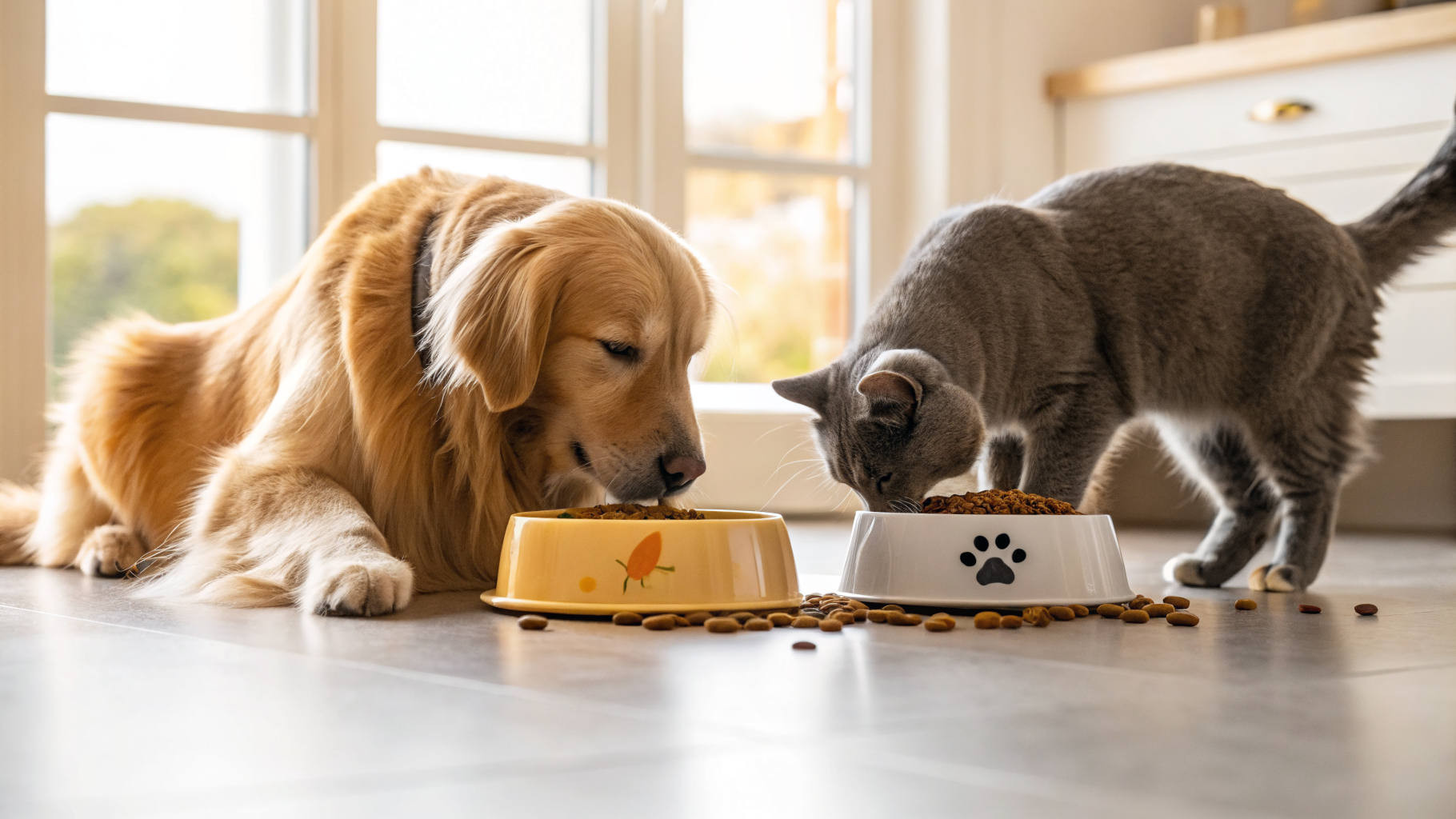
Last month, I had an emergency appointment with a client named Karen and her eight-year-old Golden Retriever, Bella. Bella had been vomiting for two days and was crying when touched near her abdomen. Karen was baffled — Bella hadn’t eaten anything unusual, as far as she knew. But when I asked about the household routine, Karen mentioned that her cat, Whiskers, ate on the kitchen counter while Bella ate on the floor. “Sometimes Bella gets into Whiskers’ bowl if it’s left out,” Karen admitted. “I figured it’s all pet food, right?” That seemingly harmless habit had landed Bella in the clinic with a painful case of pancreatitis — an inflammation of the pancreas that can be triggered by high-fat meals. Cat food, it turns out, is roughly two to three times higher in fat than dog food. Bella recovered, but the experience stuck with me because I see versions of this story play out constantly. Pet owners love their animals deeply, but many don’t realize that dogs and cats have fundamentally different nutritional needs — and letting them share food can have serious consequences.
Why Dogs and Cats Aren’t Built to Eat the Same Way
The easiest way to understand why cross-snacking matters is to look at what each species evolved to eat. Cats are obligate carnivores, meaning their bodies are designed to derive nutrition almost exclusively from animal tissue. They need high levels of protein and specific amino acids that they cannot produce efficiently on their own. Dogs, on the other hand, are omnivores with a more flexible digestive system — they can extract nutrients from both animal and plant sources.
This difference isn’t just academic. Cats require dietary taurine, an amino acid found primarily in animal protein, to maintain normal heart function, vision, and digestion. Without sufficient taurine, cats can develop dilated cardiomyopathy (a weakening of the heart muscle) and retinal degeneration that leads to blindness. They also need significantly more arginine than dogs do — a deficiency can cause dangerous ammonia buildup in the bloodstream within hours. Dog food simply doesn’t contain enough of these feline-specific nutrients to sustain a cat long-term.
Dogs face the opposite problem when they eat cat food. That concentrated protein and fat content that keeps cats healthy can overwhelm a dog’s digestive system over time. I always explain it to clients this way: your dog eating cat food regularly is like you eating nothing but rich, fatty restaurant meals every single day. It might taste great, but your body isn’t built to handle that load indefinitely.
What Cross-Snacking Actually Does to the Body
When dogs eat cat food consistently, the most common consequences are weight gain and gastrointestinal upset — diarrhea, gas, and discomfort. But the more serious risk is pancreatitis, which is exactly what Bella experienced. The pancreas produces enzymes that help digest food, and when it becomes inflamed, those enzymes can actually start digesting the pancreatic tissue itself. It’s excruciatingly painful and sometimes life-threatening.
Cats who eat dog food face slower but equally serious problems. Because dog food contains less protein overall and lacks adequate taurine, a cat sustained on dog food will gradually develop nutritional deficiencies. The damage to the heart and eyes happens progressively, and by the time symptoms appear, the effects can be difficult to reverse.
The “People Food” Trap: When Sharing Isn’t Caring
Cross-snacking between pets is one challenge, but cross-snacking between humans and pets is an entirely different — and often more dangerous — scenario. I’ve lost count of how many times a client has told me they gave their dog a chicken bone because “dogs in the wild eat bones all the time.” This is one of those myths that persists despite overwhelming evidence to the contrary.
Cooked bones are particularly hazardous because they splinter easily. Those sharp fragments can puncture the esophagus, stomach, or intestinal lining, or create a complete blockage that requires emergency surgery. Take a four-year-old Beagle named Cooper, seen last spring after his owner tossed him a leftover rib bone from a barbecue. Cooper seemed fine for about 36 hours, then started refusing food and retching. We removed three sharp bone fragments from his intestine during surgery, and his owner said something that’s stuck with me: “He looked so happy when I gave it to him. I thought I was being a good dad.”
Beyond bones, many common human foods are outright toxic to pets. The [1] list grapes and raisins (which can cause kidney failure in dogs), onions and garlic (which damage red blood cells), xylitol (an artificial sweetener found in sugar-free gum and peanut butter that causes dangerous blood sugar drops and liver damage in dogs), chocolate (which contains theobromine, toxic to both dogs and cats), and alcohol among the most dangerous offenders. Salty snacks like chips and pretzels can cause excessive thirst, sodium ion poisoning, and even seizures in severe cases.
I Understand the Impulse — But Here’s What to Do Instead
I genuinely understand why people want to share food with their pets. Food is love in almost every culture, and when those eyes are looking up at you during dinner, it feels cruel to say no. I’m not suggesting you never give your pet a treat — but the treats should be species-appropriate and given in moderation.
For dogs, small pieces of plain cooked chicken, carrot sticks, green beans, or apple slices (without seeds) are safe options. For cats, a tiny bit of plain cooked meat or fish occasionally is fine. The key word is occasionally — treats should never make up more than about 10% of your pet’s daily caloric intake.
Managing the Multi-Pet Household
So how do you actually prevent cross-snacking when you have both dogs and cats under one roof? It takes some creativity, but it’s absolutely doable.
- Elevate cat feeding stations. Most cats can easily jump onto a counter, washer, or high shelf where dogs can’t reach. Feeding your cat in an elevated location is the simplest and most effective way to keep their food separate.
- Pick up bowls after mealtime. Don’t leave food sitting out all day if your pets have access to each other’s eating areas. Scheduled feeding times help you monitor exactly what each animal consumes.
- Consider microchip-activated feeders. These devices only open for the pet whose microchip or collar tag is registered to that specific bowl. They’re particularly helpful if you have a food-motivated dog and a cat who prefers to graze throughout the day.
- Use baby gates or pet doors. Creating separate feeding zones with physical barriers works well, especially if you have a persistent food thief. A baby gate with a small cat door allows your cat to access their food while keeping the dog out.
- Supervise during transitions. If you’re moving pets between rooms for feeding, make it a deliberate routine rather than an afterthought.
The goal isn’t to create a prison-like environment — it’s to build habits that protect each animal’s health without requiring constant vigilance from you.
Navigating the Current Debates in Pet Nutrition
I’d be remiss if I didn’t address some of the bigger conversations happening in veterinary nutrition right now, because they directly affect the choices you make about what goes in your pet’s bowl.
The Grain-Free Question
The grain-free diet trend exploded over the past decade, marketed as more “natural” and healthier for pets. I’ll be honest — I initially recommended grain-free options to some clients who were concerned about allergies. But the evidence has shifted significantly. Investigations by the FDA and ongoing veterinary research have identified a potential link between certain grain-free diets and dilated cardiomyopathy in dogs, particularly breeds not genetically predisposed to the condition. A [2] synthesizes the current state of this research, and the picture is becoming clearer: while grain-free diets may be appropriate for dogs with diagnosed grain sensitivities (which are relatively rare), they aren’t inherently healthier and may carry risks we don’t fully understand yet.
My approach has evolved as the science has. I now recommend grain-inclusive diets for most dogs unless there’s a specific medical reason to avoid grains. The [3] provide a helpful overview of how different ingredients serve different purposes in pet food formulations.
Ultra-Processed Foods and Emerging Concerns
Another conversation gaining traction involves the processing level of commercial pet foods. Recent research has highlighted that ultra-processed kibbles can contain trace contaminants — byproducts of high-heat manufacturing processes that create compounds not found in less-processed foods. This has driven interest in raw, home-cooked, and minimally processed diets.
I want to be balanced here. Those concerns are legitimate and worth paying attention to, but the alternatives come with their own risks. Raw diets carry bacterial contamination risks (for both pets and the humans handling the food), and home-cooked diets without veterinary nutritional guidance frequently result in dangerous imbalances. If you’re considering a less-processed diet for your pet, work with a veterinary nutritionist to ensure it’s complete and balanced — don’t rely on internet recipes.
As one researcher framed the current question in a recent study on long-term effects of processed pet foods: we need to be asking not just whether a food meets minimum nutritional standards, but what it’s doing to the animal’s body over years of consumption. That’s a conversation worth having, and one I expect will shape veterinary nutrition significantly in the coming years.
The Bottom Line for Your Household
Your dog and your cat may share your home, your couch, and your heart — but they shouldn’t share their food bowls. The nutritional profiles designed for each species exist for good reason, and when those boundaries get blurred, pets pay the price. Feed cats as cats and dogs as dogs, keep toxic human foods securely out of reach, and if you’re unsure about what’s best for your specific animals given their age, breed, and health status, have that conversation with your veterinarian.
Because at the end of the day, good nutrition isn’t just about avoiding illness — it’s about giving your pets the best possible chance at a long, vibrant, comfortable life. And isn’t that what we all want for the animals who share our homes? The choices we make about their food, day in and day out, matter more than almost any other health decision. When we feed them according to what their bodies actually need — not what’s convenient or what feels good in the moment — we’re honoring the responsibility we took on when we brought them home.
Sources
- ASPCA's guidelines — aspca.org
- 2025 review published in the veterinary literature — pmc.ncbi.nlm.nih.gov
- Purina Institute's nutritional resources — purinainstitute.com