

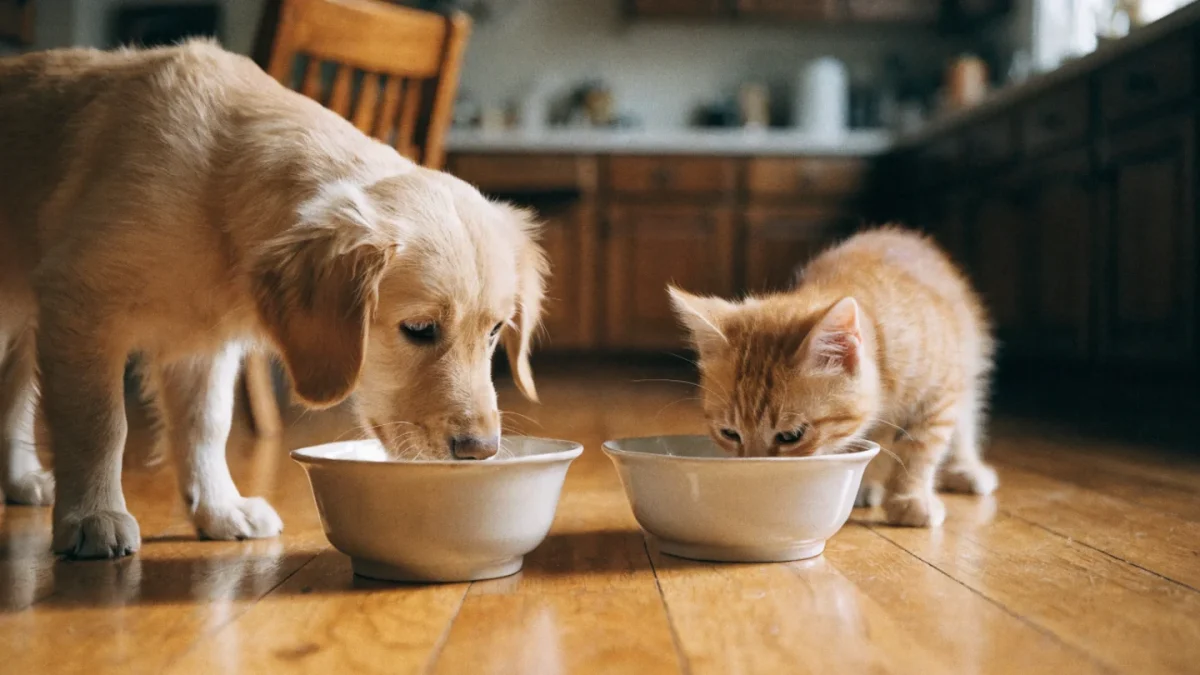
A seven-week-old Labrador mix came in one spring — visibly thin, ribs you could count at a glance — and the owner was completely at a loss. She was feeding him. Every day. And he was eating enthusiastically. But what he was eating was her four-year-old resident dog's adult kibble, scooped out of the same bag, placed in his own bowl like that made it fine. "It's all dog food," she told me, a little defensively. I've heard that sentence probably three hundred times in my career, and I understand the logic. It just isn't how nutrition works.
Those first twelve months are the most nutritionally demanding period a dog or cat will ever experience. Growth requires more protein per kilogram of body weight than maintenance does, more calcium and phosphorus for skeletal development, and more energy per meal than an adult animal of the same size needs. Getting this right doesn't require a veterinary degree — but it does require understanding what's happening biologically at each stage, and why those stages matter.
Birth to Three Weeks: Everything Comes From Mom
For healthy puppies and kittens born to a well-nourished mother, the first three weeks of life are nutritionally simple: they nurse. That's it. Mom handles everything.
What makes those early days complicated is the colostrum — the first milk produced in the hours after birth. Colostrum is nutritionally distinct from regular milk. It's loaded with immunoglobulins that provide passive immunity to neonates whose own immune systems are essentially non-functional at birth — research published in Animals (2021) confirms that colostrum delivers the IgG, IgM, and IgA antibodies that drive passive immune transfer in both puppies and kittens. Miss that window — which actually closes within the first 12–16 hours in puppies and kittens, somewhat earlier than the "24 hours" figure often cited — and you can't replicate it with supplementation. Milk replacer doesn't carry those antibodies.
Neonates also can't regulate their own body temperature. That matters more than most owners realize. A cold puppy or kitten can't digest milk properly, which starts a cascade of problems even if the milk is nutritionally perfect. If you're caring for orphaned neonates, ambient temperature management is genuinely as important as nutrition — around 29–32°C (85–90°F) for the first week, tapering down as they develop thermoregulatory capacity, per guidelines from the UC Davis Koret Shelter Medicine Program and Maddie's Fund neonatal care protocols.
The practical takeaway: if the mother is healthy and producing milk and all pups or kittens are nursing actively, don't intervene. Things go sideways when one neonate is being pushed off the nipple by bigger littermates, or when the dam isn't producing enough. That's when you need a milk replacer.
Three to Five Weeks: The Weaning Window
Deciduous teeth start coming in around three weeks, and that's when weaning typically begins — in both species. I want to be clear that weaning is a process, not an event. It happens over two to three weeks of gradual transition.
For puppies, the standard approach is a gruel: take high-quality puppy kibble, soak it in warm water until it reaches a soft, porridge-like consistency, and offer it alongside continued nursing. Texture progressively firms up over the weeks that follow.
Kittens are more opinionated about this than puppies, in my experience. They tend to be pickier about smell and texture from the very beginning. Wet food makes the transition easier for most kittens — and honestly, many cats carry that wet-food preference for the rest of their lives, which isn't a bad thing. Wet food keeps them better hydrated.
By five to six weeks, most puppies and kittens should be eating moistened solid food as their primary nutrition source. For more detail on this timeline and what to do when it doesn't go smoothly, see when and how to start solid food.
Six Weeks to Four Months: The Fast-Growth Phase
This is when everything accelerates. Proportional growth rate is highest during this window, and caloric demands are correspondingly intense. A growing puppy may need two to three times the calories per kilogram that an adult dog of the same breed requires — research shows that from weaning through the most rapid growth phase, puppies need approximately 3× the calories per kilogram of body weight compared to adult dogs of the same size, with the multiplier decreasing as they approach 50% of adult weight.
A few nutritional priorities that stand out during this phase:
Protein and amino acids. Muscle, organ, skin, coat — all of it depends on adequate protein. Puppies and kittens both need higher protein percentages than adults. For kittens specifically, this is non-negotiable: cats are obligate carnivores and can't synthesize taurine and arginine at the rates their bodies demand for growth. A low-quality or improperly formulated diet during this phase can cause irreversible damage.
DHA. Docosahexaenoic acid — an omega-3 fatty acid — is critical for brain and eye development during this period. Look for it listed in ingredients, or sourced through fish oil or animal fats. Diets formulated for growth typically include it; many adult diets don't bother.
Calcium and phosphorus ratios. This is the one that keeps me up at night with large-breed puppies specifically. Too much calcium during rapid bone growth — especially in breeds like Great Danes or Saint Bernards — can cause skeletal abnormalities including osteochondrosis and angular limb deformities that aren't fully reversible. Excess calcium in large-breed puppies has been shown to disrupt normal endochondral ossification (the process of cartilage converting to bone at growth plates), as documented in multiple studies published in the veterinary literature, including research from Nap et al. (2006) in Journal of Nutrition. The solution is to feed a diet specifically formulated for large-breed puppies, not just "puppy food." Those two categories are not the same thing.
During this phase, most puppies should eat three times a day. Kittens can go three to four times. Small and toy-breed puppies are at real risk of hypoglycemia if meals are too far apart — I typically recommend three meals a day minimum for breeds under 5 kg (11 lbs).
Four to Six Months: Steady Growth Continues
Growth slows slightly but the nutritional demands remain high. By around four months, most puppies can transition from three meals to two per day — though I'll often recommend keeping three meals for small breeds through six months. Kittens can usually manage two to three meals.
One thing I watch closely at this stage is body condition. Puppies tend to look a bit gangly — long-legged and angular — and owners sometimes interpret this as being underweight and compensate by overfeeding. Ribs should be easily felt (but not visibly jutting) and there should be a slight waist when viewed from above. If you're uncertain, your vet can walk you through the body condition scoring system.
This is also the age when some clients ask me about raw diets or home-cooked food. My honest view: I don't have strong objections to well-formulated raw diets, but the word "well-formulated" is carrying a lot of weight in that sentence. Growing animals have precise mineral requirements that are genuinely difficult to meet without careful planning. If someone is committed to homemade food for a puppy or kitten, they need a consultation with a board-certified veterinary nutritionist, not a recipe from a Facebook group.
Six Months to One Year: Approaching Adulthood
At six months, most cats and small-to-medium dogs are somewhere between 75–90% of their adult body weight. Large and giant-breed dogs are still actively growing — some won't reach skeletal maturity until eighteen to twenty-four months.
This is the phase where the question of switching to adult food comes up. My general rules:
- Small dogs and cats: transition to adult food around 9–12 months
- Medium dogs: 12 months
- Large breeds: 12–18 months
- Giant breeds: 18–24 months
Don't rush it. Puppy and kitten formulas exist because growing animals need them. Switching to adult food at six months because the bag says "puppy/kitten" feels expensive or unnecessarily specific is a false economy.
Spaying or neutering during this period — which most owners do — affects caloric needs. Altered animals tend to have lower energy requirements and higher risk of weight gain — research consistently shows neutered cats have 20–30% lower metabolic rates than intact cats, and spayed female dogs also show reduced energy needs post-surgery, as summarized in a review published in Nutrition Research Reviews (Lund et al., 2006). I typically recommend slightly reducing meal portions after surgery and monitoring body condition closely for a few months after the procedure.
What "Complete and Balanced for Growth" Actually Means
I want to spend a moment on this because it's genuinely important.
When a pet food label says "complete and balanced for growth" or "for growth and reproduction" (same thing, nutritionally), it means the formula has been verified to meet the nutrient profiles established by one of the major regulatory bodies for animals in the growing life stage. That's a meaningful statement — it's not just marketing. Formulas that say "for maintenance" or "for adult dogs/cats" don't have to meet those higher requirements.
So when I say "feed a diet formulated for growth," I mean: look at the label and find those words. Not puppy-themed packaging. Not a food marketed to puppies that has "maintenance" in the fine print. The actual label claim.
For puppies of large and giant breeds specifically: look for "large breed puppy" on the label. These formulas have modified calcium-to-phosphorus ratios and energy density designed to prevent the orthopedic problems I mentioned earlier. Regular puppy food has too much calcium and too many calories for the dogs that grow most catastrophically when overfed.
How Much to Feed
There's no universal answer here, and any article that gives you a table is oversimplifying. Caloric needs vary by breed, growth rate, activity level, and individual metabolism.
That said, the packaging guidance on a quality puppy or kitten food is a reasonable starting point — with one important caveat. Most bag guidelines are written to prevent underfeeding (because that generates complaints), which means they often lean toward the high end. Use the manufacturer's recommended range, start in the middle, and adjust based on body condition every two weeks.
I check body condition at every puppy and kitten wellness visit for exactly this reason. Weight gain too fast is a real problem, not just in small breeds. If your puppy is gaining faster than expected or starting to lose that tucked waist, pull back portions slightly. If they're looking thin and ribs are prominent, add a bit more.
Transition Tips
Switching foods: Whatever food the breeder or shelter was feeding — stick with it for at least a week before transitioning to your preferred diet. Transition over seven to ten days by mixing increasing proportions of the new food into the old. Even high-quality food can cause diarrhea if introduced abruptly to a young animal's GI tract.
Water: Always fresh, always available. This sounds obvious but I've had clients who rationed water because they were worried about accidents during house training. The puppy's kidneys need water to function; a little extra puddle is a worthwhile trade.
Treats during training: Keep them tiny — pea-sized for small breeds, marble-sized for medium and large. Training treats count toward daily calories. A lot of new puppy owners don't realize how much extra food they're adding during a heavy training period.
Frequently Asked Questions
Can I feed a puppy or kitten adult food if that's what I have?
Not long-term. Adult food doesn't contain the calcium, phosphorus, protein, or calorie levels that growing animals need. In an absolute pinch for a day or two, it's unlikely to cause lasting harm — but it's not a substitute for proper life-stage nutrition. Stock up before you bring them home.
My kitten won't eat the weaning gruel at all. What should I try?
Temperature and smell matter a lot to young kittens. Try warming the food slightly — body temperature is often the cue they're looking for. You can also try adding a small amount of the formula they were on before to the mix. Some kittens do better with wet food as the bridge food rather than soaked kibble. Give it a few days; appetite changes quickly at this age.
When should I stop free-feeding?
For most puppies, I recommend scheduled meals (rather than constant food availability) from the moment you bring them home. For kittens, free-feeding can work in the early weeks while they're adjusting to solid food, but I'd transition to scheduled meals by around three to four months, especially in multi-cat households or if the kitten is showing any tendency to overeat. Monitoring how much they actually consume is impossible when food is always out — and portion awareness matters as much at twelve weeks as it does at twelve years.
Is it okay to mix kibble and wet food during this period?
Yes, and honestly I often encourage it. Mixing textures keeps young animals from becoming fixated on a single food type, which makes future diet transitions easier. Just account for the calories in both — wet food typically has fewer calories per gram (because of higher moisture content) but you can easily overfeed if you're also giving full kibble portions.
My puppy seems hungry all the time even after eating his full portion. Should I feed more?
Puppies are often just… perpetually enthusiastic about food, especially food-motivated breeds like Labs and beagles. The test is body condition, not hunger signals. If the puppy looks and feels at a healthy weight with easily palpable ribs and a visible waist, the portions are likely right even if he acts like he's starving. That said — if a puppy genuinely seems hungry and is losing weight or looks underweight, talk to your vet. Some puppies have absorption issues that make them chronically underfed despite eating well.