

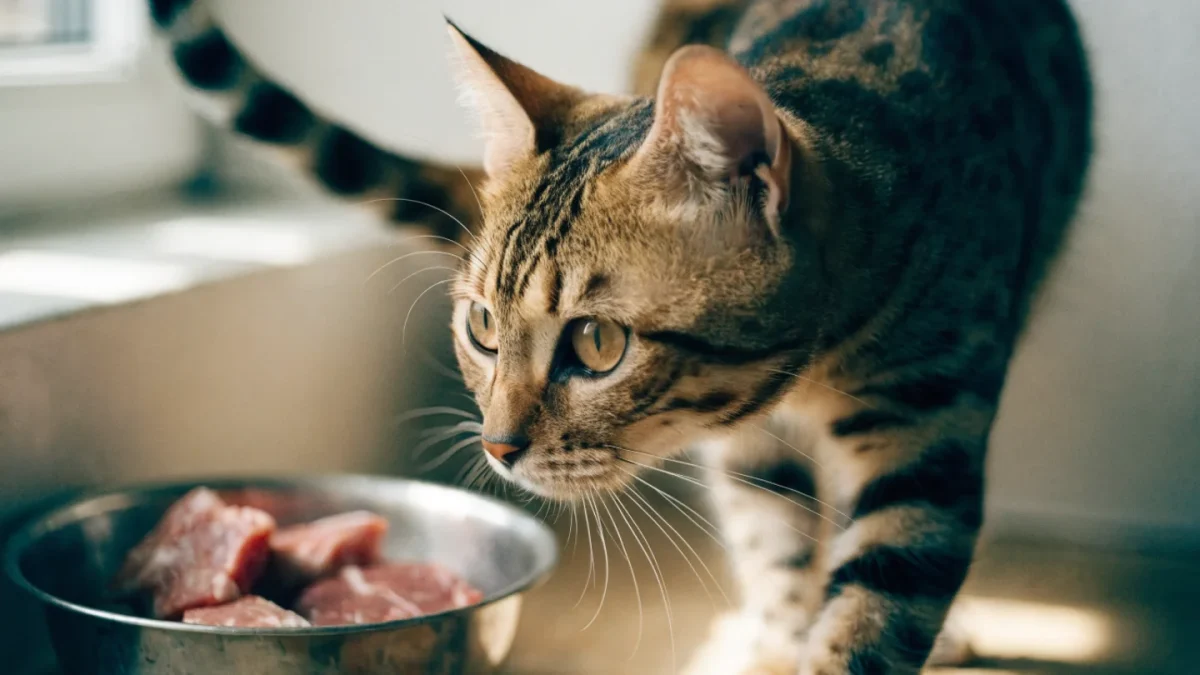
When clients ask me whether they can feed their cat a vegetarian diet — and I get this question more than you might expect — I always pause before answering, because the answer is more biological than it is opinion.
It's not that vegetarian diets are philosophically wrong for cats. It's that cats lack the metabolic machinery to survive on them.
What "Obligate Carnivore" Actually Means
The term gets used loosely, so let me be precise about what it means physiologically. An obligate carnivore is an animal whose metabolic systems have evolved to require nutrients that are only available in meaningful quantities in animal tissue — and who has lost the ability to synthesize those nutrients from plant precursors.
Dogs and humans are omnivores. We can convert beta-carotene into vitamin A, linoleic acid into arachidonic acid, tryptophan into niacin. We can synthesize taurine from other amino acids at rates sufficient to meet our needs. Cats cannot do most of these things.
This isn't a minor limitation. It's a collection of metabolic losses that, taken together, make a plant-only diet not just suboptimal for cats but genuinely incompatible with health.
The Four Core Metabolic Requirements
Taurine is the one most people in the veterinary world have heard of. It's a sulfur-containing amino acid found almost exclusively in animal tissue. Cats have minimal ability to synthesize taurine from other amino acids — their taurine synthetic capacity is far lower than in dogs or humans. Research published in The Journal of Nutrition has established that cats have very low activity of cysteine sulfinic acid decarboxylase (CSAD), the key rate-limiting enzyme for taurine synthesis, which is why dietary taurine is essential for this species.
Taurine deficiency in cats causes two specific, irreversible conditions: dilated cardiomyopathy (DCM), where the heart muscle weakens and enlarges, and central retinal degeneration (FCRD), leading to progressive blindness. Both are entirely preventable through diet. Before taurine supplementation became standard in commercial cat foods (this happened in the late 1980s following pivotal work by Pion et al., published in Science in 1987, which documented low plasma taurine in cats with myocardial failure eating commercial diets), DCM from taurine deficiency was common.
Arachidonic acid is an omega-6 fatty acid found in animal fat — chicken fat, fish, eggs. Dogs can convert linoleic acid (a plant fatty acid) into arachidonic acid through enzymatic conversion. Cats have a severely limited ability to perform this conversion — research published in Lipids (Sinclair et al., 1979; confirmed in subsequent desaturase activity studies) found no significant delta-6-desaturase activity in the cat intestine, making them the only known mammal with this absence. They must get arachidonic acid directly from animal sources.
Arachidonic acid is involved in inflammatory response, blood clotting, reproduction, and cell membrane function. Deficiency doesn't present dramatically at first, but it accumulates into problems over time — poor wound healing, reproductive failure, and coat changes being among the signs.
Preformed vitamin A is the active form of vitamin A found in animal liver and other animal tissues. Beta-carotene — the form in orange and yellow plant foods — is the vitamin A precursor that most mammals convert into retinol. Research published in The Journal of Nutrition confirmed that cats absorb beta-carotene but show negligible conversion to retinol — the dioxygenase enzyme responsible for splitting the beta-carotene molecule is either absent or severely deficient in the domestic cat, making dietary preformed vitamin A non-negotiable.
A cat eating a diet with plenty of beta-carotene but no preformed vitamin A will develop deficiency despite technically having a vitamin A "source" in their food. Symptoms include night blindness, poor coat condition, reproductive failure, and immune dysfunction.
Niacin (vitamin B3) is synthesized in most mammals from tryptophan. Cats have elevated activity of picolinic acid carboxylase, the enzyme that diverts tryptophan toward rapid catabolism to acetyl-CoA rather than toward niacin synthesis — this was documented in The Journal of Nutrition (Suhadolnik et al., 1957). Very little tryptophan ends up as niacin, and cats' niacin requirement is actually about 2.4 times higher than that of dogs. Cats need dietary niacin from meat sources.
The Protein Metabolism Difference
Beyond these specific nutrients, cats have a fundamentally different relationship with protein than omnivores. In dogs, the enzymes responsible for breaking down amino acids downregulate during protein restriction — the body adapts to preserve amino acids when protein is scarce. Cats' livers don't do this. Their amino acid-catabolizing enzymes stay active regardless of dietary protein intake, meaning cats continue to burn protein for energy even when protein intake is low.
This is why cats placed on protein-restricted diets (common in older discussions of kidney disease management) can lose significant muscle mass. The current thinking has shifted considerably — current ISFM consensus guidelines and veterinary nutrition literature now recommend protein restriction only for cats with IRIS CKD Stage 2 and beyond where nitrogenous waste accumulation is a clinical concern, not as a routine measure for aging cats with normal kidney function.
What This Means Practically
The biology here has direct feeding implications:
Any cat food adequate for health must be based on animal protein. Foods using plant proteins as primary protein sources are not meeting cat requirements in the same way — even if total protein content on the label looks similar.
Home-cooked diets for cats must be formulated with care. A diet of plain chicken breast, for example, is deficient in taurine (taurine is higher in heart muscle), deficient in calcium, and deficient in multiple other nutrients. Cats fed exclusively plain chicken have developed serious deficiencies. Work with a veterinary nutritionist if you want to cook for your cat.
And any diet claiming to be appropriate for cats without animal-derived ingredients warrants very careful scrutiny of how the obligate carnivore requirements are being synthetically met. Several of these nutrients can now be synthesized and supplemented — but the formulation must be proven nutritionally adequate through feeding trials, not just calculated on paper.
For more on how cats naturally eat and what the obligate carnivore biology means day-to-day, the patterns that emerge are as interesting as the underlying chemistry. The complete cat nutrition guide covers the full picture from a practical feeding standpoint.