

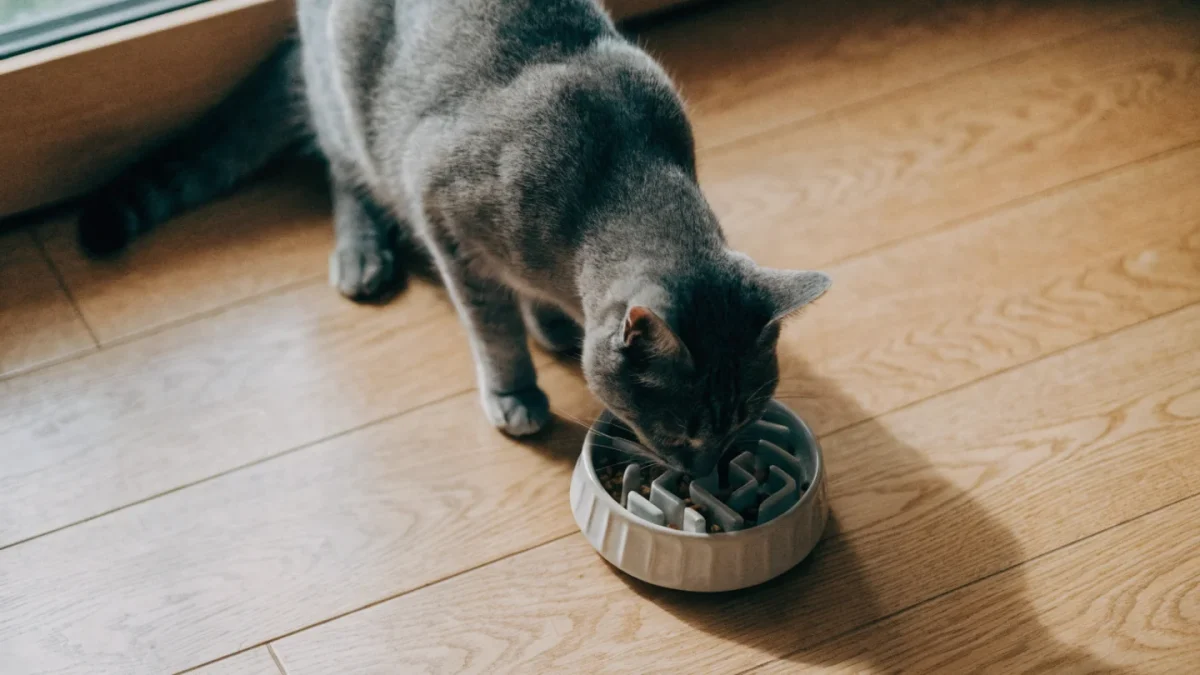
I asked a client recently how she fed her two cats, and she said "I just keep the bowl full." The cats weighed 14 and 16 pounds respectively. Both should have been around 9 pounds. She wasn't overfeeding maliciously or carelessly — she was doing what seemed natural. Cats are independent animals. They should be able to eat when they're hungry, right?
In an ideal world with real prey, yes. In the world of unlimited kibble and limited exercise, not really.
How Cats Actually Want to Eat
Wild cats are crepuscular hunters — most active at dawn and dusk, spending much of their waking time in pursuit of small prey. A successful hunt might yield a mouse: roughly 30 to 40 calories, based on the caloric content of small prey animals. They might eat 8 to 12 such small meals over a 24-hour period, scattered through the day with mostly sleeping in between.
That pattern — frequent small meals, activity between eating, variety of textures — is deeply embedded in cat behavior. The stomach of a cat is quite small relative to their body size. They're not designed for one or two large meals.
This is important context for why cats often resist meal feeding initially: it genuinely goes against their instinct to eat all at once and then stop. And it's why free feeding feels natural — they're trying to replicate the small-frequent-meal pattern.
The problem is the calorie density of commercial food bears no resemblance to the calorie density of a mouse. If you put out unlimited 350-calorie cups of kibble, a cat will not intuitively self-regulate to 12 small portions. Many will simply eat whenever they're bored, anxious, or walking past the bowl. Indoor cats with limited activity and unlimited food reliably become overweight.
Free Feeding: When It Works and When It Doesn't
Free feeding — leaving dry food out around the clock — works well for a limited subset of cats: typically young cats under 2, very active cats, underweight cats, or multi-cat households where one cat needs unrestricted access due to a health condition. In these situations, the cat's metabolism or activity level keeps pace with intake.
For most adult indoor cats, it doesn't work. According to the Association for Pet Obesity Prevention's 2022 survey, approximately 61% of cats in the United States are classified as overweight or obese by their veterinarians. Free feeding dry food is a major contributing factor. The weight creep is slow and almost invisible to owners until the cat is significantly over their ideal weight.
Meal Feeding: Making It Work for Cats
Two to four measured meals daily is my general recommendation for adult cats. The meals should be timed to roughly correspond to crepuscular activity — morning and early evening work well, which also happen to align with most owners' schedules.
The key is the word "measured." This isn't "fill the bowl halfway" — it's a specific calculated amount based on the cat's ideal body weight, the calorie density of the food, and any weight loss or maintenance goals. Most cat food bags provide calories per cup; most cats need somewhere between 180 to 300 calories per day depending on size, age, and neutering status — this aligns with standard veterinary nutrition calculations for indoor cats in the 8–12 lb range. Weigh or carefully measure the food.
For cats who were previously free-fed and resist meal feeding: the transition takes weeks, not days. Cats can be stubborn about this in a way that's genuinely impressive. Start with larger portions than you'll end with and gradually tighten over several weeks. A cat who doesn't eat for more than 24 hours is at risk of hepatic lipidosis (fatty liver disease), which is a serious condition in overweight cats especially. Do not rush a transition that's meeting resistance.
Puzzle Feeders: The Middle Ground
Puzzle feeders — bowls or devices that require the cat to work for each piece of kibble — are arguably the best feeding innovation for cats in the last decade. They slow consumption, provide cognitive enrichment, mimic the "hunting" aspect of natural feeding, and reduce the urgency cats feel around food because the act of getting it becomes more engaging.
I recommend them strongly for cats who eat too fast, for cats who seem bored (which is most indoor-only cats), and as a transition tool for moving from free feeding to controlled portions. A cat working through a puzzle feeder for a set amount of food is much closer to natural feline feeding behavior than either free feeding or two meals rapidly consumed from a bowl.
For signs your cat's nutritional needs aren't being met, appetite changes are often the first visible indicator — and knowing your cat's normal feeding pattern makes it much easier to notice when something shifts.
FAQ
My cat meows constantly before meals like she's starving. Is she?
Probably not. Cats are extraordinarily good at training their owners through vocalization, and a cat who has learned that meowing before the scheduled mealtime produces food will escalate that behavior if it ever works. Feed on a consistent schedule and don't break it in response to vocalization — this is genuinely hard for most people, but it's the only way to stop reinforcing the behavior. If the meowing is new, intense, or accompanied by weight loss, have your vet rule out hyperthyroidism, which causes genuine insatiable hunger.
Should I feed wet food, dry food, or both?
Both is fine for most cats, and the combination approach has real advantages: wet food provides hydration and tends to be more protein-dense; dry food is convenient and can provide some mechanical dental benefit. The most important thing is that total daily calories are controlled and the food is nutritionally complete. I lean toward including some wet food daily given the hydration benefits, especially for cats with any urinary or kidney history.
My cats eat at different speeds and I can't keep them from stealing each other's food. Help.
This is one of the more genuinely difficult multi-cat feeding problems. Options include feeding in separate rooms simultaneously (easiest for most people), using microchip-activated feeders that only open for the registered cat (more expensive but very effective), and staggered feeding where you supervise each cat's meal individually. What doesn't work is hoping they'll sort it out themselves — the faster eater almost always wins, and the slower one becomes food-anxious, which can cause its own behavioral problems.
My cat only wants to eat at 3am and ignores food during the day. Is this normal?
Yes and no. Cats are naturally more active at night than humans, and some genuinely are more interested in food during overnight hours. But a cat who is truly only eating overnight and ignoring daytime meals deserves a look — pain, dental disease, or other health issues can make eating uncomfortable and some cats learn to associate mealtimes with discomfort. If this is a recent change in behavior, rule out a physical cause first before assuming it's just a timing preference. For the cat nutrition overview, feeding timing is one piece of a much larger picture.