

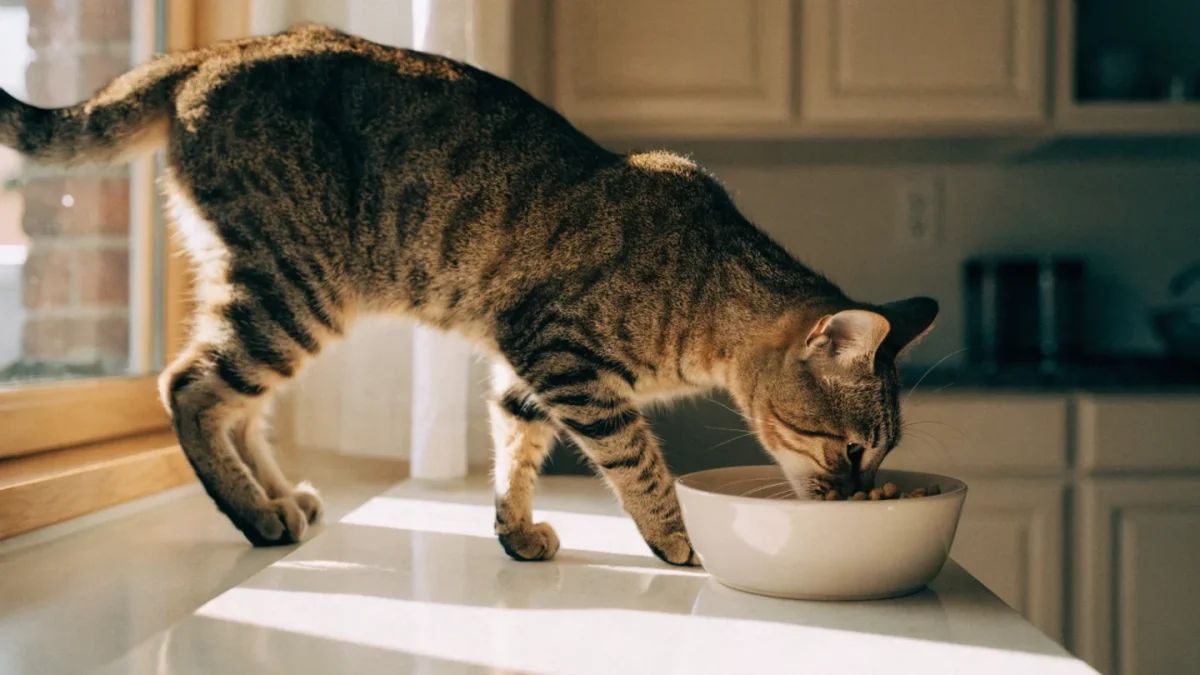
Last month a client brought in a three-year-old Siamese named Miso who'd been losing weight steadily for about four months. Not dramatic — maybe a pound and a half — but on a cat who started at nine pounds, that's significant. His owner, a genuinely conscientious person, had switched him six months earlier to a plant-heavy food she'd found at a specialty shop. The ingredient list looked impressive: lentils, chickpeas, sweet potato, flaxseed. She was eating cleaner herself and wanted the same for Miso.
His bloodwork told me what I suspected before I even ran it. Low taurine. Protein markers that looked like a cat not getting enough of the right amino acids. His coat, which she said used to be glossy and dense, had gone dull and thin at the base of his tail.
Here's the thing — she wasn't wrong to care about what she was feeding him. She was wrong about what cats actually need. And the difference between "good food" for a human and "good food" for a cat is enormous, because cats aren't small dogs, they aren't tiny humans, and their biology has non-negotiable requirements that no amount of high-quality plant protein can satisfy.
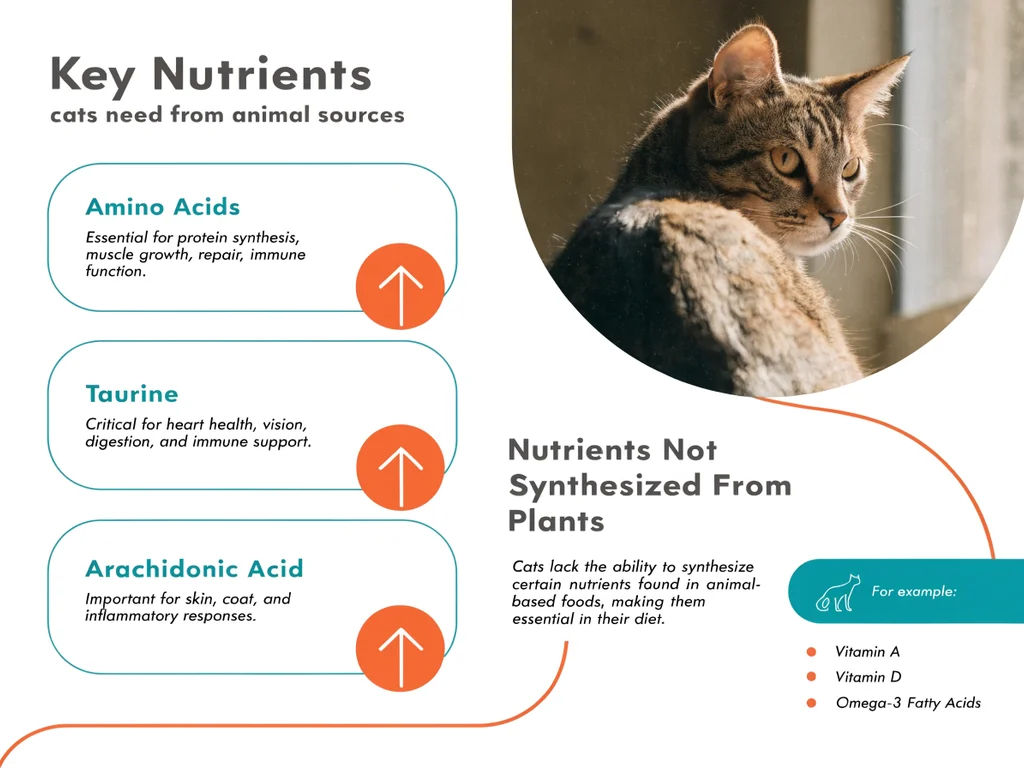
The term "obligate carnivore" is the key. It means cats are biologically required to eat animal tissue. Not "prefer" animal protein — biologically require it. Several essential nutrients cats need are only found in meaningful quantities in animal-derived foods, and cats lack the enzymatic machinery to synthesize them from plant precursors the way dogs and humans can.
This is what that means in practice.
The Obligate Carnivore Biology
This is the part of nutrition that genuinely lights me up. I could talk about this for hours — and honestly, I do, to anyone who'll listen.
Dogs are omnivores — their digestive systems and metabolisms can handle a wide range of food sources, including substantial plant matter. Cats evolved differently. Their digestive tracts are shorter, their metabolisms are calibrated for continuous small meat meals, and several of their essential metabolic pathways depend on nutrients that only exist in animal tissue.
The cat's entire physiological architecture — teeth built for shearing, a highly acidic stomach, limited carbohydrate-digesting enzymes, specific metabolic dependencies — reflects an animal that survived by eating whole small prey, and little else, for millions of years. Every single system points the same direction. It's elegant, honestly, once you see how the pieces fit.
The four most critical obligate nutrients:
Taurine. Most mammals can synthesize taurine from other amino acids (methionine and cysteine). Cats have severely limited ability to do this and must get taurine directly from food. The consequences of deficiency are severe and specific: dilated cardiomyopathy (DCM), where the heart muscle weakens and enlarges, and feline central retinal degeneration (FCRD), causing progressive blindness. Both are entirely preventable with adequate dietary taurine. Before the pet food industry understood this and began supplementing commercial foods, feline DCM from taurine deficiency was widespread — a real epidemic of preventable heart disease. That history is part of why I take taurine levels seriously when a cat like Miso comes in on an unconventional diet. We know exactly what happens when cats don't get enough.
Arachidonic acid. Dogs can convert linoleic acid (an omega-6 fatty acid from plant sources) into arachidonic acid through a specific enzymatic step. Cats have minimal activity of this enzyme and cannot perform the conversion efficiently. Arachidonic acid must come directly from animal fat — it's found in chicken fat, beef fat, fish, and eggs. It's involved in inflammation and immune regulation, blood clotting, reproductive function, and cell membrane structure.
Preformed vitamin A. Cats lack adequate activity of the enzyme (beta-carotene dioxygenase) that converts beta-carotene — the plant-derived vitamin A precursor — into retinol, the active form the body uses. They need preformed vitamin A from animal sources. Liver is the richest source. Note that this cuts both ways: too much liver causes vitamin A toxicity, which creates bony growths around the spine and joints and can permanently damage the skeleton. Balance matters.
Niacin (vitamin B3). In most mammals, niacin is synthesized from tryptophan. Cats have an elevated activity of an enzyme that diverts tryptophan down a different metabolic pathway, leaving almost none available for niacin synthesis. Cats need dietary niacin from meat. Plant niacin precursors don't help. That's basic biochemistry, and it's beautiful in its specificity — the enzyme is just tuned differently, and that one difference makes an entire nutrient pathway unavailable.
Protein: Much More Than Dogs Need
Cats have an unusually high protein requirement — substantially higher than dogs, and significantly higher than most mammals of their size. This surprises many people, who know that cats and dogs are both common carnivorous pets and assume their protein needs are broadly similar. They're not.
There are two distinct reasons for this.
First, cats use protein as a primary energy source in a way that most other mammals don't. In dogs, the liver enzymes responsible for breaking down amino acids (catabolizing them for energy) are adaptive — they upregulate when protein is plentiful and downregulate when protein is scarce, conserving amino acids during restriction. Cats' livers don't do this. Their hepatic amino acid catabolism runs at a constitutively high rate regardless of how much protein they're eating. They continue burning protein for energy even when carbohydrates and fats are available. This means they need a constant dietary protein supply that far exceeds what an omnivore of similar size would require.
The practical consequence: a cat placed on a low-protein diet doesn't conserve protein and coast on stored reserves. It begins breaking down its own muscle tissue. Weight may stay stable while lean mass gradually disappears. I've seen cats come in at a normal scale weight but with visible muscle wasting over the spine and hindquarters — and invariably, their diet history involves either protein restriction or a low-quality protein source. Miso was heading in exactly this direction. His weight loss wasn't from eating too little. It was from eating food his body couldn't use efficiently.
Second, cats have higher requirements for specific essential amino acids. Arginine is the most immediately dangerous: arginine deficiency in cats causes rapid, severe hyperammonemia (ammonia buildup in blood). Symptoms develop within hours of a single arginine-deficient meal — including vomiting, hypersalivation, ataxia, hyperesthesia, and dyspnea — and were documented in a landmark study by Morris & Rogers (1978, Science) where near-adult cats given an arginine-free meal developed toxicity within two hours, with one fatality at 4.5 hours. This is rare in practice since any reasonable diet provides arginine, but it illustrates how unforgiving feline protein metabolism is.
And then there's taurine again — classified as a conditionally essential amino acid in most mammals (they can make enough under normal circumstances), but effectively essential in cats who can't.
Hydration: A Design Mismatch Between Cat Biology and Modern Diet
Wild cats evolved in arid environments as ambush hunters. They got most of their water from prey — a mouse is roughly 65 to 70% water by weight. Eating several mice over the course of a day delivers substantial fluid intake passively, without any separate drinking behavior. As a result, cats have a lower thirst drive than dogs. They evolved not needing to seek water independently, because the water came with the food.
Dry kibble contains 8 to 12% moisture. Wet food contains 70 to 80% moisture. The moisture intake difference between a cat eating primarily dry food versus primarily wet food is enormous — and many dry-food-only cats don't compensate by drinking proportionally more water from their bowl — studies presented at WSAVA and published by Waltham have shown that total daily water intake is significantly lower in dry-food-only cats compared to wet-food-fed cats, even when water is freely available.
Two consequences dominate clinical practice:
Feline lower urinary tract disease (FLUTD) encompasses several conditions — crystal formation, idiopathic cystitis, urethral plugs — all worsened by concentrated, low-volume urine. Male cats can develop complete urethral blockages that are life-threatening emergencies. More dilute urine, produced by higher fluid intake, directly reduces crystal formation risk and irritation. For any cat with urinary history, wet food is part of treatment, not just dietary preference.
Chronic kidney disease (CKD) is the most common serious disease I see in cats over 10 years old. This one is personal for me — my own cat Olive, a 14-year-old tortoiseshell, has managed Stage 2 CKD. I monitor her bloodwork quarterly and adjust her diet myself, so I live with the daily reality of what kidney disease management looks like, not just the clinical version. Whether chronic low-level dehydration causes CKD or primarily accelerates it in cats already predisposed is genuinely debated — epidemiological studies have produced conflicting results, with some finding dry food diets as a risk factor for CKD and others finding no significant association between diet moisture content and CKD risk. The physiological rationale for moisture mattering is solid, but the direct causal link in cats has not been firmly established by the available evidence. But the association between wet food feeding and slower CKD progression appears in multiple epidemiological studies, and the physiological rationale is sound — kidneys forced to maximally concentrate urine for years experience cumulative functional stress.
I track Olive's numbers like a stock portfolio. Every quarter I'm looking at her creatinine, her SDMA, her phosphorus levels, adjusting the ratio of wet food, monitoring how much she's drinking. She's on a phosphorus-restricted wet food that she tolerates about 80% of the time — the other 20%, she looks at the bowl, looks at me, and walks away to sleep in the bathroom sink. You don't argue with a tortoiseshell.
Practically, this means incorporating wet food into almost every cat's diet is worthwhile. Even one wet meal daily is better than none. Water fountains (cats often prefer moving water), multiple water stations placed away from food bowls, and adding water to dry kibble are all useful strategies for cats who resist wet food entirely.
Fat: What Cats Can and Cannot Use
Dietary fat serves multiple purposes in cats: energy, fat-soluble vitamin transport (A, D, E, K), essential fatty acid provision, and palatability. Cats are significantly influenced by fat content in their food preferences — very low-fat cat foods are often refused, and a food the cat won't eat provides no nutritional benefit.
The essential fatty acid requirements reflect the same obligate carnivore constraint we see with everything else. Linoleic acid (omega-6, from plant sources) is technically in many cat foods, but cats can't efficiently elongate it to arachidonic acid — the form the body actually uses. So arachidonic acid must come directly from animal fat.
Similarly, cats have limited ability to convert plant-derived alpha-linolenic acid (ALA, the omega-3 found in flaxseed and similar sources) into EPA and DHA — the longer-chain omega-3s involved in anti-inflammatory signaling, brain function, and coat health. Marine sources — fish and fish oil — provide EPA and DHA directly, making them more useful omega-3 sources for cats than plant-based alternatives.
Carbohydrates: Where the Evidence Gets Nuanced
Cats have no dietary requirement for carbohydrates. They can meet all glucose needs through gluconeogenesis from protein. This fact gets weaponized in raw-feeding circles to argue cats should eat zero carbohydrates ever, and I think that overclaims the evidence.
What is clearly true: cats are not adapted to high-carbohydrate diets. They have reduced activity of carbohydrate-digesting enzymes, lower insulin responses to dietary carbohydrate, and higher postprandial glucose and insulin concentrations on high-carbohydrate diets, which are believed to contribute to beta cell fatigue and diabetes risk in predisposed cats — though I should note that the epidemiological evidence linking carbohydrate intake specifically (versus inactivity and indoor lifestyle) to diabetes development isn't as definitive as some sources suggest. High carbohydrate at the expense of protein is a problem.
What is less clearly true: that moderate carbohydrates in commercial diets — where carbs are secondary ingredients, with protein still the primary macronutrient — cause harm in healthy cats. The research on this is less definitive than the raw-feeding community often implies. I go back and forth on this one honestly. As board-certified veterinary nutritionists tend to frame it: "The question isn't whether cats need carbs — they don't. The question is whether moderate carbs in an otherwise adequate diet cause measurable harm, and we don't have that nailed down." That about sums up where I land too.
The pragmatic answer: look at the protein percentage first. If protein is adequate from quality animal sources, the carbohydrate level in most commercial foods probably isn't the critical variable. If protein is being partially substituted with legumes, peas, or potato starch to hit a protein number on the label that's actually coming from plant sources, that's more concerning.
Reading a Cat Food Label
A few things to look for:
The AAFCO statement. This is the key regulatory marker. "Complete and balanced" on a cat food must be backed by either a feeding trial statement ("animal feeding tests using AAFCO procedures substantiate that [product] provides complete and balanced nutrition") or a nutrient profile statement ("formulated to meet AAFCO Cat Food Nutrient Profiles"). Feeding trial statements carry more weight — they mean actual cats were fed this food and monitored over time, not just that the recipe was calculated to hit minimum nutrient targets.
Life stage designation. "Kitten," "adult," "all life stages," or "senior." These matter for protein and calorie density, calcium-phosphorus ratios, and specific nutrient levels calibrated for growth versus maintenance versus senior physiological changes.
The first several ingredients. Named meat proteins as primary ingredients (chicken, turkey, salmon, beef) are preferable to unnamed "meat" or protein-boosting via plant-protein concentrate. The ingredient list alone doesn't determine quality, but it tells you the primary sources.
Moisture content. On dry food labels, this is standardized (10% or less). For comparing wet foods, check the guaranteed analysis — but for cross-comparing wet and dry, you need to convert to dry matter basis to make meaningful comparisons.
Life Stage Nutrition
Kittens. The growth phase is nutritionally intense. Kittens need more calories per pound than adults, more protein, more fat, higher calcium-to-phosphorus ratios for skeletal development, and more frequent meals — their small stomachs can't hold enough in one or two sittings to meet daily needs. Feed food formulated specifically for kittens or labeled "all life stages." Adult food doesn't meet kitten requirements for energy density or calcium.
The socialization window for food preferences is also during this period. Kittens exposed to variety of textures and flavors tend to be more flexible feeders as adults. Worth noting for owners who want to avoid a notoriously rigid adult cat. My orange tabby Biscuit was exposed to everything as a kitten, and I can confirm the strategy works — possibly too well. That cat eats everything. Hair ties, rubber bands, a piece of packing foam once. He's been to the emergency vet as a patient more times than I'd like to admit. Zero survival instincts.
Adult cats. The goal is maintaining lean body mass, appropriate weight, and ongoing supply of the essential nutrients cats can't synthesize. The biggest threat to adult cat health, nutritionally, is obesity — which is common, progressive, and easier to prevent than reverse. Indoor-only cats with limited activity and unrestricted food are particularly vulnerable. Measured meal feeding (rather than free feeding) and puzzle feeders that slow consumption both help.
Weight management in cats requires care. Rapid calorie restriction in overweight cats can trigger hepatic lipidosis — the liver becomes overwhelmed processing mobilized fat stores and fails. Any weight loss plan for an overweight cat should be gradual and supervised.
Senior cats (roughly 10+ years). This section is close to my heart. Olive turned 14 this year, and every quarterly blood draw is a conversation between me and my own anxiety.
The challenges multiply. Reduced digestive efficiency — older cats absorb protein less well, even from the same food — means many actually need more dietary protein, not less, to maintain muscle mass. Kidney disease becomes common and introduces dietary tradeoffs around protein and phosphorus management. Hyperthyroidism (by far the most common endocrine disease I see in older cats) creates a metabolic state of high calorie burn that mimics starvation despite good appetite. Dental disease, nearly universal by this age, can make eating painful.
Senior cat nutrition is genuinely individualized in a way that earlier life stages aren't. Blood panels, body condition assessment, and sometimes imaging tell me more about what a specific older cat needs than any general guideline. The blanket "senior food is lower in protein to protect kidneys" advice that used to be standard is now considered too crude — protein restriction is appropriate in cats with documented, significant kidney disease and elevated nitrogen byproducts, but not as a routine measure in all aging cats. I learned this distinction the personal way, adjusting Olive's diet based on her actual numbers rather than broad age-based guidelines.
Practical Feeding Guidance
For a healthy adult cat, a diet that:
- Lists a named animal protein (chicken, turkey, salmon, beef) as the first ingredient
- Carries an AAFCO complete-and-balanced statement — ideally with feeding trial language
- Includes some wet food component for hydration support
- Does not use legumes, pea protein, or similar plant proteins as primary or near-primary protein sources
…covers the nutritional bases for most cats.
Home-cooked diets can be done well, but they require professional formulation — a veterinary nutritionist's guidance is non-negotiable. Published analyses of home-prepared cat diet recipes found online consistently show deficiencies in multiple essential nutrients — studies examining recipes from books and websites have found that the vast majority lack adequate taurine, vitamin E, calcium, or B vitamins, with some estimates suggesting up to 90% of recipes do not meet AAFCO minimums for complete and balanced nutrition. If you want to cook for your cat, work with a board-certified veterinary nutritionist to develop a properly balanced recipe, not a general one from a wellness website.
Cats with health conditions — urinary disease, kidney disease, diabetes, hyperthyroidism — typically need therapeutic diets formulated for those conditions. The formulation difference is real and not just marketing. If a therapeutic diet has been recommended and your cat is resisting it, ask your vet about transition strategies rather than defaulting back to the previous food.
And the cat will almost certainly resist the first three days of any change, express strong opinions about the new food, and eat it perfectly happily by day ten.
Miso, for what it's worth, is back on a proper animal-protein diet and has regained most of the weight he lost. His coat came back within two months. His owner still texts me photos of his food bowl sometimes — but now they're photos I'm happy to see.
That's just cats.