

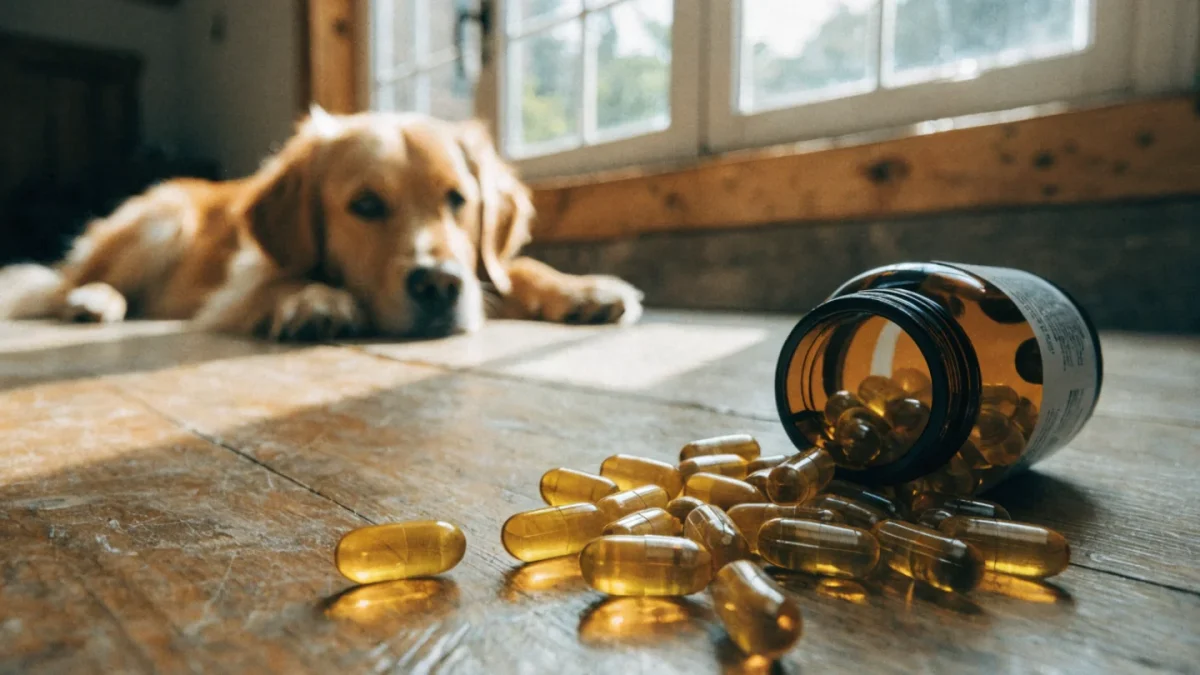
A client named Barbara came in last fall with her eight-year-old cocker spaniel, Figaro, whose skin had been dry and itchy for about three months. She'd been giving him fish oil for two months — one soft gel per day from a human supplement she'd already had at home. His skin hadn't improved at all.
I asked her to bring in the bottle the following week. The capsule contained 1,000 mg of fish oil with 180 mg EPA and 120 mg DHA. For Figaro's weight of 12 kg, a general maintenance dose of EPA+DHA runs around 360–660 mg per day — consistent with published guidelines of 30–55 mg/kg per day for general health. She was giving him about 300 mg. Not nothing, but not enough to produce the skin effects she was hoping for.
This is the core problem with fish oil supplementation in pets. The supplement itself has genuine, well-supported benefits. But the gap between what most products provide at their recommended doses and what research shows is effective is larger than most owners realize.
What Fish Oil Actually Does
The active components in fish oil are EPA (eicosapentaenoic acid) and DHA (docosahexaenoic acid) — long-chain omega-3 polyunsaturated fatty acids. These compete with arachidonic acid for the same metabolic pathways, and when EPA and DHA levels are adequate, the balance shifts toward less inflammatory eicosanoid production. This is the mechanism behind most of fish oil's documented benefits.
Skin and coat health. The best-established benefit for dogs and cats. Omega-3 fatty acids support the skin barrier, reduce inflammatory skin conditions including allergic dermatitis, and produce the coat improvements (sheen, reduced shedding) that most owners notice first. This is genuinely where I've seen the most consistent clinical response in my practice.
Osteoarthritis. Several controlled trials have documented reduced joint pain and improved mobility in dogs with osteoarthritis supplemented with omega-3 fatty acids — including a multicenter double-blind trial published in the Journal of the American Veterinary Medical Association (Roush et al., 2010) that found 50% improvements in crepitus, pain, and joint effusion versus placebo. The effect isn't as fast as pain medication and isn't a replacement for it, but as an adjunct, high-dose fish oil has meaningful clinical value for arthritic dogs.
Cardiovascular function. DHA is important for cardiac muscle function. In dogs with dilated cardiomyopathy (DCM), omega-3 supplementation has shown benefit in small trials — Freeman et al. demonstrated reduced ventricular arrhythmias and reduced cachexia in dogs with cardiac disease supplemented with fish oil, a finding supported by a therapeutic review published in the Journal of the American Veterinary Medical Association (2011). For cats with hypertrophic cardiomyopathy, the picture is less clear but there's plausible rationale.
Renal disease. In cats with chronic kidney disease, diets enriched with omega-3 fatty acids — particularly EPA — have shown reduced rates of disease progression in some studies; Brown et al. (2000) found improved survival rates in cats fed omega-3-enriched renal diets, and a 2022 pilot study in the Journal of Feline Medicine and Surgery demonstrated that DHA supplementation improved kidney biomarkers (SDMA, UPC) in cats with early CKD. This is an area where I routinely discuss fish oil with kidney disease clients.
Cognitive function. DHA is a structural component of brain tissue. There's some evidence that DHA supplementation supports cognitive function in aging dogs — a study in Frontiers in Veterinary Science (2022) found that combined DHA and sphingolipid supplementation attenuated cognitive decline in aged Beagle dogs — though I'd say honestly the clinical data is less robust than for joints and skin, and most of the promising signals come from combination supplement studies rather than DHA alone.
The Dose Problem — In Detail
This is where I want to spend more time, because it's where most fish oil supplementation goes wrong.
Fish oil products are typically labeled in total oil volume, not in EPA+DHA content. A "1000 mg fish oil" capsule might contain anywhere from 180 to 600 mg of actual EPA+DHA depending on the product and concentration. This matters enormously because the relevant dose is the EPA+DHA dose, not the oil dose.
Published dose guidelines for dogs vary by application — the Colorado State University Veterinary Teaching Hospital and Today's Veterinary Practice (Lenox, 2020) both document these ranges:
- General health/skin/coat: approximately 20–55 mg of combined EPA+DHA per kg body weight per day
- Osteoarthritis support: up to 75–200 mg/kg per day (requires veterinary oversight at higher levels)
- Kidney disease support: similar range to arthritis; dose adjusted based on clinical condition
For cats, the general guidance is lower — approximately 25–40 mg/kg per day for general use, with higher doses (up to 40 mg/kg EPA plus 25 mg/kg DHA) recommended for specific therapeutic applications like CKD, per the Journal of Feline Medicine and Surgery (Kobayashi et al., 2022).
What does this mean practically? A 20 kg dog on the general dose range needs 400–1,100 mg of combined EPA+DHA per day. A single standard 1,000 mg fish oil capsule at 30% EPA/DHA concentration provides about 300 mg. That dog needs one to three capsules depending on concentration.
Most pet fish oil products on the market, at their labeled dose recommendations, deliver 50–150 mg EPA+DHA per day. For a 20 kg dog, that's under 10 mg/kg — well below the general health range.
I'm not saying manufacturers are being deceptive. They're probably reflecting a conservative approach in the absence of standardized veterinary dosing guidelines. But if you're supplementing for a specific purpose, you need to check the actual EPA+DHA content and dose accordingly.
Quality: The Rancidity Problem
Fish oil is uniquely prone to oxidation. When exposed to heat, light, or air, the unsaturated fatty acids that make fish oil beneficial degrade into peroxides and aldehydes — compounds that cause the characteristic "fishy" smell, contribute to GI upset, and provide none of the health benefits. Rancid fish oil is at best useless and at worst pro-inflammatory.
Signs of rancid fish oil: strong fishy smell (fresh fish oil smells relatively mild), yellow or dark brown color, strong off-flavor that your pet refuses. Some rancid oils are harder to detect by smell.
To minimize rancidity risk:
Refrigerate after opening. Fish oil degrades faster at room temperature, especially in a repeatedly-opened bottle in a warm kitchen. Keep it in the fridge.
Check expiration dates and buy fresh. Don't use a bottle that's been in the cabinet for two years.
Choose products in dark containers. Light accelerates oxidation. Clear bottles are a quality concern.
Look for products with added vitamin E or rosemary extract. These are natural antioxidants that stabilize the oil and extend shelf life.
Consider capsules over liquid. Capsules protect the oil from air exposure until you open each one. Liquid fish oil that's repeatedly exposed to air in an open bottle degrades faster. If you're using liquid, small bottles that turn over quickly are better than large ones that sit around.
Sources: Fish Oil vs. Krill Oil vs. Algae Oil
Standard fish oil (from sardines, anchovies, mackerel) is the most studied and best-understood option. It's also the most affordable. The sustainability picture is mixed but improving with certification programs.
Krill oil contains EPA and DHA in phospholipid form, which does appear to improve bioavailability — a comparative study in Lipids in Health and Disease (Ulven et al., 2011) found that krill oil produced higher incorporation of EPA+DHA into plasma phospholipids relative to standard fish oil triglycerides, suggesting smaller doses may achieve similar blood levels. It's more expensive, and the EPA/DHA content per gram is lower than concentrated fish oil. I don't discourage it, but I'd want to see more head-to-head data before paying the premium.
Algae-based omega-3. This is the primary source of omega-3s in fish — fish accumulate EPA/DHA by eating algae. Algae-sourced omega-3 is the fish-free alternative, producing DHA (and sometimes EPA) without the marine chain. This is the only omega-3 source appropriate for a vegetarian or vegan pet diet. Bioavailability appears comparable to fish oil for DHA. It's more expensive and the EPA content varies by product — check labels carefully.
Flaxseed, hemp, and other plant-based omega-3 sources. These provide ALA (alpha-linolenic acid), a short-chain omega-3 that the body can theoretically convert to EPA and DHA. The conversion efficiency in dogs is modest and in cats is very poor — cats have limited delta-6 desaturase activity, meaning their conversion of ALA to EPA and DHA is virtually zero, a well-established feline metabolic limitation documented in the Journal of Nutritional Science (Bauer, 2011) and referenced in NRC nutrient requirements for cats. Plant-based omega-3 sources are not equivalent substitutes for fish or algae-based EPA/DHA in pets.
Practical Implementation
For most dogs on fish oil for skin health or general anti-inflammatory support, I'd suggest:
- Calculate the EPA+DHA dose target for the dog's weight using the general range (30 mg/kg per day is a reasonable midpoint starting estimate)
- Check the EPA+DHA content per capsule or per teaspoon on the product label (not the total oil volume)
- Divide to find the number of capsules or teaspoons needed daily
- Start at half the calculated dose for the first week to allow GI adjustment — fish oil at therapeutic doses can cause soft stools initially
- Refrigerate the product and check it monthly for rancidity
- Give with a meal to improve absorption and reduce GI effects
For Figaro, we ended up using a concentrated fish oil product — two capsules daily provided 720 mg EPA+DHA. Within six weeks his skin was noticeably better. His coat was smoother. His owner said he'd stopped scratching at night.
"Should I have been giving more the whole time?" she asked.
Yes. But the dose, the quality, and the expiration date all matter. Three separate things. And now she checks all three.
FAQ
Can I give my cat fish oil capsules meant for dogs?
Yes, with dose adjustment. Fish oil is fish oil — there's no species-specific formulation required. Cats need a lower dose than dogs (roughly by weight), and the same quality considerations apply. Soft gels designed for humans or dogs can be opened and the contents squeezed onto food for cats who won't swallow capsules.
My dog already eats a salmon-based dog food. Does she still need fish oil?
Possibly not at a general health dose. Some salmon and fish-based commercial diets provide meaningful EPA/DHA. Check the product's omega-3 content statement (some list it) or contact the manufacturer. If the diet provides 20+ mg/kg of EPA+DHA, additional supplementation for general health isn't needed. For therapeutic purposes like joint disease, the diet's contribution is rarely sufficient and supplementation is still usually warranted.
How long before I see results from fish oil supplementation?
Skin and coat improvements: typically four to eight weeks at therapeutic doses. Joint improvements: often eight to twelve weeks. This is one reason many owners stop too soon — they try it for two or three weeks at a low dose and see nothing.
Can fish oil cause problems if I give too much?
At very high doses (above therapeutic ranges), fish oil can interfere with blood clotting (relevant if your pet is on anticoagulants or scheduled for surgery), cause GI upset, and potentially affect immune function. At moderate therapeutic doses, the main side effects are occasional soft stools at the start of supplementation and, rarely, fishy-smelling breath. The margin between therapeutic and problematic is relatively wide for omega-3s compared to fat-soluble vitamins — but if you're pursuing high-dose supplementation for a medical condition, do it under veterinary guidance.
Are cheap fish oil products from discount stores okay?
Sometimes. The main concerns are EPA/DHA content (check the label, not just the oil volume), freshness and rancidity (buy recent stock, refrigerate, use within a few months of opening), and contamination (heavy metals, PCBs). Products that have been third-party tested for purity and potency provide better assurance. Expensive doesn't guarantee quality, but very cheap products in opaque, long-shelf-life formats give me more pause than mid-range options with transparent labeling.