

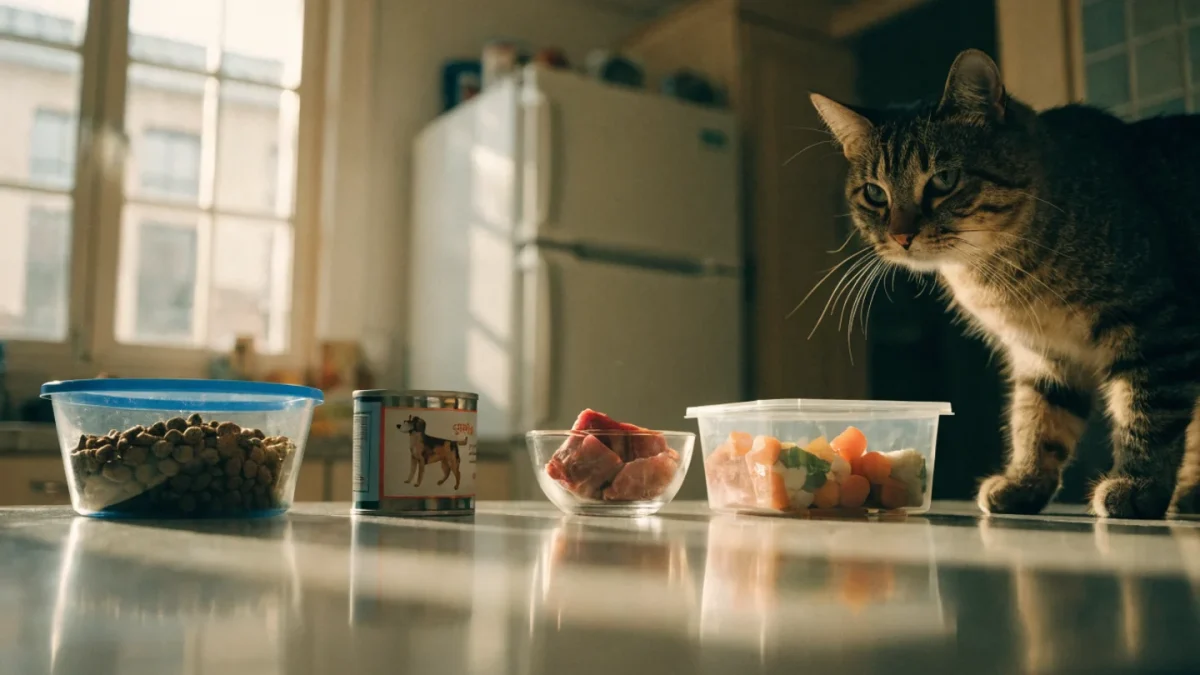
A client asked me last summer which type of food she should feed her new puppy, and then rattled off about seven options she'd seen at the pet store: dry, wet, semi-moist, freeze-dried, frozen raw, air-dried, fresh-delivered, gently cooked. She seemed mildly overwhelmed. Honestly, fair enough — the pet food market has expanded enormously in the last decade, and the marketing language around each category makes genuine comparison difficult.
Let me try to give you an actual map of what's out there, without the marketing.
Dry Kibble: The Workhorse
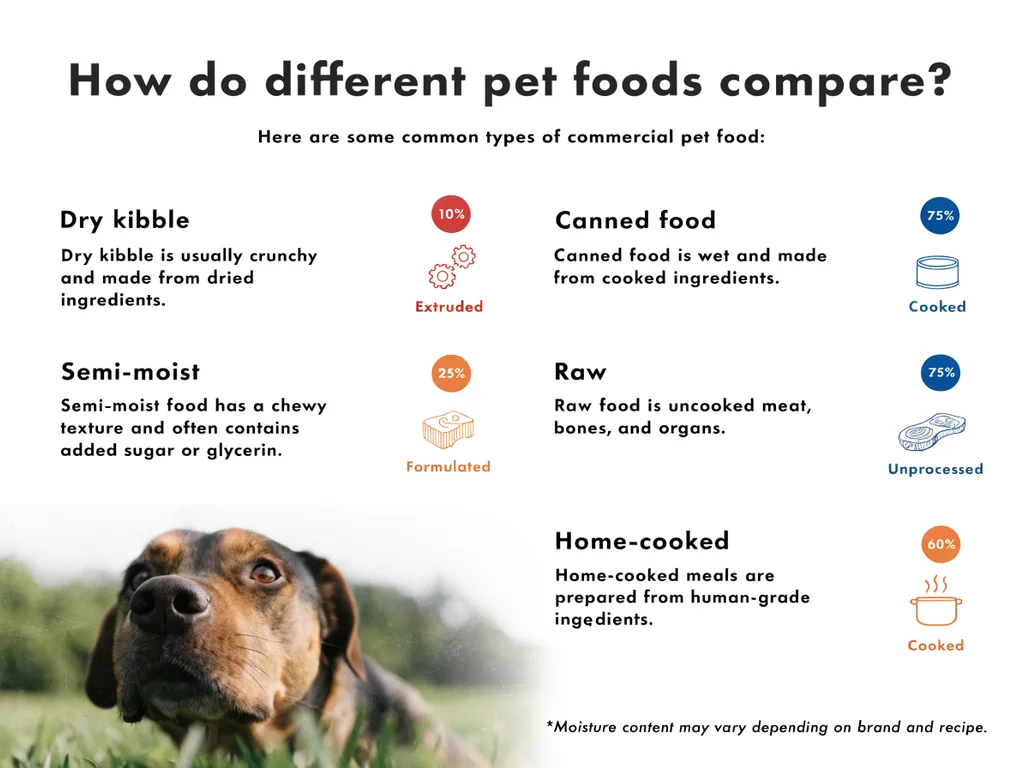
Kibble is made by extrusion — ingredients are mixed, forced through a die under high heat and pressure, and cut into pieces that are then dried. It's been the dominant form of commercial pet food for decades, and there are good reasons for that: it's shelf-stable, calorie-dense, relatively affordable, and convenient.
The tradeoffs are real. Extrusion involves high heat, which degrades some heat-sensitive nutrients — vitamins A, D, E, and several B vitamins are among the most vulnerable — and manufacturers compensate by adding vitamins and minerals back in post-processing, typically by spraying a blend onto the finished kibble before packaging. This is standard industry practice and, when properly formulated, largely effective at meeting nutrient requirements. Kibble is also very low in moisture (around 8-10%), which matters especially for cats, who have a naturally low thirst drive and can develop urinary and kidney problems when chronically underhydrated.
Kibble quality varies enormously. The cheapest formulas use lower-quality protein sources and higher proportions of plant-based filler; the premium end of the market uses named whole proteins, whole grains or legumes, and goes through feeding trials. Ingredient quality, manufacturing standards, and nutritional formulation all differ significantly between brands — and the marketing language isn't a reliable guide to any of them.
Canned and Wet Food
Wet food has a moisture content of 75-85%, which makes it the closest commercially available approximation of a fresh prey-based diet in terms of hydration. It's also typically more palatable for most pets — the smell and texture are more appealing than kibble, which matters for picky eaters or sick animals who need appetite encouragement.
The cost is higher on a calorie-for-calorie basis than kibble, and it doesn't have kibble's dental abrasion benefit. Opened cans need to be refrigerated and used within 24-48 hours.
For cats especially, I recommend wet food as at least a significant part of the diet. The hydration argument is real and backed by veterinary evidence: cats evolved as desert animals with a naturally low thirst drive, meaning they often don't drink enough to compensate for a dry-food-only diet, and concentrated urine from chronic mild dehydration is a recognized risk factor for feline lower urinary tract disease and kidney problems. I know it's more expensive. I also know cats with chronic kidney disease have better outcomes when they maintain higher fluid intake. Make of that what you will.
Raw Food
Raw diets — frozen raw meat, raw meaty bones, freeze-dried raw — have become popular partly because of legitimate nutritional arguments (high moisture, unprocessed protein, no heat damage) and partly because of enthusiastic communities promoting them. I'll try to be straightforward here.
The potential benefits: high-quality protein, good moisture content, minimal processing. The risks: bacterial contamination is well-documented — studies have found Salmonella, Listeria monocytogenes, and E. coli in commercially prepared raw pet foods at significant rates, and infected pets can shed bacteria without showing symptoms, creating household transmission risks — as well as nutritional imbalance in homemade versions and bone-feeding injuries when raw bones are involved.
Commercial frozen raw diets from established manufacturers that use high-pressure processing (HPP) to reduce pathogens represent a better option than homemade raw. HPP applies immense hydrostatic pressure to physically disrupt bacterial cell membranes — research has demonstrated 5-log reductions of Salmonella, Listeria, and E. coli with properly applied HPP, while the process has minimal impact on nutrient content or the raw texture the raw-feeding community values.
I don't recommend raw feeding for immunocompromised pets, households with young children or elderly people, or as a first-choice diet for owners who aren't willing to handle raw meat carefully. For everyone else, a well-formulated commercial raw product that meets AAFCO standards is a legitimate option — the evidence base is more nuanced than either side of the raw debate usually admits.
Freeze-Dried and Dehydrated
Both processes remove moisture to create shelf-stable products that can be rehydrated at feeding time.
Freeze-drying removes moisture by freezing the food and then applying a vacuum, which causes ice to evaporate directly to vapor without thawing. This preserves nutrients and flavor well. The result is lightweight and shelf-stable. Freeze-dried raw is one of the higher-nutrient options available.
Dehydrating removes moisture with low heat over a long period — gentler than extrusion but some nutrient degradation still occurs. Air-dried food (a specific form of dehydration at very low temperatures) tends to preserve nutrients better than conventional dehydration.
These products are typically expensive on a daily feeding basis, but some owners use them as a topper on kibble rather than a complete diet.
Fresh-Cooked and Delivered
Fresh-cooked or "lightly processed" pet food — often sold through home delivery services — involves cooking ingredients at lower temperatures than kibble extrusion to preserve more nutrients while eliminating pathogens. The moisture content is usually 60-75%, between wet food and kibble.
These diets are typically more expensive than kibble, often significantly so, and require refrigeration. The quality and nutritional completeness varies by manufacturer. The marketing around fresh food can be quite strong — "human-grade ingredients," "just like what you eat" — and some of it reflects genuine quality differences while some is primarily branding.
How to Actually Choose
Rather than prescribing a type, I'd rather give you the criteria:
For cats: Prioritize moisture. Some wet food in the diet is not optional in my opinion. Whether that's 100% wet, a mix with kibble, or fresh food is a practical question.
For dogs with health conditions: The food type matters less than specific nutritional parameters (protein level, specific nutrient restrictions). Your vet can guide you.
For healthy dogs: Good-quality kibble or a combination of kibble and wet food works for most dogs. The specific formulation matters more than the format.
For budget-constrained households: A good-quality kibble from a manufacturer with feeding trials is preferable to a boutique fresh or raw diet that you can't sustain financially. Consistency matters.
For the picky eater: Format matters a lot. A dog or cat who won't eat something is getting no nutrition from it. A slightly less ideal food they'll reliably eat beats a theoretically superior food they push away.
The honest summary: all of the main food types can support a healthy pet when properly formulated. None of them is universally best. The marketing in this space significantly outpaces the evidence, and your vet is the right person to consult when a specific health situation changes what matters most.