

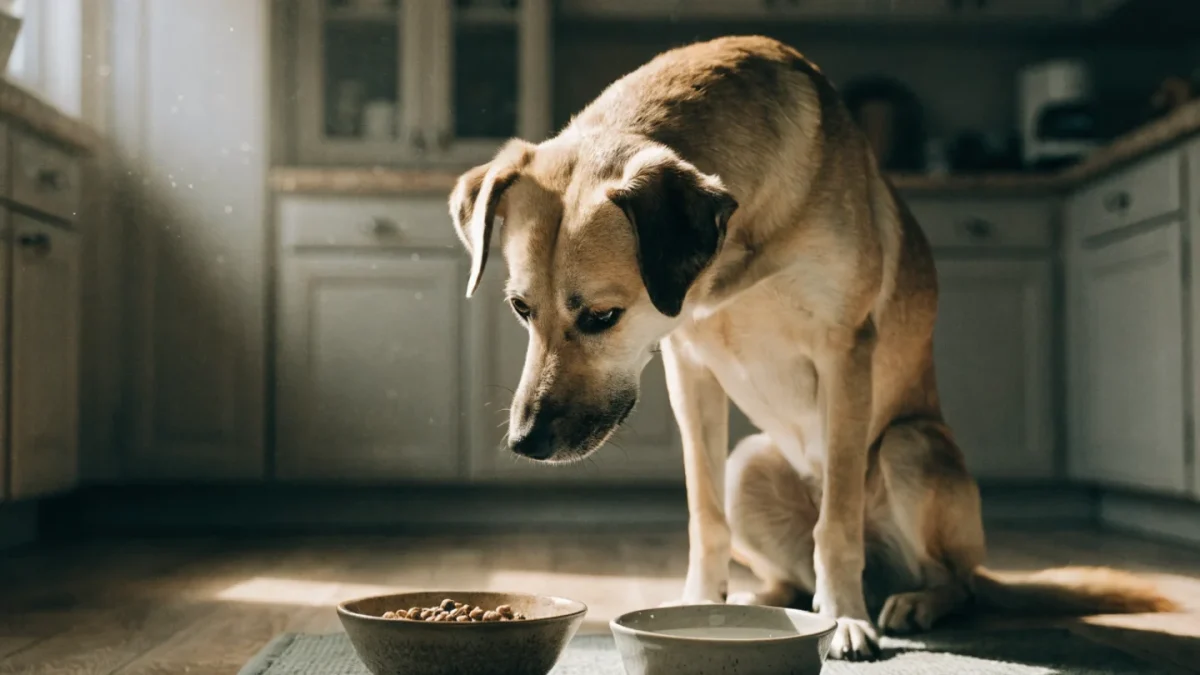
I tell people that the most important thing a feeding schedule does isn't actually about nutrition. It's about information.
When you feed twice a day and your dog ignores their morning bowl, you notice. When you free-feed and the bowl is always topped up, you might not realize for days that your dog hasn't really been eating. And loss of appetite is one of the earliest signs of dozens of conditions — infections, pain, nausea, early organ disease, dental problems. A structured feeding routine gives you a window into your dog's health that free-feeding obscures entirely.
That said, meal frequency does matter for nutrition too. Here's what I actually recommend, by life stage.
Puppies: Three to Four Meals a Day
Young puppies have small stomachs and fast metabolisms. They need frequent meals to maintain stable blood sugar and to support the enormous energy demands of growth.
From weaning through about four months: four meals a day. Breakfast, lunch, mid-afternoon, dinner. I know — it's a lot. But young puppies who go too long between meals can develop hypoglycemia, especially in small breeds, and the consequences can be serious. Toy breeds are particularly vulnerable.
From four to six months: three meals. Morning, midday, evening.
From six months to one year: you can usually drop to two meals, though large and giant breeds sometimes do better staying at three until they reach adult size. I've had Great Dane owners drop to twice-daily too early and the dogs would inhale their food so fast that bloat risk felt real.
The exact amounts per meal come from the food's feeding guide divided by the number of meals — but I'd start 10–15% below the guide and adjust based on body condition.
Adult Dogs: Two Meals a Day
Once or twice a day is the range. Twice is better.
A single daily meal isn't dangerous for most adult dogs, but I don't love it for a few reasons. Dogs fed once daily sometimes develop food-related anxiety — ravenous, frantic eating that increases gulping, gas, and in deep-chested breeds, possibly the risk of gastric dilatation-volvulus (bloat). Cornell University's College of Veterinary Medicine notes that dogs fed one large meal per day have significantly higher bloat risk than those fed two or more smaller meals. Two meals also means smaller individual portions, which is easier on digestion.
Morning and evening — the timing doesn't need to be precise to the minute, but roughly 10–12 hours apart works well. If you're working long days and the morning meal happens at 7am, the evening meal at 6pm is fine. The body condition score and the dog's appetite will tell you over time if the amounts are right.
One thing I watch for: clients who feed in the morning and then give a large treat or chew in the afternoon, then a second meal in the evening. Those afternoon treats often aren't counted. They should be.
How Much to Feed
The bag guidelines are a starting point. Not a prescription.
Manufacturers typically calculate feeding amounts for the upper end of normal activity, which overestimates the needs of most companion dogs (who are predominantly neutered, indoor, and moderately active). My general rule of thumb: start at the low end of the bag's range, evaluate body condition score after 4–6 weeks, and adjust from there.
Weighing the food is more accurate than measuring by volume. Kibble density varies significantly between brands and even between formulas from the same brand. A cup of one kibble might be 300 calories; a cup of another might be 430. If you're switching foods and maintaining "the same number of cups," you may be dramatically changing caloric intake without realizing it.
Treats count. I ask every client to estimate daily treat calories and factor that into the total. If treats are 20% of daily intake, food should be reduced by 20%. Most owners are feeding more treats than they think.
Free Feeding: When It Works and When It Doesn't
Free feeding — leaving food out all day — works for some dogs. Dogs who are naturally self-regulating, eat slowly, aren't food-motivated, and live in single-dog households can manage it fine.
Most dogs don't fit that profile.
Free feeding makes it impossible to track intake, easy to overfeed, difficult to use food for training, and hard to notice appetite changes. In multi-dog homes, it practically guarantees that the faster or more dominant dog eats more than their share. And the calories add up invisibly.
I occasionally recommend free feeding for underweight dogs recovering from illness who need to eat more — constant access can help. But as a default approach for a healthy dog? I'd steer away from it. Structured mealtimes are simply better for most animals.
Large and Giant Breeds: Extra Considerations
Deep-chested breeds — Great Danes, Standard Poodles, Irish Setters, Weimaraners, German Shepherds, and others — have a higher-than-average risk of gastric dilatation-volvulus (GDV), also called bloat. This is a life-threatening emergency where the stomach fills with gas and can twist on itself.
The relationship between feeding schedule and GDV is still being studied, but there's evidence that eating very fast and exercising vigorously within an hour of eating may increase risk — these are documented risk factors in prospective studies including a large-breed GDV cohort study published in the Journal of the American Veterinary Medical Association (Glickman et al.). For these breeds, I recommend:
- Two meals minimum per day (splitting volume reduces per-meal intake)
- Avoid vigorous exercise for 1–2 hours after meals
- Consider a slow-feeder bowl if the dog inhales food
- Know the signs: unproductive retching, distended abdomen, restlessness — call your vet immediately
Elevated feeders are worth discussing with your vet individually — the evidence on whether they help or hurt is genuinely mixed. One widely cited prospective study (Purdue University) found elevated bowls were associated with increased GDV risk in large breeds, while a later study published in Veterinary Evidence found no significant effect, so current guidance generally defaults to floor-level feeding for at-risk breeds pending better evidence.
FAQ
Q: Can I feed my dog just once a day to make things easier?
It's technically fine for healthy adult dogs, but I'd encourage twice-daily if possible. Single feeding can lead to frantic eating, more gas, and in large/deep-chested breeds, a potentially higher bloat risk. Also, one meal a day means a longer fasting window overnight, which some dogs handle fine and others don't — you may notice they're restless or demanding food earlier if the timing doesn't suit them.
Q: Should I feed at exactly the same time every day?
Roughly consistent is fine; exact to the minute isn't necessary. Dogs do develop expectations around feeding time — many will start pestering you 30 minutes before their usual meal — so consistency helps manage that behavior. But a 30–60 minute window is perfectly adequate. Life happens.
Q: My dog eats so fast they sometimes vomit — what should I do?
This is common and usually not a health crisis, but it's worth addressing. Options: use a slow-feeder bowl with maze-like ridges that force the dog to eat more slowly, spread food on a flat surface or lick mat, feed smaller amounts more frequently, or use a puzzle feeder. If vomiting persists despite slowing the pace, there may be an underlying issue like esophageal motility problems — worth a vet visit.
Q: My new puppy doesn't seem to eat much at each meal — is that normal?
Very common in the first week or two at home. Stress, environmental change, and the transition to a new food (if different from what the breeder or shelter fed) all reduce appetite temporarily. As long as the puppy is alert, active, urinating and defecating normally, and not vomiting, a reduced appetite for a few days is usually fine. If it persists beyond a week or you notice lethargy, call your vet. Hypoglycemia in small-breed puppies can develop quickly when food intake is low.