

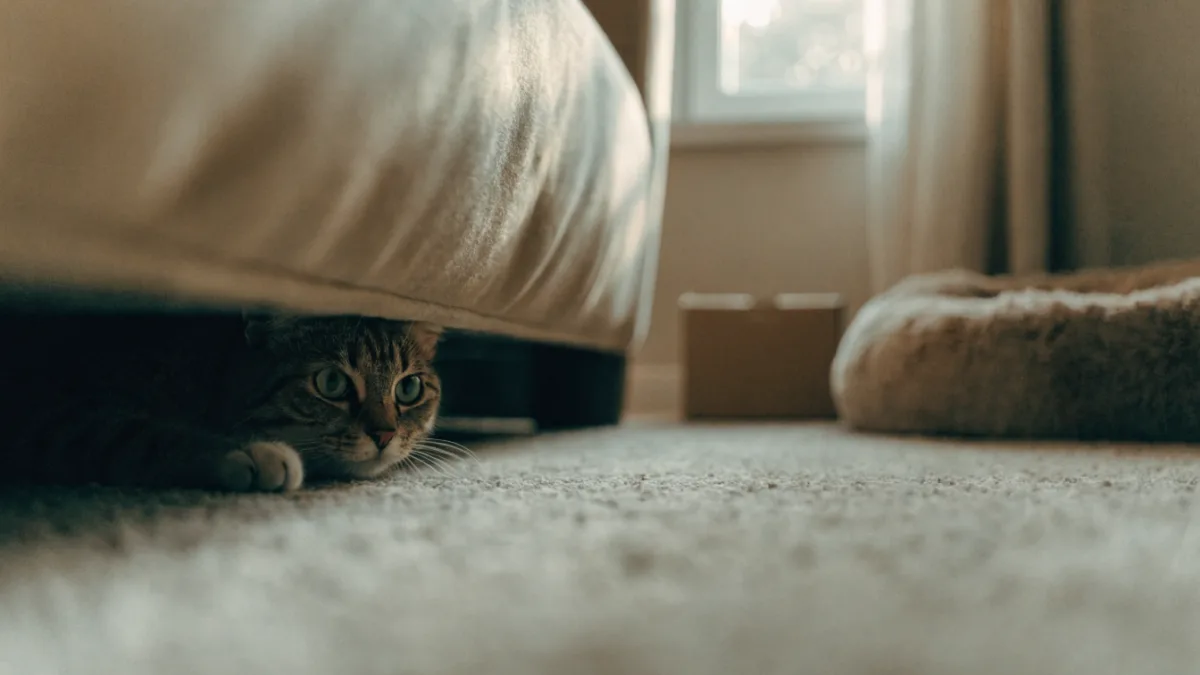
When I brought home my cat Mochi, she took one look at my living room, calculated the exact trajectory needed, and launched herself behind my refrigerator. For the first three days, I was convinced I had adopted a ghost. I’d lie on my kitchen floor with a flashlight, peering at the tiny terrified eyes reflecting back at me, holding out a piece of tuna like a hostage negotiator. It is completely normal to feel a crushing sense of rejection when your new cat vanishes into the furniture. We want to scoop them up, show them the fancy water fountain we bought, and prove that we are good people. But here is the hard truth I had to learn the messy way: dragging them out of their hiding spot is the absolute worst thing you can do.
Let’s reframe this whole situation. Your cat isn’t broken. They aren’t antisocial. They are experiencing a completely natural decompression phase, and if you want a confident, cuddly companion, you have to let them hide.
The Physics of Fear: Why Reaching In Destroys Trust
To understand why cats hide, you have to look at their evolutionary biology. Cats are both predators and prey. In the wild, a cat’s survival depends on finding a secure, enclosed space where larger predators cannot reach them.
When you bring a cat home, you have essentially dropped them onto an alien planet. Their entire environment has been stripped away, replaced by new smells, terrifying acoustics, and a giant, loud, hairless ape (you) who keeps making kissing noises.
There is a persistent, outdated myth in animal handling that you should just force exposure to get the animal “used to” you. In behavioral science, this is called flooding—making the animal endure the scary stimulus until they just stop fighting it. Modern feline behaviorists.[1] When you reach under the bed and drag a hiding cat out, you aren’t teaching them to love you. To a prey animal, being pulled from a dark hole simulates being snatched by a predator.
If you pull a fearful cat out of their hiding spot, they don’t learn to love you. They just learn that their safe space is no longer safe.
Once a cat learns that their sanctuary can be breached by you at any moment, they will become hyper-vigilant. You completely shatter their baseline of security, deeply damaging the trust-building process before it even begins.
Shrink Their World: Designing the Safe Zone
One of the biggest mistakes new cat owners make is giving their pet free roam of the entire house immediately. We feel guilty about “locking them up,” so we open all the doors. The problem? A large house is an overwhelming, terrifying landscape for a cat. If they get spooked, they will find the deepest, darkest, most inaccessible corner of your home—like inside your walls or deep in your HVAC ductwork—and you will never see them again.
The Power of Confinement
Starting a new cat in a small, contained area is significantly more effective for their psychological adjustment. Think of it as creating a studio apartment for them. A spare bedroom, a large bathroom, or a quiet office is perfect.
Here is what you need in the safe zone:
- Essential resources in plain sight: Food, water, and a litter box should be easily accessible. Don’t make them cross a massive room to get to their basic needs.
- Approved hiding spots: Provide cardboard boxes, a covered cat bed, or a chair with a blanket draped over it.
- Vertical space: Even a small cat tree or a cleared shelf allows them to observe their domain without being on the floor.
- Zero forced interactions: This room is their fortress of solitude.
The Agonizing Wait
How long does this take? Rescue organizations often use the 3-3-3 rule: 3 days to decompress, 3 weeks to learn the routine, and 3 months to feel truly at home. For exceptionally shy cats, it can easily take up to a month just to build initial trust. Patience isn’t just a virtue here; it is the entire strategy.
The Art of Doing Nothing: Consent-Based Trust
So, you’ve set up the safe zone, the cat is hiding under the bed, and you are just supposed to… leave them alone? Yes and no. You aren’t ignoring them; you are counter-conditioning them. You are teaching them that human presence equals safety and good things.
There is a massive push in modern animal behavior toward “Consent-Based Petting” and the Constructional Approach Training (CAT). This means you wait for the cat to offer “approach” behaviors, and you reward them. If they offer “withdrawal” behaviors, you immediately back off. You give them the agency to say “no.” Paradoxically, giving a cat the power to reject you builds trust infinitely faster than forcing yourself on them.
Reading Feline Body Language
Don’t stare at your hiding cat. In cat language, a hard stare is a threat. Instead, sit on the floor of their safe zone and read a book out loud. Let them get used to your voice and your smell without demanding anything from them.
When they finally emerge, [2] that they are ready to interact:
- The Slow Blink: If they look at you and slowly close and open their eyes, they are showing trust. You can slow blink back.
- Eating in the open: If they are willing to eat the food you put down while you are in the room, their guard is dropping.
- The Play Bow: If they start batting at a feather wand toy you gently drag nearby, they are letting their hunting instinct override their fear.
When they do approach you, keep your hand low and let them sniff it. If they rub against your hand, you can give them a gentle scratch under the chin. The moment they stop purring, flatten their ears, or twitch their tail, pull your hand away. Respecting their boundaries is how you prove you aren’t a predator.
The Long Game: From Hiding to Thriving
Hiding is a natural stress response for a new cat, but it can eventually become a symptom of boredom if they are kept in an unstimulating, sedentary environment for too long. Once they are confidently claiming the safe zone—sleeping out in the open, playing, and greeting you at the door—it is time to slowly expand their world.
Mochi didn’t come out from behind the fridge until I stopped trying to coax her out. I set up a small safe room, left her entirely alone with a soft blanket and a bowl of high-value food, and simply waited. One evening, about a week in, I walked in to find her sitting in the middle of the room. She looked me dead in the eye, let out a tiny squeak, and walked over to headbutt my shin. I nearly cried.
Domestic cats might not be an endangered species, but their welfare is deeply tied to how well we understand their psychology. Thousands of cats are surrendered to shelters every year simply because their owners labeled them as “defective” or “mean” when they were actually just terrified. Taking the time to learn feline body language and respecting their need for a decompression phase isn’t just about making your life easier—it is a vital part of reducing shelter surrenders and giving these incredible animals the safe, happy lives they deserve.
Leave them alone, set up the buffet, and let them conquer their world one tiny step at a time.
Sources
- strongly condemn this approach — felinebehaviorsolutions.com
- look for these signs — youtube.com