

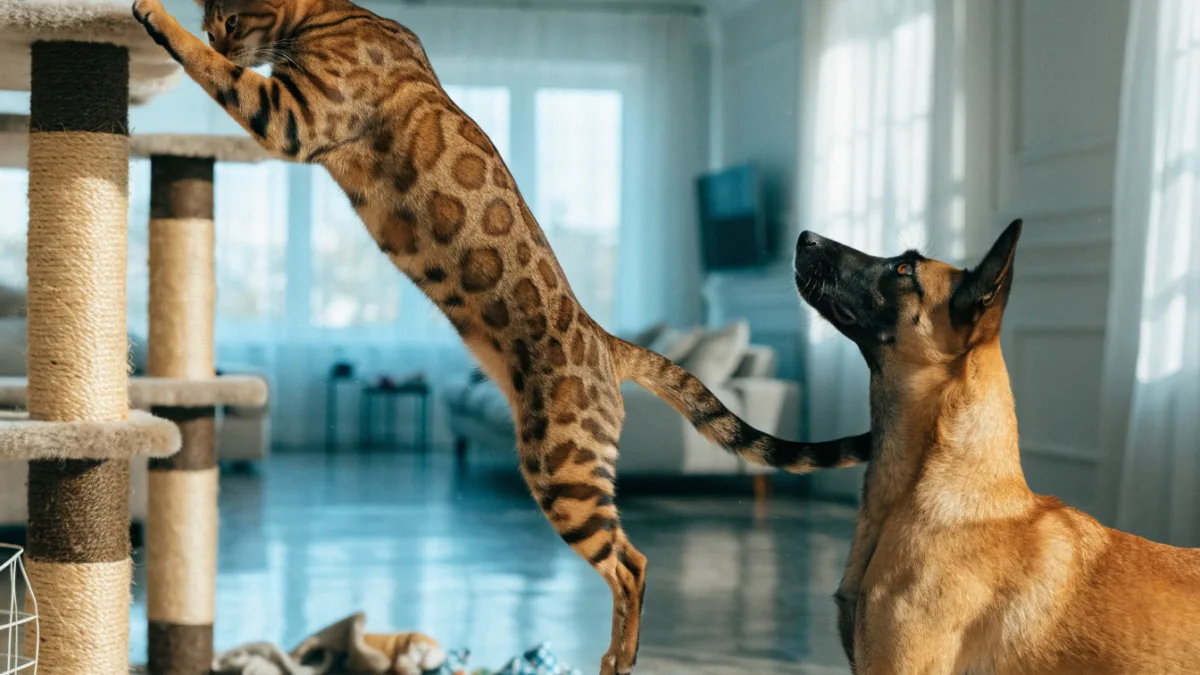
I met a Bengal named Rajah at a friend’s barbecue last summer. Beautiful cat — rosetted coat, athletic build, eyes like amber marbles. Within twenty minutes of my arrival, he’d figured out how to open the cooler, stolen a hot dog, scaled a six-foot privacy fence, and was sitting on the neighbor’s roof screaming at birds. His owner shrugged and said, “He’s basically a dog.”
No. No, he is not. And that framing — that a Bengal is “basically a dog in a cat suit” — is exactly how people end up in trouble. Rajah isn’t a dog. He’s a highly intelligent, enormously active feline with wild ancestry recently enough in his lineage that it still shows. Calling him a dog doesn’t prepare you for what he actually needs. It just makes the gap between expectation and reality wider when you’re standing in your kitchen at 6 a.m. watching him systematically clear your countertop of every glass you own.
This is what I call the high-energy trap: you bring home an animal because you love the look, the reputation, the idea — and then you discover that the animal’s energy budget was calibrated for a life you don’t actually live. It happens with Border Collies. It happens with Belgian Malinois. And it absolutely happens with Bengals.
What “Working Dog Energy” Actually Means
People throw around “high-energy dog” like it’s a personality quirk. A Labrador who likes fetch is high-energy. A Border Collie is something else entirely. Border Collies were developed to work livestock all day, every day, in rough terrain, making independent decisions about sheep movement. Their brains don’t have an off switch. A Belgian Malinois is similar but more intense — military and police work isn’t a fun side gig for them, it’s the bare minimum of what they were built to do.
I fostered a Malinois named Kira for three weeks in 2021. She needed ninety minutes of structured exercise before breakfast just to be a functional house dog. After that, she needed training sessions, puzzle feeders, and a long walk in the evening. If I skipped any of it, she ate furniture. Not chewed — consumed. A coffee table leg. A shoe rack. The corner of a wall.
That’s what working-breed energy looks like when it has nowhere to go. The dog isn’t being bad. The dog is drowning in drive with no outlet, and destruction is the only relief valve available. Huskies do this. Australian Cattle Dogs do this. Jack Russell Terriers — small body, same problem — absolutely do this.
Managing a working dog means committing to a lifestyle. Daily conditioning. Ongoing training. Often a structured “job” like agility, herding trials, dock diving, scent work, or competitive obedience. Without it, these dogs develop real psychological distress — anxiety, compulsive behaviors, reactivity. The “gentle giant” marketing around some of these breeds sets people up for failure. There is nothing gentle about a bored Malinois.
The Bengal Reality Check
Bengals come from crossing the Asian Leopard Cat (Prionailurus bengalensis) with domestic cats. The modern Bengal you’d bring home today is usually at least four generations removed from that wild ancestor — what breeders call F4 or beyond — which is why they’re classified as domestic cats. But that wild heritage still expresses itself in ways that matter.
They’re athletic. They’re vocal — and I don’t mean sweet little meows, I mean full-throoled opinion-sharing. They’re curious in a way that resembles problem-solving more than wandering. A standard domestic cat might investigate a new object, determine it’s not food, and move on. A Bengal will figure out how the object works, whether it can be opened, and what happens when it’s pushed off a table.
A friend of mine has a Bengal who learned to turn on the bathroom faucet himself. Not for water — the water bowl was full. He just liked watching it run. Another Bengal owner in a Reddit thread I read described coming home to find her cat had opened every cabinet in the kitchen, removed the contents, and arranged the boxes in a line down the hallway. That’s not destructive behavior in the way a bored dog chews a couch. That’s an intelligent animal with no enrichment inventing games.
The Bengal isn’t trying to ruin your day. The Bengal is bored, and a bored Bengal is the most creative disaster you’ll ever live with.
Where the Dog Comparison Actually Helps
People who’ve owned high-energy dogs before sometimes have an easier time with Bengals, and that’s worth acknowledging honestly. If you already understand that a smart, active animal needs daily engagement — not just food and a warm spot — you’re ahead of someone who’s only ever had a sleepy tabby. The Reddit thread I referenced was full of former working-dog owners saying the Bengal transition was manageable because the mindset transferred.
But the specific toolkit is different.
Feline Energy Needs Its Own Toolbox
Here’s where the “basically a dog” framing fails people. Dogs process the world through pack structure and cooperation. Training a Border Collie to sit, stay, and come isn’t just about obedience — it’s about giving them a role in a social hierarchy they crave. Bengals don’t work that way.
Cats are solitary hunters. Their intelligence evolved for stalking, ambush, and territorial problem-solving. So when you try to manage Bengal energy with dog methods — long obedience sessions, structured heel work, repetitive command training — you’re speaking the wrong language. Bengals need feline enrichment.
- Vertical space. Cat shelves, tall trees, access to the tops of bookcases. Bengals climb. Denying them vertical territory creates stress.
- Hunting simulations. Wand toys that mimic prey movement, not just balls to chase. The hunt is the point — the stalk, the pounce, the catch, the “kill.”
- Puzzle feeders. Food shouldn’t come free. Bengals enjoy working for meals, and it burns mental energy faster than almost anything else.
- Leash training. Many Bengals take to harnesses and leashes. Outdoor walks on a harness give them novel scent and visual input that indoor life can’t match.
- A companion. This is why you see experienced Bengal owners getting two. They entertain each other, burn energy through play, and provide social stimulation that humans alone struggle to match.
The pet tech industry has caught on. Automated laser towers, smart rolling robots, treat-dispensing gadgets with increasing difficulty levels — these exist because Bengal and other high-energy cat owners need tools to keep their animals occupied during the workday. I have mixed feelings about outsourcing enrichment to machines, but I also recognize that not everyone can work from home forever.
The Pandemic Pet Fallout
This is the part that genuinely frustrates me. Between 2020 and 2021, people brought home high-energy pets — working dog breeds, Bengals, all of it — because they were home all day and finally had the bandwidth. Then offices reopened, commutes returned, and thousands of owners discovered their animals had grown accustomed to constant companionship and engagement that suddenly vanished.
Shelters and rescues saw the predictable result: surrenders spiked. High-energy dogs who’d never learned to be alone. Bengals who’d been the center of someone’s world for eighteen months suddenly locked in apartments for ten hours a day. The “high-energy trap” snapped shut, and the animals paid the price.
I don’t think this makes those owners villains. Most of them loved their animals. But love doesn’t replace an unmet need. A Bengal who’s screaming and destructive isn’t a bad cat — he’s a cat whose environment stopped meeting his requirements. A Malinois who’s chewing through drywall isn’t broken — she’s a dog whose job disappeared.
Where the Wild Ancestor Stands
Since we’re talking about Bengals, it’s worth noting where their wild ancestor sits in all of this. The Asian Leopard Cat is listed as Least Concern on the IUCN Red List globally, which sounds reassuring — but that status masks regional problems. Habitat loss across Southeast Asia, fur hunting in parts of their range, and capture for the pet trade have put pressure on local populations. They’re not endangered as a species, but “least concern” doesn’t mean “safe.” It means “not currently disappearing fast enough to trigger alarm.” That’s a low bar.
The modern domestic Bengal is far enough from that wild ancestor — genetically and behaviorally — to be a pet. But the breed exists because humans found the spotted coat beautiful and decided to breed for it. There’s a legitimate ethical conversation about whether creating animals whose energy levels exceed what most owners can handle is responsible breeding practice. I don’t have a clean answer to that, and I don’t think anyone does.
What I know is this: the high-energy trap is avoidable. It requires honesty before the adoption — about your schedule, your home, your tolerance for chaos, and what the animal actually needs versus what you hope they’ll be. A Bengal isn’t a dog. A working dog isn’t a project. Both deserve owners who understood the assignment before signing up.