

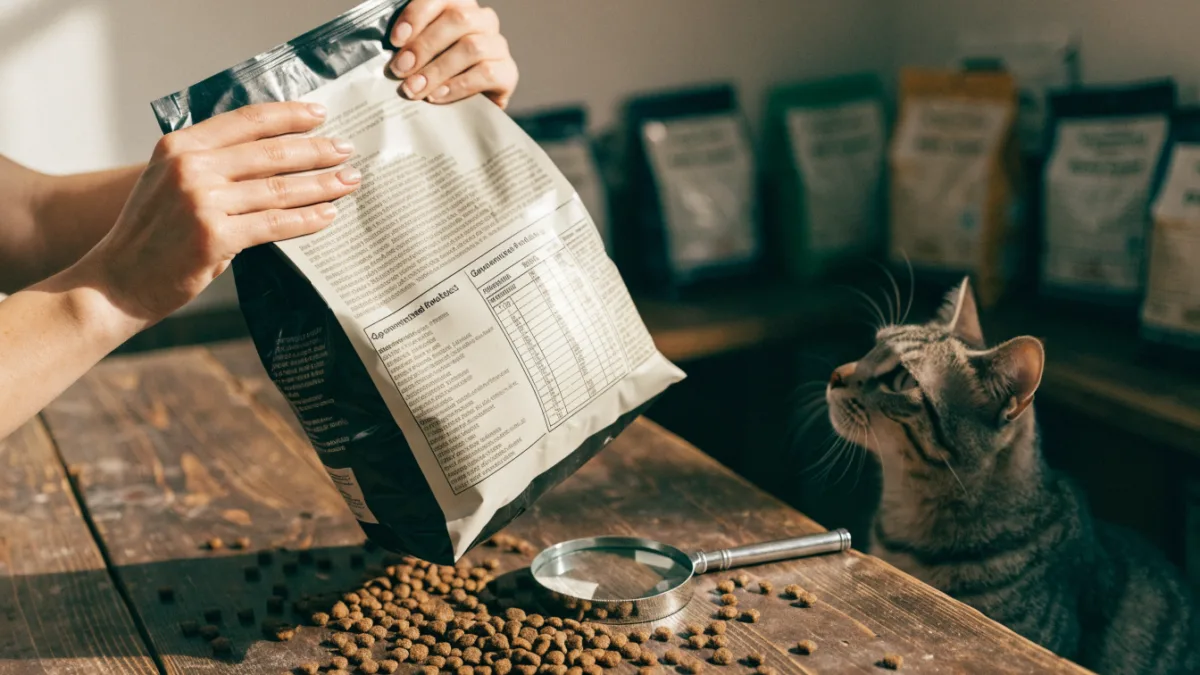
Just last week, a client named Tom brought his four-year-old Beagle, Max, into the clinic. Max had been dealing with chronic ear infections and a dull, flaky coat. Tom was frustrated. “I don’t get it, Dr. Mitchell,” he sighed, setting a massive, brightly colored bag of kibble on my exam room floor. “The bag says it’s premium chicken. I’m spending a fortune on this stuff at the pet store, but he just isn’t thriving.”
I flipped the bag over, bypassed the beautiful photos of roasted chickens and farm-fresh vegetables, and looked at the tiny print along the bottom. Within seconds, the problem was clear. The bag was labeled “Chicken Flavor,” meaning it legally contained almost zero actual chicken. Instead, the first five ingredients were cheap fillers and unnamed meat meals.
Tom, like many loving pet owners, had been completely spun around by brilliant marketing. If you want to make sure you’re actually getting your money’s worth and feeding your pet a nutritious diet, you have to ignore the front of the bag entirely. Let’s talk about how to read dog food labels, spot the best cat food ingredients, and understand exactly what those AAFCO pet food statements actually mean.
The Name Game: The 95%, 25%, and 3% Rules
The Association of American Feed Control Officials (AAFCO) is the organization that dictates the rules for pet food labels in the United States. They don’t approve or test the food themselves, but they set the standards that state feed control officials enforce. One of the most fascinating things AAFCO regulates is the product’s name. The wording on the front of the bag isn’t just marketing; it’s a strict legal code.
The 95% Rule
If a product is named simply “Chicken Cat Food” or “Beef Dog Food,” that named ingredient must make up at least 95% of the product’s total weight, not counting the water used for processing. If you include the water weight, it still has to be at least 70% chicken or beef. These diets are mostly meat.
The 25% Rule (The “Dinner” Rule)
If the named ingredient makes up only 25% to 94% of the total weight, the manufacturer has to use a descriptive qualifier. That’s why you see bags labeled “Chicken Dinner for Dogs,” “Beef Entree,” or “Salmon Platter.” If Tom had bought a “Chicken Dinner” for Max, he would know the food was at least 25% chicken.
The 3% Rule (The “With” Rule)
This is where things get incredibly sneaky. If you see a label that reads “Dog Food with Chicken,” the manufacturer is only legally required to include 3% of that ingredient. Three percent! Many budget-conscious owners grab a bag of “Kibble with Beef,” thinking they are buying a beef-heavy diet, when they are actually buying a plant-heavy diet with a tiny sprinkle of beef.
The “Flavor” Rule
Remember Max’s food? It was labeled “Chicken Flavor.” Under this rule, the food only needs to contain enough of a chicken digest or broth for the pet to taste it. There is required to be a specific percentage of actual chicken in the bag—often, there’s none at all.
Decoding the Ingredient List
Once you’ve navigated the name, it’s time to flip the bag over. Ingredients are legally required to be listed by weight before processing. This is a crucial distinction. Whole meats, like deboned chicken, contain about 60% to 70% water. When the food is cooked and baked into kibble, that water evaporates. So, while “deboned chicken” might be the first ingredient on the list, its actual weight drops significantly once cooked, pushing the remaining ingredients higher up the concentration list.
Does that mean whole meat ingredients are bad? Not at all. Whole-food ingredients are generally cleaner and highly digestible. However, you should also look for named meat meals, like “chicken meal” or “salmon meal.” Meat meals are rendered, meaning the water and fat have been removed before weighing. A high-quality named meat meal is incredibly nutrient-dense. What you want to avoid are vague terms like “meat meal” or “animal fat.” If the manufacturer won’t tell you which animal it came from, it’s usually a low-quality by-product.
Beware of Ingredient Splitting
Learning how to read dog food labels means understanding a marketing trick called “ingredient splitting.” To make a food look like it has more high-quality protein than it actually does, companies will split cheap filler ingredients into specific fractions.
Instead of listing “corn” high on the list, they might list “ground corn,” “corn gluten meal,” and “corn bran” separately. Because each individual corn fraction weighs less than the meat ingredient, the meat stays at the top of the list. But if you add all three corn fractions together, corn is often the true primary ingredient in the bag!
Finding the Best Cat Food Ingredients
Cats are obligate carnivores, which means their bodies are designed to run on animal protein. When looking for the best cat food ingredients, you want to see a named meat, meat meal, or meat broth as the first two or three ingredients. You also want to watch out for excessive plant-based proteins, like peas and lentils, which are biologically inappropriate for felines in high amounts. Named fats, like chicken fat or salmon oil, are excellent for their coat and skin, while artificial dyes and vague by-products should be hard passes.
The Golden Ticket: The AAFCO Statement
Somewhere on the side or back of the bag, you will find a small, unassuming block of text. This is the AAFCO pet food nutritional adequacy statement, and it is arguably the most important sentence on the entire bag.
You want to look for language stating the food is “complete and balanced” for a specific life stage. For example, a bag should explicitly say it is formulated for “growth” (for puppies and kittens) or “maintenance” (for adults). If a food says it is for “all life stages,” it meets the minimum requirements for growth—which means it has the higher protein and fat content needed for a growing animal. While that sounds great, it means an older, less active senior dog might be eating far too many calories and calcium, leading to obesity and joint stress.
I always tell my clients: AAFCO sets the absolute minimum nutritional requirements to keep a pet alive. Meeting bare minimums is not the same as achieving optimal, long-term health. You want a diet that doesn’t just hit the baseline, but helps your pet thrive.
Doing the Math: Navigating the Guaranteed Analysis
Labels must legally list the minimum percentages of crude protein and crude fat, alongside the maximum percentages of crude fiber and moisture. But comparing wet food to dry food using this panel is like comparing apples to oranges, because wet food is mostly water. If you want to ensure you’re paying for protein and not just water, you have to do a little bit of basic math to find the “Dry Matter Basis.”
Here is how I explain it to my clients:
- Subtract the moisture percentage from 100 to find the total dry matter. (For example, if a canned food has 80% moisture, 100 – 80 = 20% dry matter).
- Divide the crude protein percentage by the dry matter percentage, and multiply by 100. (If the can has 10% protein: 10 / 20 = 0.5. Multiply by 100, and you get 50%).
- That means the food is 50% protein on a dry matter basis.
Doing this calculation is the only way to accurately compare a bag of kibble to a can of wet food to see which one offers better nutritional value for your budget.
Fillers, Binders, and Preservatives to Avoid
As consumers push back against deceptive marketing, brands are becoming more transparent. However, there are still a few ingredients I recommend minimizing or avoiding entirely:
- Cheap Fillers: Look out for wheat middlings, soybean hulls, and Brewer’s rice. These are nutritional leftovers from human food processing and offer very little dietary value.
- Artificial Preservatives: Try to avoid foods preserved with chemical compounds like BHA, BHT, and ethoxyquin. Look for natural preservatives like mixed tocopherols (a form of Vitamin E) and rosemary extract instead.
- Artificial Dyes: Ingredients like Red 40 or Blue 2 are only added to make the food look appealing to you. Your dog or cat does not care about the color of their kibble.
A Word on the Grain-Free Debate
I’ll be the first to admit I’ve changed my mind on grain-free diets. Ten years ago, the trend was massive—everyone wanted grain-free because it was marketed as “more natural” and “ancestral.” But in recent years, the FDA has been investigating a potential link between grain-free diets (specifically those high in peas, lentils, and potatoes) and a fatal canine heart condition called Dilated Cardiomyopathy (DCM). In DCM, the heart muscle thins, stretches, and struggles to pump blood effectively. Unless your pet has a diagnosed, specific grain allergy from a veterinary dermatologist, I highly recommend feeding a grain-inclusive diet.
Cracking the code on your pet’s food label takes a little practice, but the payoff is immense. By understanding the 95% and 3% rules, doing a quick dry matter calculation, and checking that AAFCO statement, you can bypass the marketing and put your money toward genuine nutrition. And while it might feel like a small choice in the aisle of a pet store, feeding your companion a high-quality, sustainably sourced diet has a massive ripple effect. When we demand transparently sourced ingredients and environmentally responsible practices from pet food manufacturers, we aren’t just protecting the health of our dogs and cats—we are voting for agricultural practices that protect wild habitats, reduce overfishing, and conserve the planet we all share.