

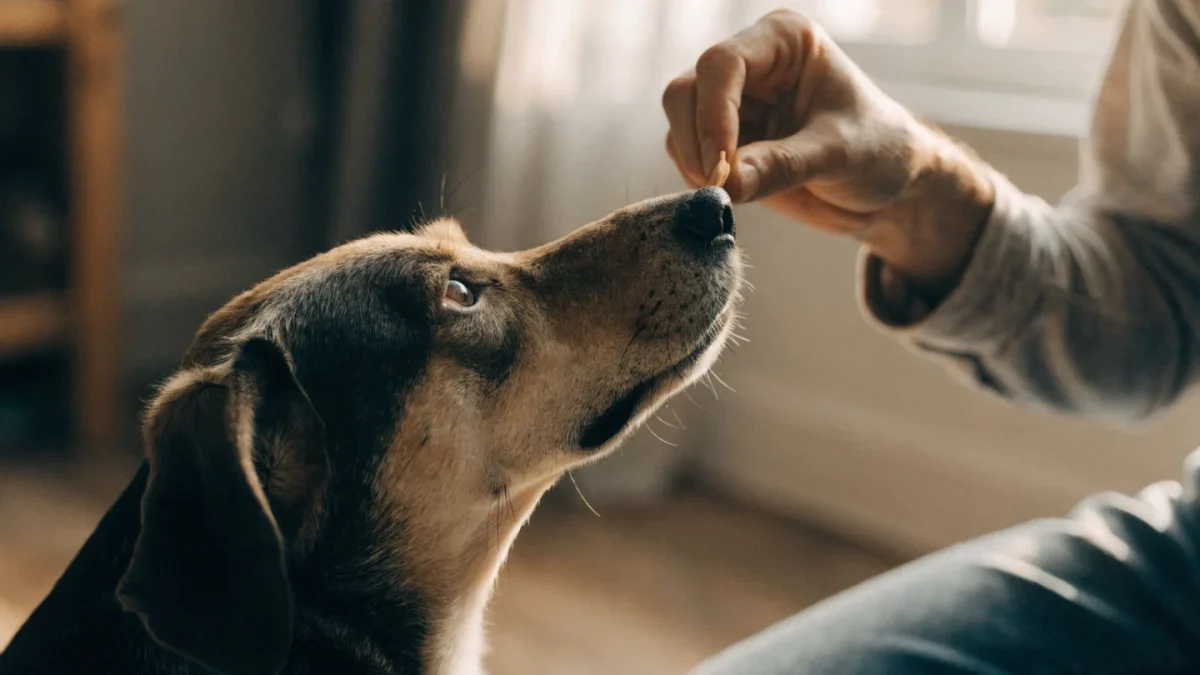
One of the most powerful concepts in training is deceptively simple: if you want a dog to stop doing X, give them Y to do instead — and make Y more rewarding than X.
The formal term is differential reinforcement of incompatible behavior (DRI). The practical term is just teaching a replacement behavior. It's more effective than punishment, more durable than suppression, and it leaves the dog with something to do.
What Makes a Behavior Incompatible?
An incompatible behavior physically prevents the problem behavior from occurring simultaneously.
- Sitting is incompatible with jumping (you can't sit and jump at the same time)
- Having a toy in the mouth is incompatible with barking
- Lying on a mat is incompatible with counter surfing in the kitchen
- Looking at the handler is incompatible with pulling toward a distraction
Notice that incompatible means physically impossible to do at the same time — not just unlikely, not just unlikely in context. The sit literally prevents the jump.
Why This Works Better Than "No"
When you tell a dog "no" or correct a problem behavior, you're removing an option. But you haven't given the dog an alternative. They still have the same drive that produced the behavior, minus the outlet. The behavior usually comes back.
When you teach an incompatible behavior and reinforce it heavily, you're giving the dog a strategy that works even better than the problem behavior. Sit → greeting. Four on floor → attention. Toy in mouth → owner is happy. The dog has a new path to the outcome they want.
Examples in Practice
Jumping → Sit for greetings. The dog is highly motivated to greet people. Jumping was how they did it. Now sitting gets the greeting faster. The motivation hasn't changed; the behavior that produces the outcome has.
Demand barking → Go to mat. Dog barks to get attention or get you to do something. Instead of reinforcing the bark (giving attention) or punishing it (removing something), teach: go to your mat gets you my attention. Barking gets nothing.
Counter surfing → Go to designated kitchen spot. Dog wants to be near food preparation and occasionally check for windfalls. The mat in the kitchen gives them a place to be; going to the mat gets rewarded; approaching the counter gets nothing (because counters are empty).
Leash pulling → Checking in with handler. The dog pulls to get where they want faster. Instead: looking back at the handler and maintaining loose leash gets forward progress. Pulling stops forward progress.
How to Train It
- Identify the problem behavior and its motivation. What does the dog get from it?
- Choose the incompatible behavior. It must be physically impossible to do the problem behavior while doing this.
- Train the incompatible behavior until it's reliable. Practice in easy contexts before the triggering ones. (See also: positive reinforcement dog training.)
- Make the incompatible behavior more rewarding than the problem behavior. High-value reinforcement, frequent reinforcement in early stages.
- Set up triggering situations and cue or capture the incompatible behavior. With enough repetitions, the trigger begins to elicit the trained behavior rather than the problem behavior.
This is slower to start than punishment-based approaches. But the resulting behavior is more durable, and you haven't added any stress or fear to the dog's experience.