

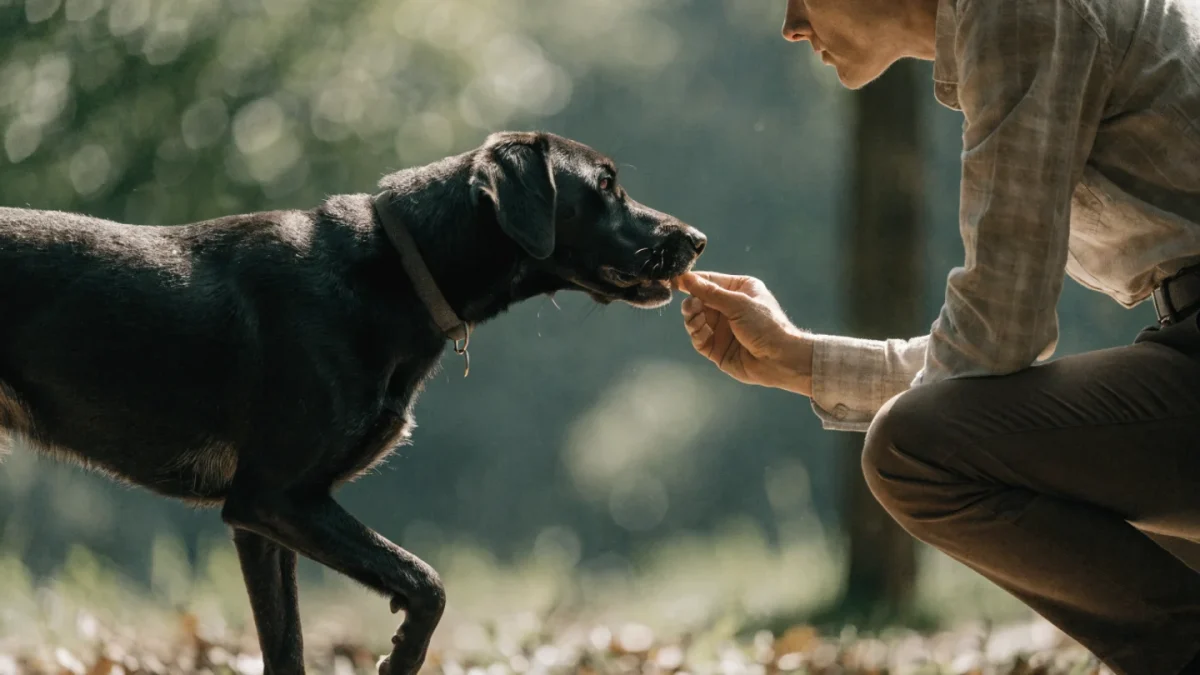
I'll be straight with you about positive reinforcement training: it's not the soft option. Done well, it requires precision, good timing, clear criteria, and understanding of how learning actually works. It's the most effective approach we have because it's built on how animal learning actually functions — not on how we'd like it to function.
The Four Quadrants
Behavior is shaped by consequences, and there are four types of consequence in operant conditioning:
Positive reinforcement (R+): Add something desirable → behavior increases. Sit → treat → dog sits more.
Negative reinforcement (R-): Remove something aversive → behavior increases. Leash pressure removed when dog walks forward → dog moves forward more readily.
Positive punishment (P+): Add something aversive → behavior decreases. Dog jumps → gets sprayed with water → jumps less.
Negative punishment (P-): Remove something desirable → behavior decreases. Dog jumps → owner turns away, removing attention → jumping decreases.
All four are in use by trainers across the spectrum, whether they acknowledge it or not. Positive reinforcement training primarily uses R+ and P- (and some R- in specific contexts). "Balanced" training tends to add significant P+.
Why R+ Produces Better Results
The question isn't whether punishment "works." It does, in the narrow sense of suppressing behavior. The questions are:
What are the side effects? Punishment-based training has documented associations with increased stress, anxiety, and fear responses in dogs — a 2020 study out of the University of Porto tracked this directly, measuring cortisol spikes and stress behaviors in dogs trained with aversive methods versus reward-based ones. Dogs trained with aversive methods are more likely to develop fear-based aggression.
What is the dog learning? R+ teaches the dog what TO do. Punishment teaches the dog what NOT to do — without necessarily providing an alternative. A dog told "no" 50 times has learned nothing about what "yes" looks like.
Is the relationship affected? The trainer (or owner) associated with punishment becomes a signal for something aversive. The trainer associated with reinforcement becomes a signal for good things. This affects the dog's motivation to work with you.
How Positive Reinforcement Training Works in Practice
Timing is everything. The reinforcer must be delivered within one to two seconds of the behavior you want. Deliver it late and you're reinforcing whatever happened in that two-second window, not necessarily the target behavior.
Reinforcer selection matters. The most effective reinforcer is what the dog values most in that moment — not what you think they should value. Some dogs are highly food-motivated; some value toys, play, or social interaction. Know your dog's hierarchy.
Criteria must be clear. What exactly are you reinforcing? Vague criteria produce vague results. Before each training session, know exactly what you're looking for.
Rate of reinforcement. In early learning, reinforce frequently — every correct response, or nearly so. As the behavior is established, you can shift to a variable schedule, which produces more durable behavior.
Building Duration, Distance, and Distraction (The 3 Ds)
One of the most common mistakes in positive reinforcement training: adding too many challenges too fast.
Duration: How long can the dog hold the behavior?
Distance: How far away can you be while the dog holds it?
Distraction: What level of competing stimuli can be present?
Only change one D at a time. If you're building duration, stay close and minimize distractions. If you're building distance, keep duration short and distractions low. If you're building distraction tolerance, work at close range and low duration.
FAQ
Does positive reinforcement training work for serious behavior problems?
Yes. Counter-conditioning, desensitization, behavior modification for aggression and anxiety — these are all built on reinforcement-based principles. Serious problems require more systematic work, not more punishment.
Will my dog only work for treats?
Only if you exclusively use treats and never teach the dog to work for other things. Real-world training involves teaching dogs to work for a variety of reinforcers, eventually including life rewards (going outside, greeting people, playing). Treats are an efficient training tool, not a permanent dependency. (See also: the complete guide to puppy training.)
What's wrong with a little punishment now and then?
The problem is the unpredictability and side effects, not the conceptual idea. Even mild punishment can create fear associations in dogs that are already anxious. And the consistency required to use punishment effectively is higher than most people achieve, meaning the punishment is often poorly timed and adds stress without reliably suppressing behavior.
Is positive reinforcement the same as permissiveness?
No. Clear criteria, consistent consequences, and high expectations are entirely compatible with positive reinforcement. Training dogs to stay, to not jump, to recall reliably under distraction — these require precision and structure. Positive reinforcement is not "let the dog do whatever."