

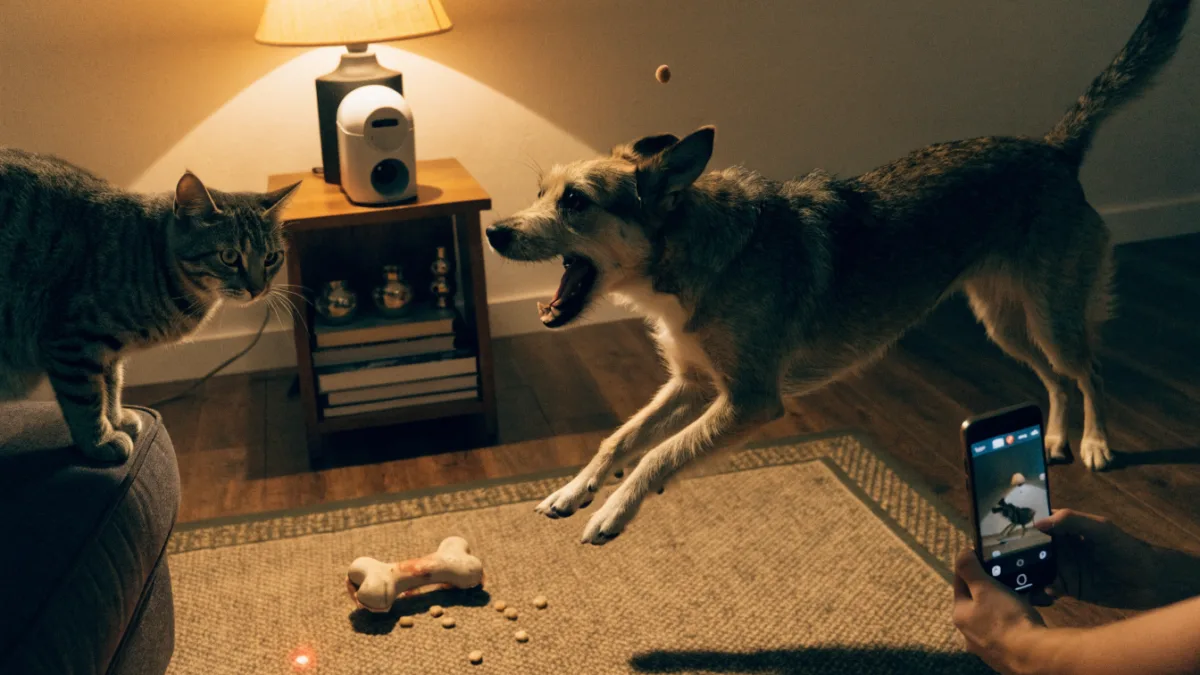
When I first unboxed my interactive pet camera, I felt like I’d unlocked a new level of pet parenthood. Two-way audio? Check. HD video streaming directly to my phone while I’m at work? Check. A little laser pointer I could control from anywhere with a WiFi connection? Double check. Mochi, my tabby cat, was about to be the most entertained feline on the block.
But then I mentioned the laser feature to my partner Jake, who has spent years working with dogs. He looked horrified. That reaction sent me down a research rabbit hole — or should I say mouse hole — and what I learned completely changed how I think about these devices. The short version: interactive pet cameras are fantastic tools, but the laser pointer feature that comes standard on so many of them is a very different proposition depending on whether you’re sharing your home with a cat or a dog.
The Instinct Behind the Chase
To understand why pet cameras affect dogs and cats so differently, you first have to understand what happens in an animal’s brain when that little red dot skitters across the floor. That fast, erratic movement — bouncing off walls, floors, and even the pet’s own body — closely mimics the movement of fast-moving prey. It’s not a conscious decision to chase. It’s an instinctual override.
Both cats and dogs are predators. When they see something zip across their field of vision at high speed, their prey drive activates almost instantaneously. Heart rate increases. Pupils dilate. Muscles coil. The body prepares for pursuit before the brain has even fully processed what it’s looking at. This is why even lazy, well-fed pets who haven’t hunted a day in their lives will launch themselves off the couch the second that dot appears. They can’t help it.,[1] the hunting sequence is deeply hardwired: stalk, chase, pounce, catch, kill, eat.
And here’s where the problems start. That final sequence — the catch, the kill, the satisfaction — never comes. A laser beam cannot be physically caught. It cannot be “killed.” It just… disappears when you stop pressing the button.
You’ve essentially hit the start button on a hunting sequence with no off switch. The instinct fires, the chase begins, but the brain never gets the chemical payoff that says “mission accomplished.”
Why Cats Get a Pass (Mostly)
For cats, laser pointers are generally considered a safe and highly effective form of enrichment. This isn’t just my opinion — [2] them as a way to provide both physical exercise and vital mental stimulation for indoor cats who might otherwise spend their days sleeping on your laundry pile.
Cats are natural-born hunters who, in the wild, would spend a significant portion of their waking hours stalking, chasing, and capturing prey. Indoor cats don’t have that outlet, which is why so many of them become bored, restless, and destructive. A laser pointer session taps directly into that predatory sequence in a way that few other toys can replicate. Mochi will chase that dot until she’s panting — which, honestly, is the only time I ever see her move faster than a slow saunter toward her food bowl.
The One Catch for Cat Owners
Even for cats, there’s a smart way to use laser pointers. Remember that unfulfilled hunting sequence? You can actually complete it. Many behaviorists recommend ending every laser play session by directing the beam onto a physical toy or treat that the cat can actually catch and “kill.” Throw a mouse toy. Drop a treat. Let them pounce on something real. It gives their brain the closure it’s looking for and prevents that frustrated energy from building up over time.
I do this with Mochi now. Three minutes of laser chasing, then the dot “lands” on a catnip mouse she gets to tackle. She struts off afterward looking deeply satisfied with herself, and I get back to work feeling slightly less guilty about leaving her alone all day.
Why Dogs Are a Different Story Entirely
Here’s where things get serious. Dogs are highly prone to developing what behaviorists call “light fixation” — essentially an obsessive-compulsive response to light sources. And it’s not rare. It’s not an edge case. It’s a well-documented [3] in dogs who’ve been exposed to laser pointers.
The obsessive behavior doesn’t always show up immediately, which makes it especially sneaky. A dog might seem fine after a few laser play sessions. But over time — sometimes weeks, sometimes months — they can develop a fixation that extends far beyond the original laser pointer. I’m talking about dogs who become compulsively obsessed with shadows, reflections on the ceiling, light glinting off a watch face, the glimmer of a phone screen. They’ll stare at walls waiting for light to move. They’ll neglect food, walks, and interaction with their humans because they’re so fixated on chasing light.
Once that neurological pathway is established, it is incredibly difficult to undo. We’re talking about behavioral modification that can take months or even years, sometimes requiring professional intervention from a veterinary behaviorist. Some dogs never fully recover from it.
This is exactly why I don’t give dog training advice — that’s Jake’s territory — but even I know enough to say this with certainty: if you have a dog, the laser pointer feature on your pet camera should stay off. Permanently.
Treat Tossing: The Better Alternative for Dogs
So your interactive pet camera has a laser pointer you can’t use with your dog. Does that mean the whole device is useless for canine households? Not even close. This is where the treat-tossing feature earns its keep.
While a laser pointer triggers a hunting sequence with no satisfying conclusion, a treat tosser does the exact opposite. It creates a clear cause-and-effect loop: good thing happens, dog gets rewarded, brain releases dopamine, cycle complete. It’s positive reinforcement in its purest form, and it works with a dog’s psychology rather than against it.
The physical satisfaction matters too. A dog catching a treat gets to use their mouth, taste something delicious, chew, swallow. Their body completes an action and receives a tangible reward. Compare that to a dog snapping at empty air where a light used to be, and you can see why one activity enriches while the other potentially harms.
For dogs who experience separation anxiety, a treat-tossing camera can be genuinely therapeutic. You can check in via video, speak to them through the two-way audio to reassure them, and toss a treat as a reward for calm behavior. It’s a way of staying connected and providing positive reinforcement even when you’re physically absent. That’s technology working with canine psychology, not against it.
The Great Laser Debate
I should mention that not everyone agrees on where exactly the line falls — especially when it comes to cats. There’s a genuine debate happening among pet owners, behaviorists, and even some veterinarians about whether laser pointers are truly safe for any animal.
The pro-cat camp argues that lasers are perfectly safe, effective, and highly recommended tools for feline exercise. Given the epidemic of obesity and boredom in indoor cats, they see laser pointers as an accessible way to get cats moving. The anti-laser camp pushes back hard, arguing that the fundamental frustration of uncatchable prey can lead to behavioral issues and obsessive-compulsive tendencies in both species — yes, even cats.
I land somewhere in the middle, and I think the research supports a nuanced position. Used thoughtlessly — long sessions, no physical reward at the end, several times a day — lasers probably aren’t great for any animal’s mental health. But used in short bursts with a satisfying conclusion, the risk to cats appears minimal while the enrichment benefit is substantial. Every cat is different though, and if you notice your cat becoming obsessively focused on lights or shadows after laser play, it’s worth having a conversation with your vet.
What to Watch For If You’ve Already Used Lasers with Your Dog
If you’re reading this and realizing you’ve already used a laser pointer — manually or through a pet camera — with your dog, don’t panic. Not every dog develops fixation. But it’s worth being observant over the coming weeks and months.
Watch for these behaviors:
- Staring at the floor, ceiling, or walls for extended periods, seemingly waiting for something
- Obsessive tracking of shadows, reflections, or light glints from phones, watches, and windows
- Refusing to engage with toys, food, or people when light sources are present
- Panting, pacing, or signs of anxiety when sunlight creates moving reflections in your home
- Frantic searching behavior after a light source disappears
If you notice any of these patterns, talk to your veterinarian. They can help determine whether what you’re seeing is concerning and, if necessary, refer you to a behaviorist. Catching these patterns early makes a real difference.
Using Pet Tech Thoughtfully
Interactive pet cameras are remarkable pieces of technology, and I genuinely believe they’ve improved the lives of countless pets and the humans who love them. Being able to see Mochi mid-stretch on the sofa while I’m sitting in a meeting three miles away brings me an embarrassing amount of joy. Knowing I can toss her a treat or — for cat households only — engage her in a quick play session makes me feel connected even when I’m gone.
But like any tool, these devices are only as good as our understanding of how to use them. The fact that a laser pointer comes built into your pet camera doesn’t mean it’s appropriate for every pet in your home. The fact that your dog loved chasing the dot doesn’t mean it was good for them. Sometimes the kindest thing we can do for our animals is understand their psychological needs well enough to know when to leave a feature unused.
The goal of enrichment isn’t just to keep our pets busy — it’s to fulfill their natural instincts in ways that leave them satisfied, content, and mentally healthy. For cats, that might mean a laser pointer session that ends with a pounce on a real toy. For dogs, it means skipping the light entirely and leaning into the things that actually complete their behavioral loops: treats, puzzles, training, and your voice coming through a speaker telling them they’re the best girl in the world.
At the end of the day, the best pet tech is the kind that works with who your animal actually is — not the version of them that’s most entertaining to watch through a camera. Understanding the difference between dogs and cats when it comes to prey drive, fixation risk, and psychological fulfillment isn’t just good pet parenting. It’s the difference between enrichment and its opposite, and our pets are counting on us to get it right.
Sources
- As PetMD notes — petmd.com
- veterinary professionals widely recommend — 7hillsvet.com
- behavioral issue that veterinarians and trainers see regularly — reddit.com