

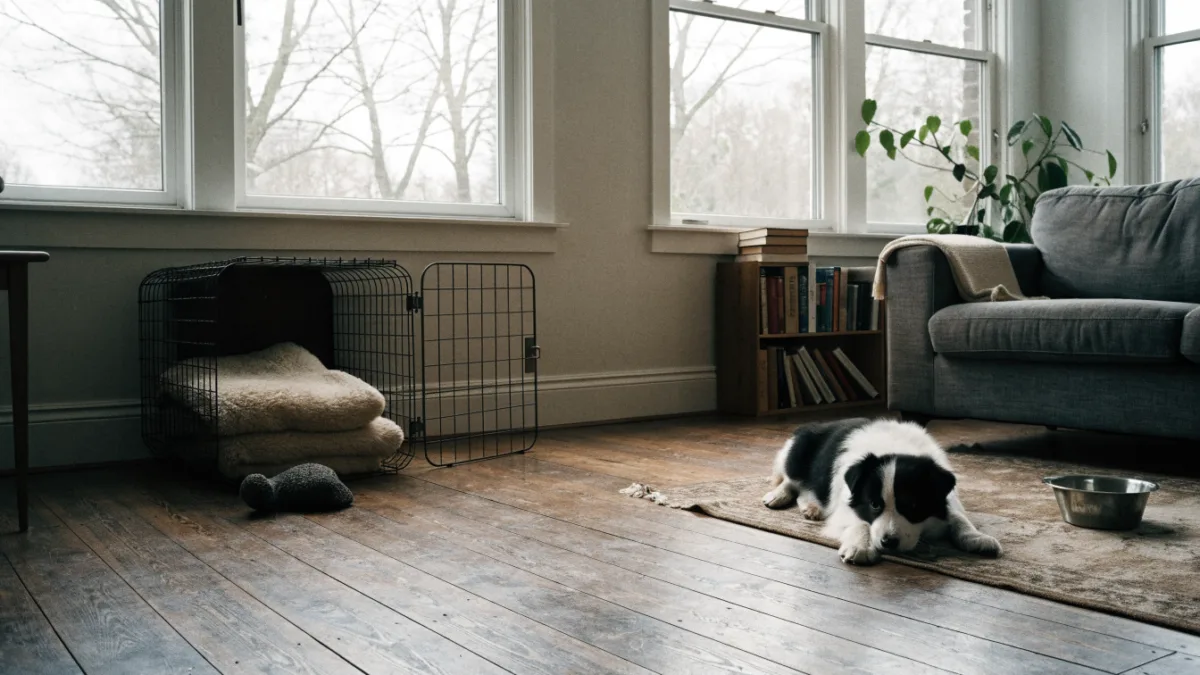
Ask ten dog people about crates and you’ll get ten confident answers, at least five of which directly contradict each other. One person swears the crate is a den — a cozy bedroom your dog instinctively craves. Another calls it a cage, full stop, and says using one is lazy ownership. Here’s where I’ve landed after watching this fight play out in real homes with real dogs: both people are describing real crates. The difference is never the wire and the plastic tray. It’s the training, the duration, and whether the dog ever got a say in the matter.
The “Den Animal” Story We All Repeated
The classic pitch goes like this: dogs are den animals, so a crate feels like home to them. I repeated that line for years before I actually looked into it, and I was wrong. Adult wolves don’t live in dens. They use them for a few weeks a year while raising pups, then sleep out in the open. And dogs aren’t solitary den-dwellers anyway — they’re,[1] wired to stay close to their group, not to seek out small locked spaces.
Here’s what is true: a lot of dogs genuinely like sheltered spots. Under the coffee table, behind the couch, in the closet during a thunderstorm. That’s a real preference you can build on. But a preference for a corner isn’t the same as wanting a box with a latch on it. A dog doesn’t “get” a crate the way the marketing suggests. A dog learns one. That distinction drives everything else in this debate.
What Crate Training Actually Delivers
House training that works with the body, not against it
Dogs naturally avoid soiling where they sleep, so a correctly sized crate helps a puppy build bladder control instead of practicing accidents on your rug. But the crate only works as a house training tool when it matches the puppy’s clock. The rough guideline: a puppy can hold it about one hour per month of age. Eight weeks old means two hours, tops. Ignore that math and the crate stops teaching anything.
Safety when you can’t supervise
I once spent a long night at an emergency clinic with a client’s nine-month-old Labrador who’d swallowed a dish towel. The surgery cost more than my first car. Puppies eat socks, batteries, gum, drywall — confinement when you can’t watch them isn’t about convenience. It’s about keeping the inside of your dog dog-only.
Emergencies you didn’t plan for
If your dog is ever hospitalized, boarded, or evacuated, confinement is already in the script. A dog who’s never seen a crate and then gets shut in one mid-crisis gets hit with fear on top of fear. Crate training is insurance you hope to rarely use.
A retreat the dog chooses
The best crate setups I see barely function as crates at all. The door hangs open all day, and the dog naps in there on purpose — or disappears into it when the party gets loud or the fireworks start. That’s the [2] and it only exists because somebody spent weeks making the crate the best real estate in the house.
So Is Crate Training Cruel? Here’s Where the Line Sits
Not inherently — but it slides into cruelty fast when it’s misused. The four big offenders:
- Duration. Common humane guidelines put adult dogs at four to six hours routinely, eight occasionally. Crating a dog ten or twelve hours a day around a work schedule is where welfare concerns get loud — that’s under-stimulation, frustration, and a body that has to hold it far too long.
- Forcing puppies past their limit. Crate a ten-week-old puppy for six hours and you don’t get house training. You get a puppy who soils the crate and learns to live in it, which quietly destroys the whole mechanism.
- Punishment. Shoving a dog into the crate after you’re angry at them teaches one lesson: bad things happen in there. That lesson is nearly impossible to untrain.
- Anxiety. For some dogs, confinement doesn’t contain panic — it amplifies it. A dog breaking nails or teeth on the bars isn’t being stubborn. That’s panic, and the crate is simply the wrong tool for that dog.
Watch for the warning signs: drooling and thrashing well past the adjustment period, self-injury, soiling inside, or flat-out refusal to go near the crate. Any of those means stop and reassess, ideally with a veterinarian or a qualified behavior consultant. Don’t push through it.
There’s also a cultural layer worth sitting with. One of the most-discussed threads on dog forums is literally titled:
What is it with Americans and their crates?
It’s a fair question. Crate training is mostly a North American habit. In countries like Sweden and Finland, keeping a dog crated at home is restricted under animal welfare law, and [3] raises perfectly behaved dogs without one — they just lean harder on management, puppy-proofing, and supervision. That’s not proof crates are evil. It’s proof they’re a cultural tool, and it’s worth asking honestly whether you’re using the tool or the tool is using you.
How to Crate Train a Puppy Without Making It Weird
Make it the best room in the house
Feed meals inside. Toss treats in and let the dog dive in after them. Leave a long-lasting chew in the back. Door stays open. You never shove, never force, never lure-and-trap. The dog should always feel like they walked in on their own terms.
Build duration in small bites
Close the door for ten seconds while they’re eating, then open it. Then a minute. Then five. Then step out of the room briefly. If the dog panics, you went too fast — drop back a step and stay there a few days. This takes weeks, not one weekend.
Keep the door open whenever you’re home
The goal is a crate the dog goes to, not a crate the dog is put in. That single shift is the difference between sanctuary and storage.
Know when it’s not the right tool
Some dogs never settle in a crate, and that’s not a failure. An exercise pen, a gated kitchen, or a puppy-proofed room stocked with enrichment gets the same safety job done for many of them. There is no approach that works for every dog — anyone who tells you otherwise is selling something.
And Cats? Different Animal, Literally
Cats need zero confinement for house training — litter box use comes standard in the feline package. But there are two pieces of the crate concept that translate, just not the way you’d expect.
The carrier is the cat crate
Most cats hate carriers because the carrier only ever appears for vet visits. Leave it out permanently instead. Feed treats near it, then in it. Take a few practice drives that end back home. A cat who walks into a carrier on their own is a cat whose emergency evacuation is actually survivable — for both of you.
Hide, don’t lock
A 2014 study from Utrecht University found that shelter cats given a simple cardboard hiding box recovered from stress noticeably faster than cats without one. Cats crave enclosed spaces — that they control. So give them boxes, covered beds, a perch behind the couch. The honest exceptions for confinement are brief and purposeful: a safe room for introducing a new cat, post-surgery recovery, or holding periods during trap-neuter-return work. Those are situations, not lifestyles.
So — den or prison? Wrong question. A crate is a tool with no morality of its own, and the verdict always lives in the details: how it was taught, how long the door stays shut, and whether the animal inside can rest, feel safe, and move when the body needs to. Dogs and cats gave up nearly all of their choices to live with us. Giving some of that choice back — an open door, a hiding box, a carrier that doesn’t smell like fear — is the bare minimum of the deal we made with them.
Sources
- social animals — facebook.com
- sanctuary model — acanineaffinity.com
- plenty of the world — reddit.com