

I've had a lot of clients who adopted a puppy and then immediately realized that full-time work and house training are fundamentally incompatible without some help. Young puppies cannot be alone for eight hours. They cannot hold their bladder that long, and leaving a puppy alone that long creates behavior problems regardless of their bladder.
But millions of people successfully raise puppies while working full time. Here's how they do it.
The First Few Weeks: Plan for More Help
The first two to four weeks are the most labor-intensive. This is when habits form, when the schedule gets established, and when house training either clicks or doesn't. Investing more support here pays off later.
Options:
- Take a few days of leave around the puppy's arrival week
- Work from home if that's possible in your job
- Have a partner, friend, or family member available during the day
- Hire a dog walker or puppy sitter for midday care
The goal is that the puppy is not alone for more than 1-2 hours at a stretch during the first month. As their bladder develops, the requirement loosens.
The Midday Solution
A midday visit from a dog walker or puppy sitter is not optional for very young puppies — it's necessary. A 10-week-old puppy cannot hold their bladder for 8 hours. A 3-month-old cannot either.
Most puppies under 4 months need at least one midday bathroom break when their owner is away. By 4-5 months, many can start managing 4-5 hours without a break.
If professional dog walkers aren't in your budget, look at:
- A trusted neighbor or friend who can pop in once a day
- A pet-sitter service
- Puppy daycare (also provides socialization, which is valuable during the socialization window)
Puppy daycare is genuinely excellent during the 8-14 week window — puppies get socialization with other dogs and humans, exercise, and supervision. By the time they age out of daycare (usually 4-5 months when they go to adult daycare or are old enough for longer alone time), the hardest phase is behind you.
Setting Up the Space
When you can't be home, your puppy needs a safe, confined space. Not free roam of the house — that leads to unsupervised accidents, chewing, and developing habits you don't want.
Two main options:
Crate: Works for shorter periods (within the puppy's hold time for their age). Good if you can get midday visits.
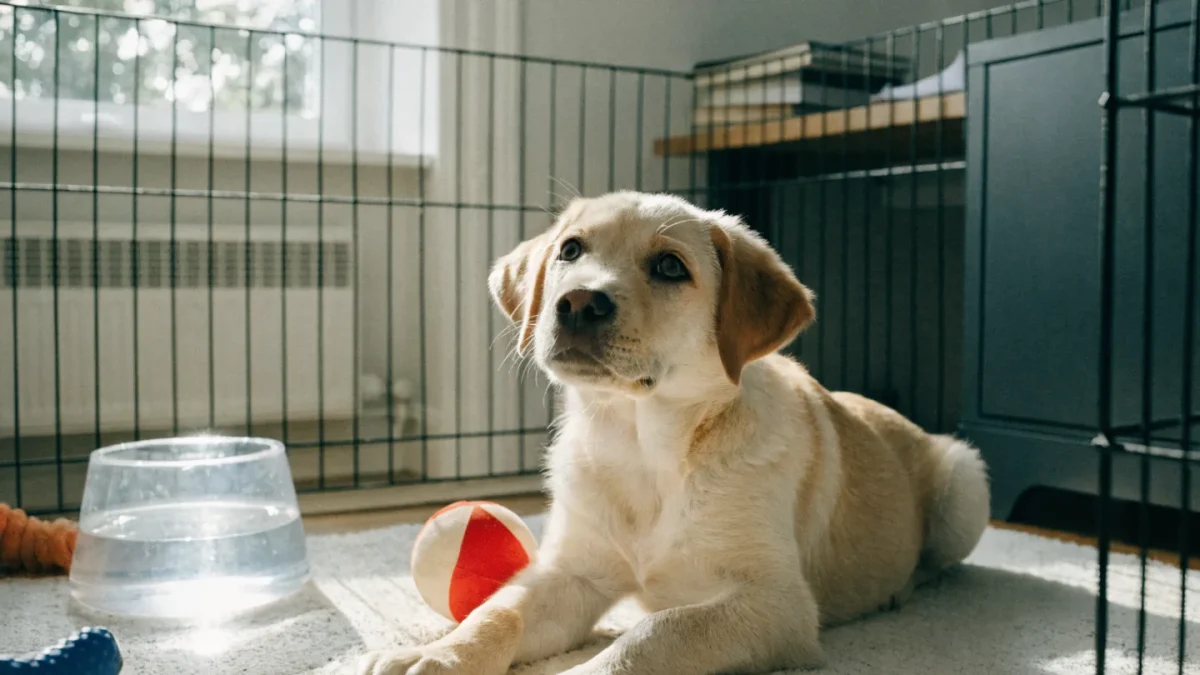
Playpen or exercise pen: A larger confined area with a crate inside, a pad option, fresh water, and appropriate toys. Works for longer periods when the puppy can't make it through without an elimination opportunity. Set up the pen so the crate is at one end and any pad is at the far end.
Rotate toys before you leave to keep them engaging. A long-lasting chew item can help your puppy settle.
Before and After Work Training
You have maybe 15-20 minutes before work and 30-40 minutes after work where your puppy can get actual training. Use them intentionally.
Before work: Quick bathroom trip, 5 minutes of training (sit, name recognition, come), back in the crate or pen.
After work: Longer training session (5-10 minutes), a walk, play time, evening routine.
The key is consistency over intensity. Five minutes of training every day outperforms an hour of training on weekends, easily.
The Weekend Recoupment Myth
A common mistake: not doing much training during the week because you're busy, then trying to make up for it with long sessions on weekends.
Puppies don't store learning from one big session. They consolidate across many sessions. A weekend training blitz followed by five days of nothing is less effective than five minutes per day, seven days a week.
Even on busy days, find two or three opportunities for ten-repetition sessions. Before work, during a lunch break if working from home, after dinner.
Managing Guilt
A lot of working puppy owners feel guilty. Their puppy needed more than they could give in a particular week. An accident happened because the midday visit was cancelled. Training slipped. (See also: house training a puppy.)
Guilt doesn't help the puppy. Consistency does.
The puppies I've seen raised by working full-time owners are not worse off than those raised by stay-at-home owners, provided the structure is in place and the care needs are being met. Millions of dogs live excellent lives with working owners. Yours will too.
This week: book a midday dog walker if you haven't, and set up your puppy's daytime space so it's appropriate for their age and bladder capacity. Those two things will make everything else easier.