

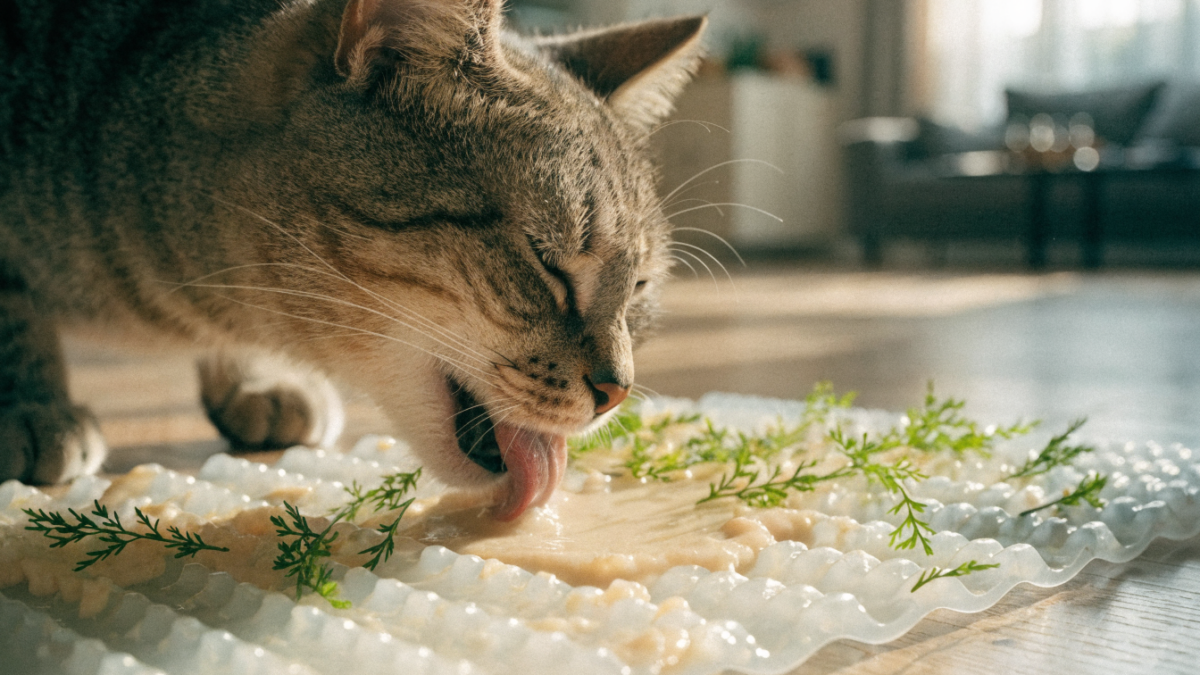
Last Tuesday, I spent twenty minutes scraping wet cat food out of the intricate grooves of a silicone mat with a toothpick. My tabby, Mochi, watched from the counter, looking thoroughly amused. A year ago, I would have told you that anyone willingly buying a textured square of rubber for their cat to drool on was out of their mind. But after discovering what happens when you combine a lick mat with a pot of fresh cat grass, I’m completely converted. It changed my chaotic apartment dynamics entirely.
For the longest time, the pet industry treated enrichment as a dog-specific concept. You give a dog a Kong, you give a dog a puzzle feeder, and you hope they don’t eat your couch. Cats, meanwhile, were handed a fake mouse on a string and expected to be thrilled. But modern,[1] emphasizes that environmental enrichment—the provision of equipment that improves an animal’s physical and psychological well-being—is absolutely vital for indoor cats. The most fascinating shift right now isn’t about physical toys, but oral enrichment. Let’s talk about why your cat’s mouth is the key to their brain, and why the combination of a simple silicone mat and a pot of sprouted grass is the ultimate feline hack.
The Surprising Science Behind the Lick
To understand why oral enrichment works, we have to look at the physiology of a cat. Licking is not just a way for cats to taste their food; it is a complex neurological event.
When a cat engages in repetitive licking, it stimulates saliva production. That saliva is packed with digestive enzymes that kickstart the digestive process before the food even hits the stomach. But the real magic happens in the brain. The physical act of repetitive licking triggers the release of endorphins—the brain’s natural calming chemicals.
Cats aren’t just eating; they are actively self-soothing through a mechanical process that evolution fine-tuned over millions of years.
This is why a cat will groom itself when it feels stressed or anxious. It’s their version of taking a deep breath. By giving them a surface that forces them to lick repeatedly to extract food, we are hijacking their biological calming mechanisms to our advantage. Increased saliva also acts as a natural defense against plaque and oral bacteria, giving their dental health a gentle, passive boost.
Why Dogs and Cats Need Different Enrichment
If you browse social media, you’ll see hundreds of videos of dogs tearing into lick mats smeared with peanut butter or wet food. Dogs are natural scavengers and hunters; they use lick mats to work for high-value treats, expending pent-up physical energy.
Cats, on the other hand, are obligate carnivores. They don’t need to scavenge a frozen block of peanut butter. In the wild, a cat hunts, catches prey, and eats mindfully and relatively slowly. For a domestic cat, a lick mat isn’t about exhausting physical energy; it’s about forcing prolonged, mindful eating. It prevents the frantic gulping that leads to vomiting (a familiar sound to any cat owner at 3:00 AM) and taps directly into that endorphin-releasing zen mode.
Lick Mats: Not Just for Dogs Anymore
Historically, lick mats were designed with dogs in mind, featuring deep, wide grooves meant to accommodate a dog’s large, relatively smooth tongue. But there has been a massive, growing trend of cat owners realizing their feline companions benefit from these mats just as much—and thankfully, product designs are finally catching up.
A cat’s tongue is a marvel of biology. It is covered in tiny, backward-facing barbs called papillae. When a cat licks a deep-grooved dog mat, they can get frustrated because their papillae get caught, or they simply can’t reach the bottom of the grooves. Newer mats designed specifically for feline anatomy feature shallower, more intricate textures perfectly suited for a cat’s smaller, barbed tongue.
The High-Stress Event Hack
My favorite use for a lick mat is distraction. Mochi hates having her nails trimmed. Jake, my partner, handles the dog training in our house, but Mochi is entirely my problem. Previously, a nail trim involved a towel, a lot of yowling, and mutual exhaustion.
Now, I smear a thin layer of a high-value, sticky wet food onto a shallow cat lick mat and stick it to the floor. While she is intensely focused on extracting every last molecule of food with her barbed tongue, I can clip her front claws in under two minutes. It works for baths, thunderstorms, and even helping them adjust to the smell of a new pet in the home. As noted by experts who champion [2] this oral fixation completely overrides their anxiety response.
The Hygiene and Safety Debate
I won’t pretend these mats are perfect. There are real debates among veterinarians regarding material safety and hygiene. The same textured grooves that provide mental stimulation can become breeding grounds for harmful bacteria if not scrubbed properly. You cannot just rinse a lick mat. You have to scrub it with hot water and soap, ideally using a stiff brush, immediately after use.
Furthermore, if your cat is an aggressive eater (or if you accidentally buy a cheaply made mat), there is a choking hazard. Some cats will try to bite the edges of the mat or chew off pieces of the silicone. You need to look for mats made of 100% food-grade, BPA-free silicone. And no matter how food-safe the silicone is, if you have a cat that likes to chew on plastic or rubber, you need to supervise them closely. I never leave a lick mat down for more than twenty minutes.
The Living Enrichment Option: The Cat Grass Connection
While a lick mat is a fantastic manufactured tool, it’s only half the equation of species-specific oral enrichment. To truly satisfy a cat’s instinctual urge to chew and graze, we need to look at living enrichment: cat grass.
There is a pervasive myth that cats eat grass because they are sick and need to vomit. While it is true that the fibrous nature of oat, rye, barley, or wheat grass acts as an emetic—helping cats safely regurgitate indigestible matter like hairballs—experts actually debate whether the primary purpose is dietary, gastrointestinal, or purely behavioral.
Cat grass provides trace vitamins, minerals, and folic acid, which is essential for cellular health. It also promotes gastrointestinal motility, acting essentially as a mild laxative that keeps their digestive tract moving smoothly. But from a behavioral perspective, chewing grass satisfies a deep, instinctual oral fixation.
Think about what a wild cat eats. When an obligate carnivore catches a mouse or a small bird, they consume the entire animal, including the stomach contents—which is usually partially digested plant matter. By offering a pot of fresh cat grass, you are allowing your indoor cat to mimic the physical act of consuming the plant matter they would naturally get in the wild.
Marrying the Manufactured and the Natural
The market for indoor, hydroponically grown cat grass kits has exploded recently, and for good reason. It allows urban cat owners to provide fresh, pesticide-free grazing opportunities year-round, completely eliminating the need for outdoor space.
I keep a low pot of wheat grass on my kitchen windowsill next to the sink. Having the living grass available satisfies Mochi’s daily urge to chew on something fibrous. When I need to actively distract her or manage her anxiety, that’s when the lick mat comes out. The two complement each other perfectly. The grass provides passive, on-demand oral enrichment, while the lick mat provides focused, anxiety-reducing enrichment.
If you want to get creative, you can even blend fresh cat grass into a puree and smear it onto a.[3] It marries the digestive benefits of the grass with the prolonged, endorphin-releasing mechanics of the lick mat. It sounds a bit ridiculous, but watching a cat methodically extract grass puree from a silicone mat is a beautiful, highly effective form of behavioral management.
Ultimately, keeping domestic cats indoors is the safest choice for them and for local wildlife, but it strips them of the daily physical and mental challenges they evolved to overcome. When we talk about animal welfare, we aren’t just talking about keeping a species alive; we are talking about behavioral conservation. Preserving a cat’s natural, instinctual behaviors—like hunting, foraging, and slow, mindful eating—in an indoor environment is the responsibility of anyone who shares their home with a feline. They might not be tearing across the savannah, but by giving them the right tools to use their mouths exactly how nature intended, we give them a much richer, far less anxious life.
Sources
- animal welfare science — pmc.ncbi.nlm.nih.gov
- lick mats for stress and boredom — samscatsanddogs.com
- specially designed enrichment mat — farmtopettreats.com