

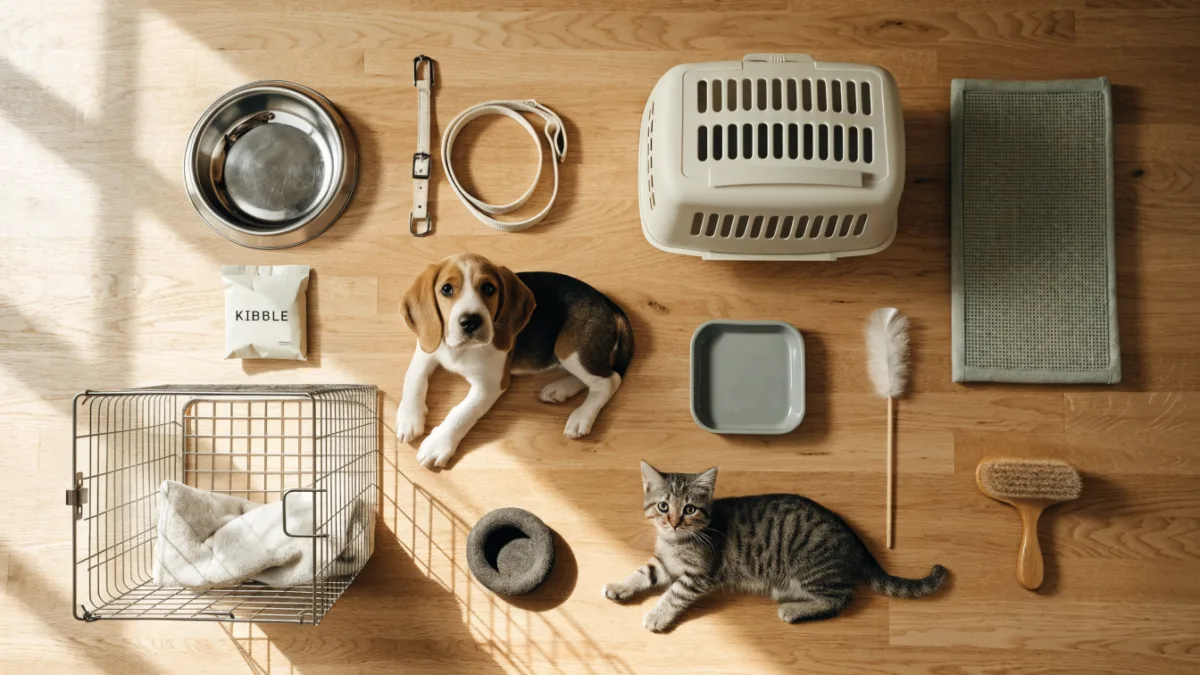
Walking into a pet store the week before your first dog or cat comes home is a special kind of ambush. There’s an entire wall of bowls, an aisle of beds, a freezer of raw food, and a display of contraptions that promise to enrich, entertain, and automate your animal’s every need. The U.S. pet industry pulled in roughly $147 billion in 2023, and a lot of that growth is powered by first-time owners buying under the influence of panic and cuteness. Expect your first year to cost somewhere around $1,300–$1,900 for a dog and about $1,200 for a cat before the extras pile up. Here’s the honest version of the checklist — what you actually need on day one, what can wait, and what’s pure marketing.
The Non-Negotiables (Both Species)
Food that’s actually food
Buy food with an AAFCO “complete and balanced” statement for your pet’s life stage — puppy, kitten, adult, all life stages. That nutritional adequacy claim is the part that means something. Words like “ancestral,” “premium,” and “human grade” are marketing, not nutrition. Then ask the shelter, rescue, or breeder exactly what the animal has been eating, buy a bag of that, and transition gradually over 7–10 days by mixing increasing amounts of the new food into the old. A sudden switch is a great way to spend week one cleaning up GI upset.
Bowls, collars, and other boring winners
Stainless steel or ceramic bowls — non-porous, dishwasher-safe, cheap. Plastic scratches, those scratches harbor bacteria, and plastic bowls are linked to feline chin acne, which is exactly as fun as it sounds. A flat collar with an ID tag comes next: snug enough that two fingers slide under but no more, with your phone number engraved. Then the ID item people skip: the microchip. A landmark JAVMA study found microchipped dogs were returned to owners 52.2% of the time versus 21.9% without one, and microchipped cats came home 38.5% of the time versus just 1.8%. That’s a twentyfold difference for cats. One catch — the chip only works if you actually register it, so do that the same day.
The stuff nobody puts on a gift registry
- Enzymatic cleaner. Regular cleaners mask odor for your nose but leave scent markers that read as “the bathroom is here” to your pet. Enzymatic formulas actually break the stuff down.
- A toothbrush and pet toothpaste. About 80% of dogs and 70% of cats show periodontal disease by age three. Look for the VOHC seal of approval, and never use human toothpaste. Starting young makes this a two-minute non-event instead of a wrestling match.
- A measuring cup. Roughly 59% of dogs and 61% of cats are overweight, and free-pouring kibble is how it happens. Keep treats under 10% of daily calories.
- A vet appointment within the first 3–7 days, even if your pet seems perfect — and a decision, made on purpose, between pet insurance and a dedicated savings account. Both work; drifting into neither doesn’t.
The New Puppy Checklist
For the full walkthrough, the [1] is the gold standard, but here’s the short version. A 4–6 foot fixed leash and flat collar — not a retractable, more on those below. A crate sized correctly: the dog should be able to stand, turn around, and lie down, and that’s it. An oversized crate defeats the purpose, and many crates come with dividers so the crate grows with the puppy. This matters more than people think — puppies need 18 to 20 hours of sleep a day, so a crate is a rest space and a welfare need, not a luxury. How you introduce it is a conversation for your vet or a trainer, and worth having before day one.
Add puppy-proofing supplies: baby gates, cord protectors, a secure trash solution, and bitter-apple deterrent spray for whatever the cord protectors miss. Then enrichment — appropriate chews for teething, a puzzle feeder, and poop bags in bulk. And clock this: the puppy socialization window closes somewhere around 14 to 16 weeks, so gentle, positive exposure to the world is time-sensitive, not optional. Ask your vet how to socialize safely before vaccinations are complete.
3 days to decompress. 3 weeks to learn your routine. 3 months to feel truly at home. The [2] that shelter folks swear by is the single best expectation-setter a first-time owner can memorize.
New Kitten Supplies: A First-Time Cat Owner Guide
Cats have opinions, and your job is to buy for the cat you have, not the cat in the advertisement. The essentials, in rough order of importance:
- A hard-sided carrier, ideally top-loading. Top-loaders let a vet reach in gently instead of performing an extraction. Leave the carrier out as permanent furniture — cats who only see it before vet trips learn what it means immediately.
- Litter boxes done right. General rule: one per cat, plus one. Bigger is better. Kittens need low sides they can climb over, and very young kittens should get non-clumping litter since they may ingest it; everyone else does well with unscented clumping. Start with whatever the shelter used and change gradually.
- A tall, sturdy scratcher — at least 28 to 32 inches so an adult cat can get a full-body stretch, in sisal or cardboard. Wobbly scratchers get ignored. And never declaw: it’s amputation of the toe at the first joint, it’s banned in New York and Maryland, and a good scratcher makes the whole question moot.
- Vertical space and a hideaway. A cat tree or shelf, plus somewhere to disappear. Set up one quiet “safe room” before arrival and let the cat decompress there.
- Wand toys. The interaction is the point — a basket of ignored stuffed mice is one of the most common new-owner purchases on Earth.
Two things that matter more than any product: first, get the litter setup right from day one, because litter box avoidance is a leading reason cats are surrendered to shelters, and a good setup is the cheapest insurance you’ll ever buy. Second, no lilies in the house, ever — even trace pollen or vase water can be lethal to cats, and exposure is a same-day emergency.
Skip, Save, or Wait: The Gimmick Filter
Skip: Retractable leashes (rope burns, dropped handles that turn into chase-me games, and they actively teach pulling). Elevated feeders, which are marketed to prevent bloat in large breeds even though a Purdue study associated raised bowls with increased bloat risk — the opposite of the claim. Grain-free diets as a default: the FDA investigated a possible link between some grain-free diets and heart disease in dogs, found no proven cause, and veterinary cardiologists still urge caution — so pick an AAFCO-complete diet and run it past your vet instead of the internet. Raw diets, which the CDC, FDA, and AVMA all warn against — the December 2024 recall of contaminated raw food linked to H5N1 cat deaths made that warning very concrete. Supplements for a healthy animal on a complete diet, which are mostly an upsell. And those pre-stuffed “starter kit” bins, which are usually 30% useful and 70% landfill.
Wait: Automatic litter boxes (expensive, some cats boycott them, and sensor safety is a real question with kittens), pet cameras, and the entire wardrobe. I bought Benny two dog beds before he came home; he slept on the doormat for three weeks while both sat untouched like furniture I’d bought for a dog who didn’t exist yet. Even “whisker fatigue” — the claim that deep bowls stress cats’ whiskers — has thinner evidence than the internet suggests, though a wide, shallow bowl costs nothing, so it’s a harmless hedge if you want it. The pattern is simple: the animal arrives with opinions you can’t shop for in advance, so leave room to learn who you actually live with. A [3] can fill gaps later; it can’t predict your pet’s taste in beds.
Here’s the takeaway I’d tattoo on the receipt: around 6.5 million animals enter U.S. shelters every year, and many of them arrive already vaccinated, spayed or neutered, and microchipped — better equipped, frankly, than most starter kits. Your new dog or cat needs a bowl, the right food, solid ID, a vet appointment, a safe place to sleep, and a patient human who understands the 3-3-3 rule. Everything else is a decision you get to make together, after you’ve actually met. The $147 billion industry will still be there next month. The animal on your couch is the only part of this that was ever the point.
Sources
- AAHA's new dog checklist — aaha.org
- 3-3-3 rule — facebook.com
- comprehensive checklist — coastalpet.com