

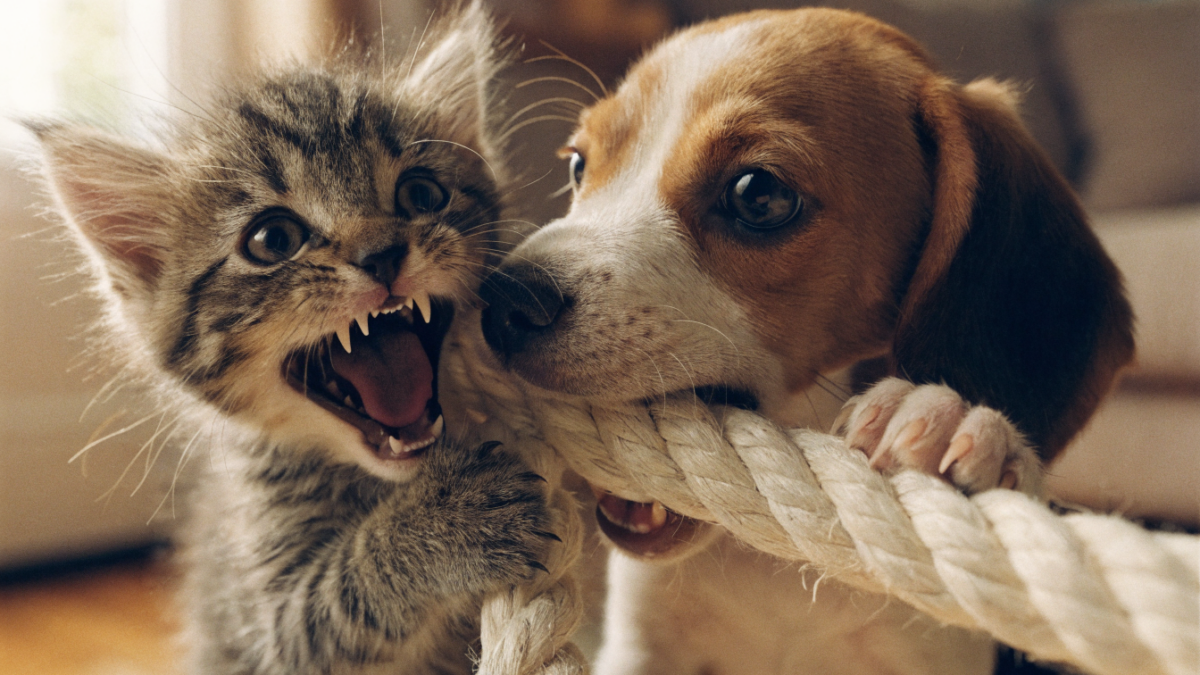
You bring home an eight-week-old fluffball. For the first 48 hours, you are living in a Disney movie. Then day three hits. Suddenly, your hands look like you tried to win a knife fight with a cactus. Whether you are dealing with a bouncing puppy or a tiny feline terror, the biting phase is brutal. I’ve seen owners in my living room holding up bleeding hands, looking utterly defeated, wondering if they accidentally adopted a land shark instead of a family pet.
Take a deep breath. Those needle teeth and razor claws are entirely normal. Your pet isn’t broken, and you aren’t doing everything wrong. Surviving this phase requires understanding exactly why your pet is attacking your extremities, what they are trying to tell you, and how to calmly turn off the faucet of blood and frustration.
The Biology of “Needle Teeth” and “Razor Claws”
To survive the biting phase, you first have to stop taking it personally. Your puppy or kitten isn’t plotting against you. They are simply dealing with the reality of their own anatomy.
When a puppy arrives in your home, typically between eight and twelve weeks old, they come packing a full set of 28 razor-sharp baby teeth. There is a biological reason these teeth are shaped like needles. Puppies have incredibly weak jaw muscles. If they had blunt adult teeth right out of the gate, they wouldn’t be able to chew effectively or process solid food. The extreme sharpness of their baby teeth acts as a compensatory mechanism, allowing them to slice through meat and kibble while their jaw muscles are still developing.
The Feline Double Threat
Puppies have the teeth, but kittens have the full arsenal. A kitten comes equipped with both needle teeth and razor claws. It is incredibly common for new cat owners to jokingly refer to their sweet little angel as an “evil young kitty” when those weapons sink into an arm or an ankle. When a kitten latches onto your wrist and starts kicking with their hind legs, it feels like you’ve been shoved into a tiny paper shredder. Just like with puppies, kittens have these weapons for biological reasons. In the wild, cats need sharp tools to grapple with prey and defend themselves. In your living room, you are the prey.
It Is Not Aggression—It Is Conversation
I used to panic when a puppy would nip at my hands. I thought I was raising an aggressive dog. I was wrong. Biting, mouthing, and scratching are natural forms of communication for young animals.
Animals don’t have hands to pick things up and examine them. They use their mouths. Puppies and kittens use their teeth to explore their environment. If a tissue falls on the floor, they bite it. If your shoelace dangles, they bite it. If your hand moves quickly, they bite it. They are simply investigating the texture and movement of their world.
More importantly, they use biting to initiate play and get results. If you’ve ever watched a litter of puppies or kittens interact, it looks like a violent free-for-all. They tackle, bite, scratch, and body-slam each other. When your puppy nips your elbow, they are saying, “Let’s wrestle!” When your kitten attacks your ankle as you walk by, they are saying, “Chase me!”
Your pet nips you, you react by pulling away or scolding them, and boom—they got your attention. Even negative attention is still attention.
They quickly learn that biting gets a specific result. It gets you to look at them, talk to them, and move around. To a bored puppy or kitten, being yelled at is still more fun than being ignored.
The “Yelp and Ignore” Method (And When to Tweak It)
The gold standard for stopping puppy biting has always been the “yelp and ignore” method. It is heavily recommended by behaviorists and organizations like the ASPCA. The concept is brilliant in its simplicity. The very second your puppy’s teeth touch human skin, you let out a high-pitched yelp—mimicking the sound a littermate would make if bitten too hard. You immediately stand up, turn your back, and walk away. You ignore the puppy for 30 to 60 seconds.
This method teaches a clear boundary: biting ends the fun. When they play nice, you stay. When they bite, you vanish.
The Flaw in the Yelp
I used to tell every single client to yelp when their puppy bit them. Most of the time, it worked beautifully. The puppy would get startled, lick the hand, and soften their mouth. But then I noticed a pattern with certain breeds—mostly high-drive working dogs and terriers. For these dogs, the high-pitched yelp didn’t act as a punishment. It acted as a hype video.
I worked with a ten-week-old Australian Cattle Dog mix named Ranger. Every time his owner yelped, Ranger’s eyes would light up. He thought the yelp was the sound of a dying squeaky toy. He would bite down twice as hard, completely overstimulated by the noise.
If you try the yelp method and your puppy looks at you like you just rang a dinner bell, stop yelping. For these specific pets, a calm, quiet withdrawal of attention is much more effective. Don’t say a word. Don’t make a sound. Just stand up, turn your back, and leave the room for a minute. The sudden, silent absence of their favorite person is a massive buzzkill and teaches the same lesson without overstimulating their nervous system.
Management Over Punishment
When your hands are bleeding, it is incredibly tempting to scold your pet, grab their snout, or push them away. Don’t do it.
Punishment doesn’t teach a young animal what to do instead. If you shove a puppy away, they usually think you are playing a physical game and will come back biting harder. Scolding a kitten just teaches them that you are unpredictable and scary, which damages the trust you are trying to build.
Instead of relying on punishment, rely on environmental management. You have to set your pet up to win. Here is what that looks like in practice:
- Always have a toy within reach: When your puppy or kitten tries to engage you with their mouth, smoothly redirect them to an appropriate chew or kicker toy. You want to teach them that human skin is boring, but their toys are incredibly rewarding.
- Look for the right equipment: Skip the expensive, gimmicky toys. Look for durable rubber chew toys that can be stuffed with wet food and frozen. For kittens, look for long, braided fabric toys that let them bite and bunny-kick without making contact with your hands. Always ensure the materials are non-toxic and the size is appropriate so they can’t swallow them.
- Enforce nap time: This is the big one. When a puppy or kitten gets overly tired, they lose all impulse control. I cannot count the number of “aggressive” land sharks that simply turned into sleeping angels after 20 minutes in a cozy enclosure. If your pet is biting frantically and ignoring redirection, they are probably exhausted. Put them down for a nap.
Surviving the Timeline
You need to know that there is an end date to this madness. Most puppies will naturally begin to grow out of the biting and mouthing habit when they are between three and five months old. As their adult teeth come in and their jaw muscles strengthen, the urge to chew on everything shifts.
The ASPCA notes that while the phase is painful and frustrating, it is a standard developmental stage. Even if your specific pet doesn’t grow out of it completely on their own, they can absolutely be trained to stop using the redirection and withdrawal methods we just covered. The key is absolute consistency. If you let them chew on your sleeve during a Netflix binge, but yell at them for chewing on your hand during a dinner party, they will never learn the rules. Skin is never allowed. No exceptions.
Keep your sense of humor. Wear thick socks. Invest in some good chew toys. This phase is intense, but it is temporary. By understanding the biology behind those needle teeth and communicating in a way they actually understand, you’ll build a foundation of trust that lasts long after their baby teeth are gone. And ultimately, understanding the natural behaviors of the animals we bring into our homes—whether they are domesticated companions or the wild neighbors sharing our planet—is the first step toward a more compassionate world.