

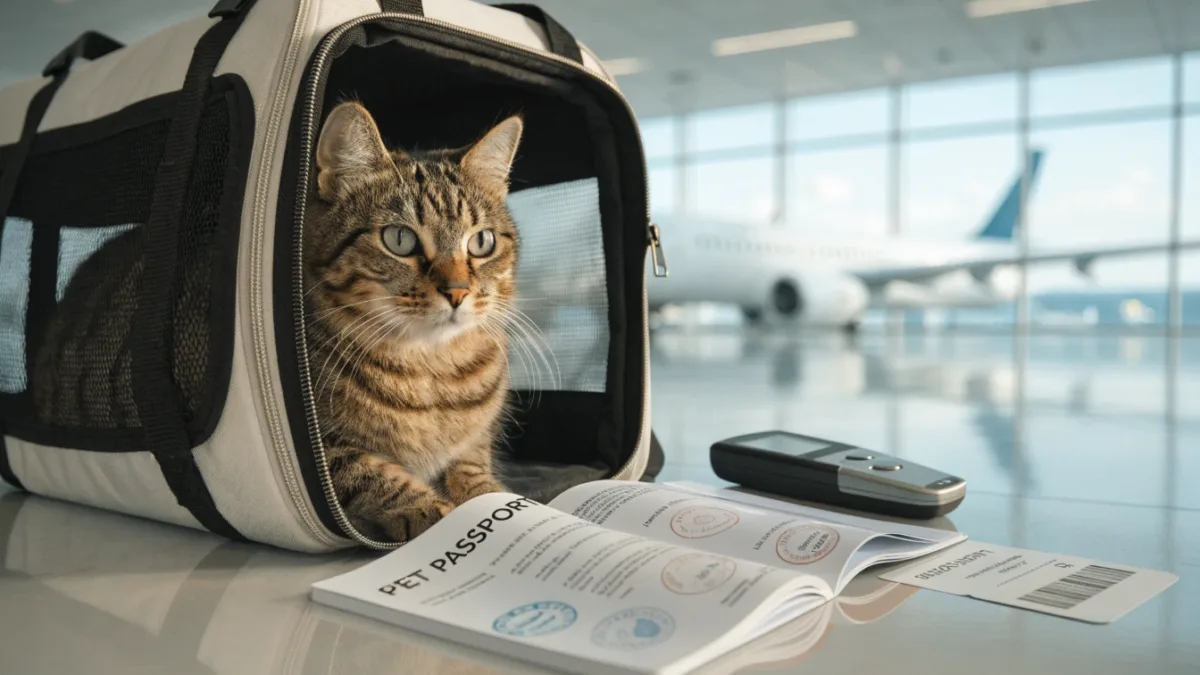
We’ve all seen those romanticized videos of someone moving to a villa in southern France with their perfectly coiffed Golden Retriever in the passenger seat, or a cat lounging in a sunny apartment in Tokyo. What those videos completely leave out is the absolute mountain of red tape, the panic-inducing vet appointments, and the labyrinth of government websites you have to navigate to get that animal across an international border.
When my partner and I moved abroad with our cat, Mochi, I naively thought a quick visit to our local vet and a standard vaccine record would be enough to get us on the plane. I was spectacularly wrong. International pet travel isn’t a weekend errand; it’s a multi-month logistical project. Whether you’re an expat taking a new job, a military family receiving PCS orders, or just someone planning a very long-term trip, getting your pet from Point A to Point B safely and legally requires extreme attention to detail.
The Microchip Paradox: Why Sequence is Everything
If you take away only one thing from this entire article, let it be this: the order in which you do your paperwork matters. You cannot just show up with a standard vaccine card and expect to board an international flight. Most countries—especially those in the European Union and the UK—have incredibly strict entry protocols to prevent the spread of diseases like rabies.
First, your pet needs an ISO-compliant microchip. The International Organization for Standardization sets the standard for these tiny transmitters, ensuring that any customs scanner anywhere in the world can read your pet’s identification. If your pet has an older, non-ISO chip, you might have to bring your own scanner, or worse, get them chipped again.
The absolute most critical detail in this entire process is that the microchip must be implanted before the rabies vaccination is administered. If your pet gets their rabies shot before the microchip goes in, the destination country will consider the vaccination invalid for travel. You will have to start the clock all over again.
Once that microchip is in place, the rabies timer starts. Most countries require the vaccine to be administered at least 21 to 30 days prior to arrival. But if you’re heading to an island nation with strict quarantine laws—like Japan, the UK, Australia, or Hawaii—you’re looking at a waiting period of up to six months, often requiring a blood titer test to prove the rabies antibodies are actually in your pet’s system. Miss this window, and your pet will be spending weeks in a government quarantine facility. Nobody wants that.
Decoding “Pet Passport Requirements”
Unlike human passports, which are universally recognized little blue (or red, or green) books, pet passports are a patchwork of regional documents. If you live in the US, you might be looking for an official “pet passport,” but technically, no such universal document exists for American pets. Instead, you are looking at securing an international health certificate.
To meet standard pet passport requirements from the US, the timeline looks a lot like this:
- Research: Check the exact rules for your destination country via official government resources.
- The Vet Visit: Take your pet to a USDA-accredited veterinarian. This vet will verify the microchip, administer any missing vaccines, and issue an international health certificate.
- The Government Stamp: You cannot just take your vet’s word for it. That health certificate must be mailed or hand-delivered to your local USDA APHIS (Animal and Plant Health Inspection Service) office for official endorsement.
Timing is tight here. In the US, these health certificates are generally only valid for 10 days from the date of issuance to the date of travel. You are essentially racing against the clock to get the vet appointment, get the USDA endorsement, and get to the airport.
The Brexit Complication
If you are moving to or from Europe, keep in mind that Brexit completely rewrote the rulebook. Great Britain is now a “Part 2 listed third country.” This means that if you previously had an EU pet passport issued in Great Britain, it is no longer valid for travel into the EU. You now need to obtain a new Animal Health Certificate (AHC) for every single trip you take from the UK to the EU. For frequent travelers, this is an expensive and frustrating headache.
Going Digital
Thankfully, the days of lugging around overstuffed manila folders of origami-folded vet records are slowly ending. The USDA has been transitioning to a digital system—the Veterinary Export Health Certification System (VEHCS)—to streamline endorsements. There are also excellent digital management tools out there, like PadsPass, specifically designed to help expat and military families track varying vaccination deadlines, calculate quarantine windows, and store digital copies of essential documents so you don’t end up crying in an airport terminal because you lost a specific rabies titer certificate.
Flying with a Cat: Cabin vs. Cargo Realities
Once the paperwork is sorted, you have to actually get the animal on the plane. Airline policies vary wildly, but there are three primary ways pets fly: in-cabin (usually small dogs and cats under the seat in front of you), as checked baggage (in a climate-controlled, pressurized section of the cargo hold), or as manifest cargo (typically for larger animals or unaccompanied pets).
If you are flying with a cat, the in-cabin route is almost always the goal. Airlines strictly limit the number of pets allowed in the cabin per flight—usually around two to four—so you absolutely must call the airline to secure a spot before you book your own ticket. Your cat’s soft-sided carrier needs to fit under the seat and be large enough for them to stand up and turn around in.
One piece of advice I cannot stress enough: do not sedate your cat for the flight. It is widely discouraged by both airlines and veterinarians. Sedatives compromise a pet’s ability to regulate their body temperature and breathing at altitude, which can be fatal. Instead, talk to your vet about pheromone sprays or natural calming aids that won’t suppress their respiratory system.
The Great Cargo Debate
If your dog is too large for the cabin, cargo is often the only option, and it is heavily debated. Viral horror stories of pets lost or injured during international transfers have led many major airlines to completely pause or overhaul their pet cargo transport programs. Advocacy groups argue that cargo is highly stressful and risky, pointing to tragic incidents of heatstroke or hypothermia.
However, airlines maintain that modern cargo holds for live animals are pressurized, climate-controlled, and largely safe. The reality is somewhere in the middle. If your pet absolutely must fly cargo, you have to do your homework. Look for airlines with specialized live animal programs. Avoid flying during the peak of summer or dead of winter, and opt for direct flights whenever humanly possible to eliminate the risk of your pet sitting on a sweltering tarmac during a layover.
Breed Bans and the ESA Loophole
Even if you have the perfect carrier, your pet might be banned from the flight entirely. Many countries and airlines enforce Breed-Specific Legislation (BSL). Dogs deemed “aggressive”—often Pit Bull types, Rottweilers, or Dobermans—are outright banned from entering certain countries.
Similarly, brachycephalic (flat-faced) breeds like Pugs, Bulldogs, Boxers, and even Persian cats are frequently banned from flying in cargo. Their compressed airways make it incredibly difficult for them to breathe, especially under the stress of altitude and temperature changes. It feels discriminatory, especially if you have a perfectly healthy brachycephalic cat, but the rule is medically grounded and strictly enforced.
And for those wondering—no, you cannot slap a vest on your pet and call them an Emotional Support Animal to bypass the rules. Following a massive surge in passengers trying to bring peacocks, pigs, and squirrels onto planes, the US Department of Transportation cracked down in 2020. Pets are now universally treated strictly as carry-on baggage, subject to standard fees and carrier restrictions.
Why We Jump Through the Hoops
Navigating the labyrinth of international pet travel is exhausting, expensive, and occasionally maddening. There were days during my own moving process where I stared at so many government PDFs that the words stopped making sense. But we do it because they are family. We jump through these bureaucratic hoops to keep our companions by our sides.
But there is a bigger picture here, too. These strict, frustrating quarantine laws and [1] exist for a critical reason: biosecurity. When we move animals across the globe, we have the potential to introduce non-native diseases, parasites, and invasive species into vulnerable ecosystems. A single missed rabies vaccination could spell ecological disaster for an island nation that has spent millions of dollars eradicating the disease. By following the rules—microchipping, testing, and waiting—we aren’t just proving our pets are healthy; we are acting as responsible stewards of the global environment, protecting both native wildlife and the domestic animals that already call our destination home.
Sources
- documentation requirements — state.gov