

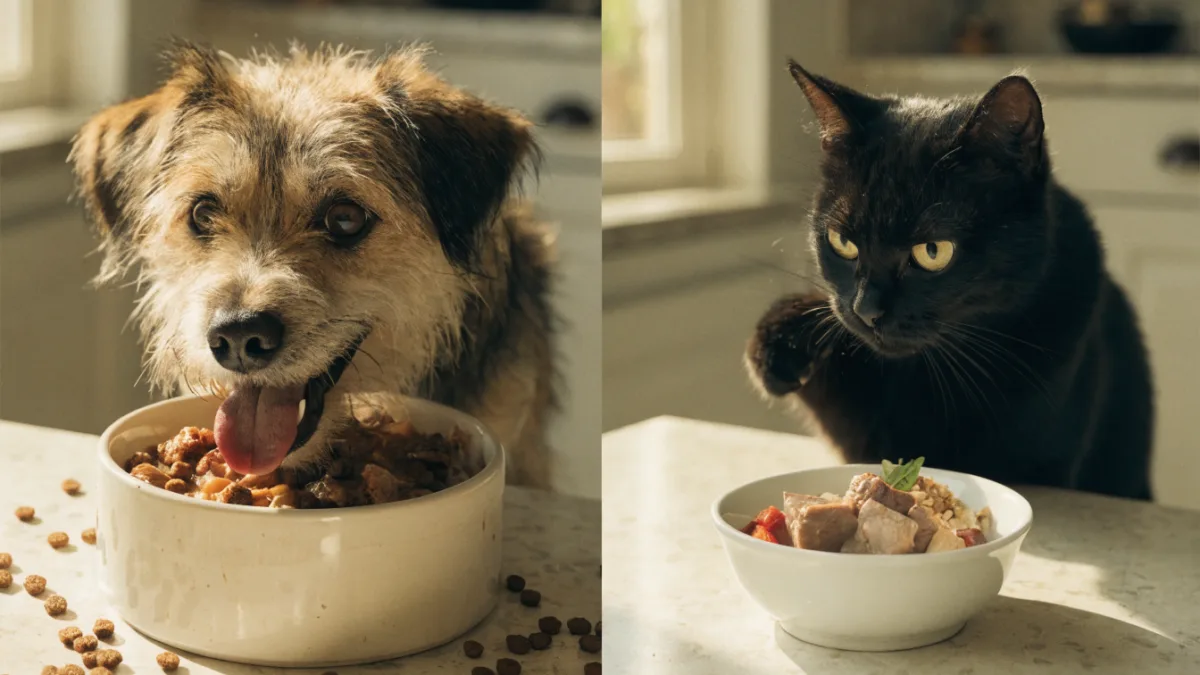
Let me ask you a candid question: have you ever popped a piece of your dog or cat’s kibble into your mouth just to see what it tastes like? If you just nodded, you’re in very good company. A recent poll of 2,004 cat and dog owners revealed that nearly 4 in 10 pet parents admit to taste-testing their pet’s food themselves. It’s a humorous habit, but it highlights a fascinating misunderstanding we have about our pets. We tend to assume that because they eagerly eat things we wouldn’t touch, their sense of taste is entirely different from ours—and sometimes, that they have no standards at all. But the science of animal taste buds reveals a much more incredible story, explaining exactly why your dog acts like a living garbage disposal while your cat behaves like a Michelin-star food critic.
The Canine Scavenger: It’s All in the Nose
Dogs will eat almost anything. I once treated a Labrador named Buster who had enthusiastically consumed an entire garden hose, a tube of diaper rash cream, and three pounds of leftover holiday turkey in one weekend. His owner stood in my exam room, completely bewildered, asking, “He’s so picky about his dog food, but he eats garbage. Why?”
The answer lies in Buster’s evolutionary history. Domestic dogs are scavengers by nature. In the wild, a wolf or a feral dog cannot afford to be a picky eater. If food is available, they eat it, because they never know when their next meal is coming. To survive on varied, sometimes decaying omnivorous diets, dogs developed a highly resilient digestive system and a specific set of taste receptors geared toward identifying meats, fats, and crucially, water. Yes, dogs have special taste buds specifically tuned to detect water, a vital adaptation for a scavenging carnivore that needs to stay hydrated while surviving on less-than-ideal moisture sources.
But when Buster turns his nose up at a perfectly good bag of premium kibble, he isn’t being stubborn. He’s relying on a sense that vastly overpowers his taste buds: his sense of smell. While humans have about 6 million olfactory receptors, dogs have up to 300 million. A,[1] successfully used a modified “2-bowl test” and an “olfactometer”—a device designed to precisely measure how animals respond to specific odors—to prove that a dog’s food preference is overwhelmingly driven by aroma long before the food ever touches their tongue. If it doesn’t smell right, they won’t taste it.
The Feline Food Critic: Built for Meat
Cats, on the other hand, are an entirely different story. I often see feline patients like Luna, an 8-year-old Siamese mix who outright refuses to eat the same flavor of wet food two days in a row, and who will stage a literal hunger strike if her owner tries to switch brands. Her owner frequently jokes that Luna is a demanding aristocrat trapped in a fur coat.
While Luna’s behavior seems dramatic, it is rooted deeply in her genetics and her biological classification. Cats are obligate carnivores, meaning their bodies strictly require meat-based proteins and specific amino acids—like taurine—to survive. Unlike dogs or humans, cats cannot synthesize these essential nutrients from plant matter. Their “finickiness” is actually a highly sophisticated evolutionary survival mechanism. Their taste buds are hardwired to seek out the precise nutritional profile of fresh prey and to reject anything that doesn’t meet their strict biological requirements.
Here is the most fascinating genetic quirk of the feline tongue: cats literally cannot taste sweetness. They lack the genetic ability to process sweet flavors. While humans and dogs have functioning Tas1r2 and Tas1r3 genes that combine to create sweet receptors, cats have a mutation that breaks the Tas1r2 gene. If your cat begs for a piece of your cake or ice cream, they aren’t craving the sugar; they are drawn to the animal fat content. As [2] cats are instead highly sensitive to umami—the rich, savory flavor profile found in meats and broths.
The Danger of the “Garbage Disposal” Myth
Because dogs like Buster will happily inhale a dropped pizza slice or lick the grease out of a roasting pan, we often fall into the trap of thinking their stomachs are made of iron. This is a dangerous medical assumption. I have changed my mind on this over my years in practice. Early in my career, I used to shrug off the occasional plate of table scraps as harmless bonding. But after seeing dozens of dogs come into the clinic doubled over in severe abdominal pain, I now firmly redirect owners away from the table.
Even though a dog will eagerly consume heavily seasoned or high-fat human leftovers, their digestive systems are absolutely not equipped to process them. Feeding a dog a rich, fatty meal can trigger a painful and potentially life-threatening condition called pancreatitis, which is the inflammation of the pancreas. It can also cause severe gastroenteritis and colitis, leaving both the pet and the owner dealing with miserable, sleepless nights.
Their eager “garbage disposal” mentality is behavioral, a holdover from their scavenging ancestors. Their internal anatomy, however, is still very much that of a domesticated dog that needs a balanced, easily digestible diet. Always consult with your veterinarian before making major changes to your pet’s diet or offering them home-cooked meals.
The Table Scraps Debate
There is a healthy, ongoing debate in the pet community right now regarding the safety of “human food.” Traditional veterinary advice strongly warns against table scraps due to the medical risks I just mentioned. However, a growing movement of modern raw-feeders and home-cookers argue that fresh, properly prepared, human-grade meats and vegetables are vastly superior to highly processed commercial kibble. The truth is, both sides have a point. If you want to cook for your pet, that can be a wonderful, enriching choice—but it requires strict adherence to veterinary-approved recipes to ensure nutritional completeness. Dumping the leftover holiday ham into their bowl is where the danger lies.
The “Human Guinea Pig” Trend
So, what about those 4 in 10 humans who taste their pet’s food? If you’ve ever tried it, you know it tastes incredibly bland, slightly metallic, and wholly unappetizing.
This makes perfect sense when you look at the differences in our taste bud density. Humans have roughly 9,000 taste buds, while dogs have only about 1,700, and cats have fewer than 500. Furthermore, commercial pet foods are formulated to vastly different sodium and seasoning standards than human food. Our high-sodium, heavily spiced human palates are completely overwhelmed by the subtle, meat-forward, and low-sodium profile of pet food. To us, it tastes like cardboard. To a dog or cat, the specific aroma and fat content trigger a sensory experience we simply cannot comprehend.
Taste perception varies wildly across the animal kingdom, and we aren’t the gold standard. For example, studies on rodents like mice and rats suggest that pure water actually activates “sour” taste receptors in their brains, fundamentally altering how they perceive hydration compared to humans. Every species experiences the world of flavor completely differently.
Engineering the Perfect Bite
Our growing understanding of how pets perceive flavor has completely revolutionized the pet food industry. The development of modified, low-stress cognitive tests—like the 2-bowl preference test and olfactometry used in the 2017 pilot study—represents a massive shift in how diets are formulated. Rather than just guessing what pets might like based on human assumptions, manufacturers are now using scientific, minimally invasive methods to map out exactly which odors and flavors trigger the strongest positive responses in animals’ brains.
This means that the kibble you pour into your dog’s bowl is the result of meticulous behavioral science, carefully engineered to trigger their specific savory and fat receptors, while your cat’s food is perfectly tuned to hit their unique umami cravings.
While domestic dogs and cats aren’t exactly facing conservation threats—spending their days safely on our couches rather than navigating the wild—their taste buds are a beautiful, living record of their wild ancestry. Every time your dog inhales a meal with joyful abandon, you are witnessing the survival instincts of an ancient scavenger. And every time your cat snubs a less-than-fresh piece of food, you are watching the exacting standards of a solitary hunter ensuring they get the pure meat their body demands. By respecting their unique palates and feeding them according to their biology, rather than our own human expectations, we give them the healthiest, happiest lives possible.
Sources
- 2017 pilot study led by researcher NJ Hall — pmc.ncbi.nlm.nih.gov
- National Geographic points out — nationalgeographic.com