

It was 2:00 AM on a Tuesday when the phone rang. On the other end of the line was a panicked voice I recognized immediately—it belonged to Mark, a dedicated runner and the owner of Barnaby, a sleek, five-year-old Weimaraner. “He’s pacing, he won’t sit down, and his belly looks like a drum,” Mark blurted out. “He’s trying to throw up but nothing is coming up.” I told him to drop everything and race to the emergency clinic.
Barnaby was experiencing classic symptoms of gastric dilatation-volvulus, commonly known as bloat. It’s a condition where the stomach fills with gas and, in the worst-case scenario, twists on itself like a wrung-out towel. It is fast, excruciating, and frequently referred to as a silent killer.
Contrast that with a typical Tuesday afternoon appointment I had earlier that same week. A wonderfully chill orange tabby named Clementine came in because her owner, Sarah, was worried about her persistent, slightly offensive flatulence. Clementine was eating normally, her belly was soft and painless, and she was using her litter box without issue. She just had some mild, noisy gas.
Both of these scenarios involve a digestive system full of air, but they exist on completely different ends of the veterinary spectrum. Understanding the difference between a life-threatening emergency in a deep-chested dog and mild, harmless gas in a cat is essential knowledge for any pet parent.
The Anatomy of a Disaster: Canine Bloat and GDV
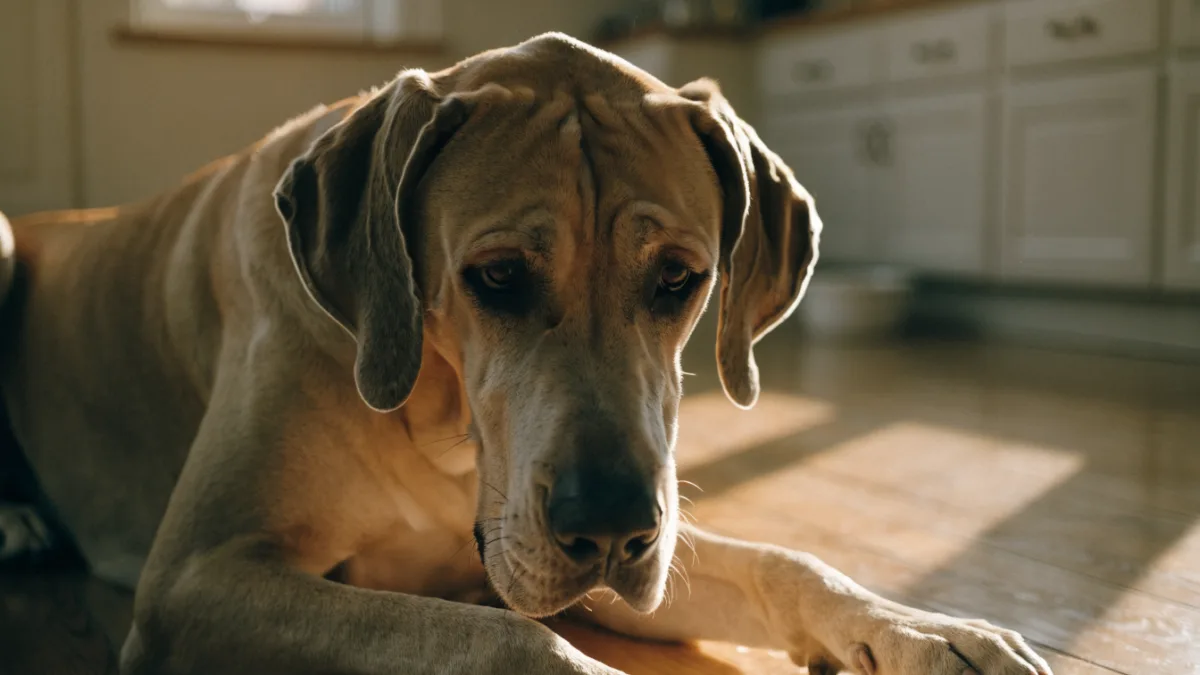
To understand why bloat is so dangerous, you have to picture the anatomy of certain dogs. When we talk about “deep-chested” breeds—like Great Danes, German Shepherds, Weimaraners, Irish Setters, and Standard Poodles—we mean dogs whose chests are narrow from side to side but very deep from back to front. Because of this specific shape, their stomachs have a lot of vertical room to swing.
[1] begins simply enough: the stomach fills with food, liquid, or gas, causing it to expand like a balloon. This is uncomfortable, but not immediately fatal. The true disaster occurs if that heavy, bloated stomach drops and rotates on its axis. This is a gastric dilatation-volvulus, or GDV. When the stomach twists, it seals off both the entrance and the exit. Gas continues to build with nowhere to go. Even worse, the twist cuts off blood flow to the stomach tissue and the spleen, and stops blood from returning to the heart. Without immediate surgical intervention, a dog can go into shock and pass away within hours.
The warning signs are exactly what Mark described with Barnaby. The dog will often appear restless, pace anxiously, and drool excessively. They will make unproductive attempts to vomit—retching without bringing anything up. If you look at their abdomen, it might appear visibly swollen, and if you tap it, it can sound tight and hollow like a ripe watermelon.
The Elevated Bowl Myth
For years, the standard advice in the veterinary community was to feed large breed dogs from elevated food bowls to prevent bloat. I’ll admit, I used to echo this advice. However, research has evolved, and I’ve completely changed my mind on this. Modern veterinary studies suggest that elevated bowls actually increase the risk of a dog developing GDV. By elevating the food, dogs tend to eat faster and swallow more air. Unless a dog has a specific orthopedic issue—like severe arthritis in their neck or elbows that makes bending down painful—I now advise all my clients to feed their dogs from bowls resting flat on the floor.
Mitigating the Risk: Diet, Bowls, and Behavior
While we cannot completely eliminate the risk of bloat in susceptible dogs, we can drastically reduce the chances of it happening through daily management. [2] are working hard to spread awareness because prevention is truly the best medicine.
Here is what I recommend for deep-chested breeds:
- Feed smaller, frequent meals: Feeding one massive meal once a day forces the stomach to stretch to its absolute limits. Instead, divide the daily food allowance into two or three smaller meals.
- Slow down the speed-eaters: Some dogs eat like they haven’t had a meal in years. Gobbling food traps air in the stomach. Look for puzzle bowls or slow-feeder mats with complex ridges and mazes that force the dog to physically slow down and work for their kibble.
- Mandate a rest period: A dog should never engage in vigorous exercise immediately before or after eating. When the stomach is full and heavy, running and jumping make it much easier for it to swing and flip. Enforce a strict one-hour rest rule before and after meals.
- Create a calm dining environment: Stress and anxiety increase the likelihood of swallowing air. Feed your dog in a quiet, low-traffic area away from other competing pets to promote calm digestion.
The Ultimate Preventative: Prophylactic Gastropexy
If you have a high-risk breed, the most effective thing you can do is talk to your vet about a prophylactic gastropexy. This is a surgical procedure where the veterinarian permanently tacks the right side of the stomach to the inner abdominal wall.
I frequently recommend this procedure be performed when a dog is already under anesthesia for their spay or neuter. A gastropexy does not stop the stomach from filling with gas—your dog might still experience the discomfort of a mild bloating episode—but it physically prevents the stomach from twisting. By preventing the deadly GDV, you are essentially saving your dog’s life in advance. I performed this procedure on Barnaby a few years ago, which is why when he bloated that Tuesday night, we were able to stabilize him with a simple stomach tube rather than emergency, middle-of-the-night surgery.
The Other End of the Spectrum: Mild Gas in Cats
Now, let’s return to Clementine the orange tabby. While a dog’s swollen belly warrants a midnight sprint to the ER, a gassy cat is an entirely different clinical picture. Feline digestion is uniquely adapted for processing high-protein diets, and occasionally, things get a little bubbly.
Mild gas in cats is incredibly common and rarely dangerous. If your cat’s stomach makes loud, rumbling noises—a medical term we call borborygmi—or if they occasionally clear a room with their flatulence, it usually points to a few benign causes:
- Dietary changes: Cats have notoriously sensitive stomachs. Switching from one type of food to another too quickly can disrupt the natural balance of good bacteria in their gut, leading to temporary gas.
- Food intolerances: Just like humans, some cats lack the enzymes needed to break down certain carbohydrates or fillers found in lower-quality commercial diets.
- Hairballs: As cats groom, they swallow hair. This hair passes through the digestive tract and can temporarily slow down digestion, causing food to ferment and produce gas.
- Eating too fast: While cats don’t get GDVs, they can still be greedy eaters. Swallowing air alongside their kibble will inevitably lead to a little flatulence.
Unless a cat’s gas is accompanied by explosive diarrhea, persistent vomiting, lethargy, or a painful, tense abdomen that makes them cry out when touched, you usually do not need to panic. For mild cases, switching to a highly digestible diet or using a slow-feeder bowl designed for felines often resolves the issue within a few weeks. Always consult your own veterinarian before introducing any new supplements or over-the-counter gut-health products, as feline metabolisms process ingredients very differently than we do.
Knowing the Difference
Listening to an owner describe their pet’s symptoms is the most important tool in my clinical arsenal. When Sarah called about Clementine’s gas, the softness of her description—the lack of panic, Clementine’s normal energy levels—told me immediately that we were dealing with a simple dietary quirk. When Mark called about Barnaby, the tension in his voice and Barnaby’s unproductive retching told me we had minutes to spare.
Our pets rely on us to interpret their silent signals. By understanding the mechanical dangers of a deep-chested dog’s anatomy and the benign nature of a cat’s noisy tummy, you can react with confidence. Stay observant, manage their feeding environments thoughtfully, and never hesitate to call your vet when your gut tells you something just isn’t right.
Sources
- Bloat — valeveterinarygroup.co.uk
- Wellness advocates and veterinary professionals — instagram.com