

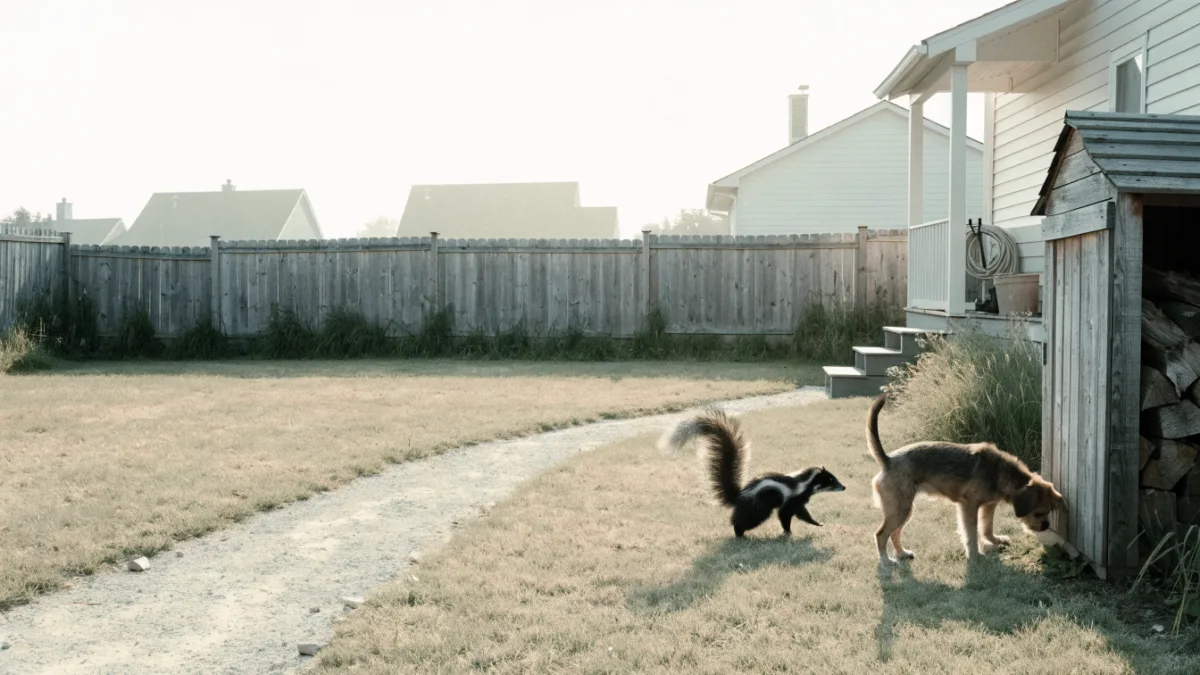
Here’s a fun game for your next neighborhood get-together: ask the dog owners for their skunk stories, then ask the cat owners. The dog people will talk over each other — the midnight potty break, the bath that ran till 2 a.m., the car that smelled like burning rubber until Thanksgiving. The cat people will shrug. Most of them have never smelled skunk on their cat and never will. That gap isn’t luck, and it isn’t because cats are smarter. It’s behavior — your dog’s nose, the skunk’s patience, and a chemistry problem that tomato juice has never once solved. Let’s break down how the whole encounter actually plays out, and what to do the night your dog loses it.
The Skunk Is the Reasonable One Here
Striped skunks get cast as the villain, but they’re the pacifists in this story. They’re slow, nearsighted, and docile, and their famous weapon is a limited resource. A skunk carries roughly a tablespoon of spray — about 15 milliliters total — and can fire five or six rapid blasts before running dry. Refilling takes around ten days. A skunk that sprays your dog is then wandering around defenseless for a week and a half, which is why spraying is a last resort, not an opening move.
Before anything gets sprayed, the skunk runs through a whole warning routine: stamping the front feet, hissing, raising the tail, short bluff charges. Spotted skunks — the acrobatic cousins — literally do a handstand, rear legs in the air, as a final warning. Trail cam footage of it has gone viral more than once, and yeah, it’s worth watching.
Your dog reads none of this. When the warnings fail, the skunk fires accurately at targets up to about ten feet away, and it aims for the eyes — the spray causes intense stinging and temporary blindness in a predator. One myth worth killing now: the spray comes from anal glands, not urine. It’s an oil-based secretion, and that detail matters when we get to the bath.
Why Dogs Get Hammered and Cats Skate By
Dogs investigate the world nose-first, at speed. That means noses going into brush piles, under decks, down holes, and into den entrances — which is to say, directly into a skunk’s face. A dog that presses the encounter gets sprayed virtually every time. And plenty of dogs press it, because we bred them to. Terriers were literally created to go to ground after burrowing animals. Boldness toward a critter in a hole isn’t a flaw in these dogs — it’s the résumé.
A few years back I worked with a terrier mix named Biscuit who got sprayed twice in three weeks. Same woodpile, same skunk, same result. His owner asked me what was wrong with him. Nothing was wrong with him. He was a terrier doing terrier math: furry thing in woodpile equals investigate immediately. The third week, we worked on a rock-solid “leave it” and kept him leashed past the woodpile at dusk. Problem solved.
Cats play a completely different game. They’re cautious, ambush-style hunters that give anything their own size a wide berth, and they almost never pursue a skunk. They’re also the same size and keep the same dawn-and-dusk schedule, so cats and skunks often just share space — there’s no shortage of reports of the two eating side by side from an outdoor bowl like roommates who don’t talk. Even in,[1] cat skunkings barely register.
Timing stacks the deck, too. Skunks are crepuscular — most active at dawn and dusk — which is exactly when most of us walk our dogs. Encounters peak in spring, when breeding season pushes skunks to move around, and again in fall, when juveniles disperse to find their own territory. If it feels like there’s a skunk season for your walks, there is.
The Tomato Juice Thing Needs to Die
I’ll own this: early in my career, I repeated the tomato juice advice. I was wrong, and so was everyone who told you. Tomato juice doesn’t neutralize anything. What actually happens is olfactory fatigue — your nose gets so overwhelmed by tomato that it stops registering the skunk smell. You think the dog is fixed. Your neighbor, walking into the house an hour later, knows better. The dog still reeks. So does the couch.
Here’s the chemistry, because it explains everything else. The stink comes from sulfur compounds called thiols, and the human nose can detect them at concentrations around ten parts per billion — we’re absurdly sensitive to this stuff. The spray also carries thioacetates, which are nearly odorless but slowly convert back into thiols whenever they get wet. That’s why a skunked dog smells again every time it rains or gets a bath for weeks afterward. Owners call it skunk remembrance. Chemistry calls it a recurring nightmare.
And this is why you shouldn’t start with a plain water rinse, either. Water can kick off that conversion and make the smell worse, while doing nothing about the oil. Same reason tomato juice fails — masking isn’t neutralizing. You need to break the molecules.
The Recipe That Actually Works
The fix that vets actually endorse came from a chemist, not a groomer. Paul Krebaum published his de-skunking formula in Chemical & Engineering News back in 1993, and it’s been the standard ever since —.[2] It costs about two dollars and it works because it’s chemistry.
The formula
- 1 quart of 3% hydrogen peroxide (the plain stuff from any drugstore)
- ¼ cup baking soda
- 1 teaspoon of liquid dish soap
Double it for big dogs. Mix it in an open container and use it immediately — never store it, never seal it. The reaction releases gas, and a closed container can burst.
Why it works: the peroxide and baking soda react to release oxygen that oxidizes the thiols into odorless sulfonates. The dish soap strips the oily spray so the peroxide can actually reach it. You’re destroying the smell, not hiding it.
How to apply it
- Bathe the dog outdoors, or your house is the new skunk
- Work the mixture into dry fur — no pre-rinse — and saturate fully
- Keep it away from the eyes, ears, and mouth
- Let it sit 5–10 minutes, then rinse thoroughly
- Repeat if needed, then finish with a regular gentle shampoo
Two honest caveats. Peroxide can slightly lighten dark coats, so keep contact time shorter on black dogs. And porous gear usually can’t be saved — that collar and leash will hold the smell for months. Toss the collar, wash fabrics with baking soda added to the load, and consider it a tax.
When it’s a vet visit, not a bath problem
Most skunkings end with a humiliated dog and a successful bath. But call your vet if your dog took a [3] — rinse the eyes with saline or plain water right away, since the spray causes painful conjunctivitis. Mouth exposure can mean drooling, nausea, or vomiting. Comb through the fur for bite wounds, because skunks are among the main rabies carriers in U.S. wildlife, and confirm your dog’s vaccination status the same night. Rarely, a heavy close-range spraying can trigger a condition called Heinz body hemolytic anemia in dogs — so if your dog seems lethargic or has pale gums in the days after a bad hit, that’s a same-day phone call.
Breaking the “Every Walk” Cycle
If your neighborhood is skunk country, you’re not doomed to repeat Biscuit’s woodpile saga:
- Keep the leash on for dawn and dusk walks during spring and fall — this is the single biggest factor you control
- Bring pet food in overnight. Outdoor feeding stations feed skunks too, and concentrated food means concentrated encounters
- Block access under decks, sheds, and porches before spring denning season
- Motion-sensor lights genuinely help — skunks would rather not work lit stages
- Train a real “leave it” with rewards, not corrections. A dog that checks in with you instead of charging the bush is a dog that stays clean
One last thing worth knowing: that skunk under your deck is earning its keep. Skunks eat enormous numbers of ticks, grubs, and rodents — free pest control, if you can keep your dog out of its face. Striped skunks are thriving, one of the most successful suburban mammals in North America, so deter and exclude rather than trap and relocate, which is illegal in many places anyway and just clears territory for the next skunk. Their handstand-performing cousin, the eastern spotted skunk, is quietly declining across its range and needs all the goodwill it can get. Skunks don’t want a fight. They never did. They just want your dog to read the room — and since your dog won’t, you’ll have to do it for both of them.
Sources
- casual surveys of pet owners — quora.com
- Cornell's veterinary school still points owners to it — vet.cornell.edu
- direct hit to the face — vcahospitals.com