

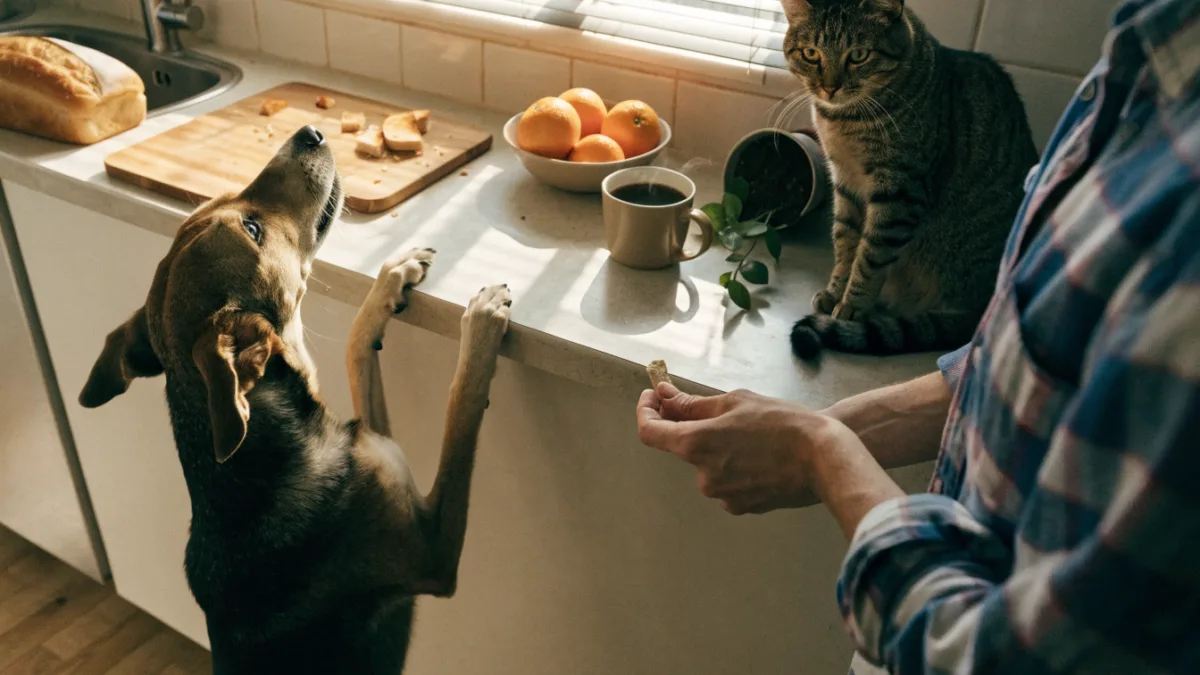
You leave a loaf of bread on the counter, turn your back for literally five seconds to grab a plate, and suddenly half the loaf is gone. You look down at your dog, who is now innocently licking their chops, and wonder how they morphed into a stealthy kitchen ninja. Meanwhile, your cat is perched on top of the refrigerator, staring down at the chaos like a gargoyle guarding a cathedral.
Welcome to the daily reality of sharing a house with opportunistic scavengers and vertical-seeking predators. But here’s the thing: while both species are ending up on your kitchen counters, they are doing it for entirely different reasons. If you want to stop the madness, you have to understand the “why” behind the behavior.
Scavengers vs. Tree-Huggers: Why They Want the Counter
Dogs and cats approach kitchen counters with completely different evolutionary playbooks.
Dogs are opportunistic scavengers. When your dog jumps up to snag a piece of leftover chicken, they aren’t trying to assert dominance or rule your household. They just found a high-value piece of food, and their brain screams, “Free calories! Grab it before the competition does!” Counter surfing usually ramps up right around canine adolescence—say, nine months old. This is the age where puppies get a bit more freedom in the house, their confidence peaks, and their impulse control is practically nonexistent.
Cats, on the other hand, arefeline predators who view the world vertically. A cat doesn’t usually jump on the counter because they’re trying to steal your sandwich (though they won’t turn down a loose piece of deli ham). Cats seek out high places because of a deep-seated instinct for safety, observation, and territory. In the wild, a high vantage point keeps a cat safe from predators and allows them to spot prey. To a cat, the top of the refrigerator or the highest kitchen cabinet isn’t a kitchen accessory—it’s a safe haven.
The Environmental Reality Check
I used to tell owners that if they just trained their dog hard enough, the dog would eventually learn to ignore a cooling roast beef on the counter. I was wrong.
The absolute gold standard for stopping counter surfing isn’t a magical command—it’s environmental management. As the pros at [1] point out, the most universally agreed-upon fact among trainers is that 100% prevention requires 100% management of the environment.
If food is left out, your dog will eventually try to get it. Every time your dog successfully snags a piece of pizza off the island, that behavior is reinforced. You are literally paying them in food to try again later.
Adapting to the Growing Puppy
Management looks different depending on the age and size of your dog. I worked with a family who had a Nova Scotia Duck Tolling Retriever puppy. For the first four months, a simple baby gate kept her out of the kitchen. Problem solved.
But at nine months old, she hit a growth spurt, figured out her legs were basically springs, and started sailing right over the gate to raid the trash. The owners were frustrated, thinking their dog had suddenly gone rogue. The reality? The management strategy had expired. We had to swap the low gate for an extra-tall one and start locking the pantry.
Punishment vs. Positive Reinforcement
There is a lot of outdated advice out there about how to stop a dog from stealing food. You’ll hear people suggest putting double-sided tape on the counter edges, lining the counters with aluminum foil, or setting up motion-activated spray devices to scare the dog.
Here’s why I don’t recommend those, and why the veterinary community [2] over passive punishers: punishment doesn’t teach your dog what to do instead.
If you put tin foil on the counter, your dog might get spooked once. But the drive for that unattended stick of butter is going to outweigh the annoyance of the foil eventually. More importantly, these deterrents don’t address the root of the problem, and they can make your dog anxious about being in the kitchen altogether.
Instead of focusing on how to punish the jump, we need to focus on proactively teaching and rewarding the dog for the desired behavior.
The Incompatible Behavior Strategy
You can’t yell “no” at a dog every time they jump if you haven’t given them a replacement job to do. This is where the incompatible behavior strategy comes in.
If a dog is standing firmly on a specific mat in the kitchen, they physically cannot be on the counter at the same time. It’s impossible.
Here is what you actually do:
- Get a comfy dog bed or a non-slip bath mat. Place it just outside the main cooking zone.
- Stand near the mat. When your dog looks at it, steps on it, or sits on it, mark the behavior (with a clicker or a happy “Yes!”) and give them a treat.
- Practice sending them to the “place” command while you walk toward the counter. Reward heavily for staying put.
- Gradually increase the difficulty. Put a fake piece of food on the counter, step back, and reward the dog for holding their position on the mat instead of breaking to investigate.
Now, instead of leaving them to their own devices and hoping they don’t steal your dinner, you’ve given them a paying job. They learn that keeping four paws on the floor (or on their mat) is what earns the good stuff.
What About the Cats?
While we can easily manage dogs out of the kitchen or train them to stay on a mat, applying these same rules to cats is an exercise in futility. You can’t just “train” the tree-climbing instinct out of a cat. If they want up, they are going up.
If your cat is constantly underfoot on the kitchen counters, ask yourself why. Are they trying to get away from a busy household? Are they looking for a warm spot? Are they playing with the faucet?
Instead of fighting biology, provide them with legal vertical space. Install floating wall shelves that lead up to a high window perch. Get a tall, sturdy cat tree and place it right next to the kitchen so they can survey their domain without needing to use your cutting board. If you give a cat an acceptable high-altitude option, they will almost always choose it over your kitchen counters.
The Final Takeaway
Living with animals means understanding their natural instincts rather than fighting them. Your dog isn’t a bad dog for stealing food off the counter; they are just a dog doing dog things. By keeping your counters clear, using physical barriers when you can’t supervise, and rewarding an alternative behavior like “place,” you set your dog up to succeed without ever needing to raise your voice.
And when it comes to your feline acrobats? Stop expecting them to be dogs. Give them a tree to climb, and they’ll happily leave your leftovers alone. Managing a multi-species household isn’t about winning a battle for control—it’s about arranging the environment so everyone can naturally do what they are wired to do, safely and peacefully.
Sources
- Best Friends Animal Society — bestfriends.org
- favors positive reinforcement — veterinarypartner.vin.com