

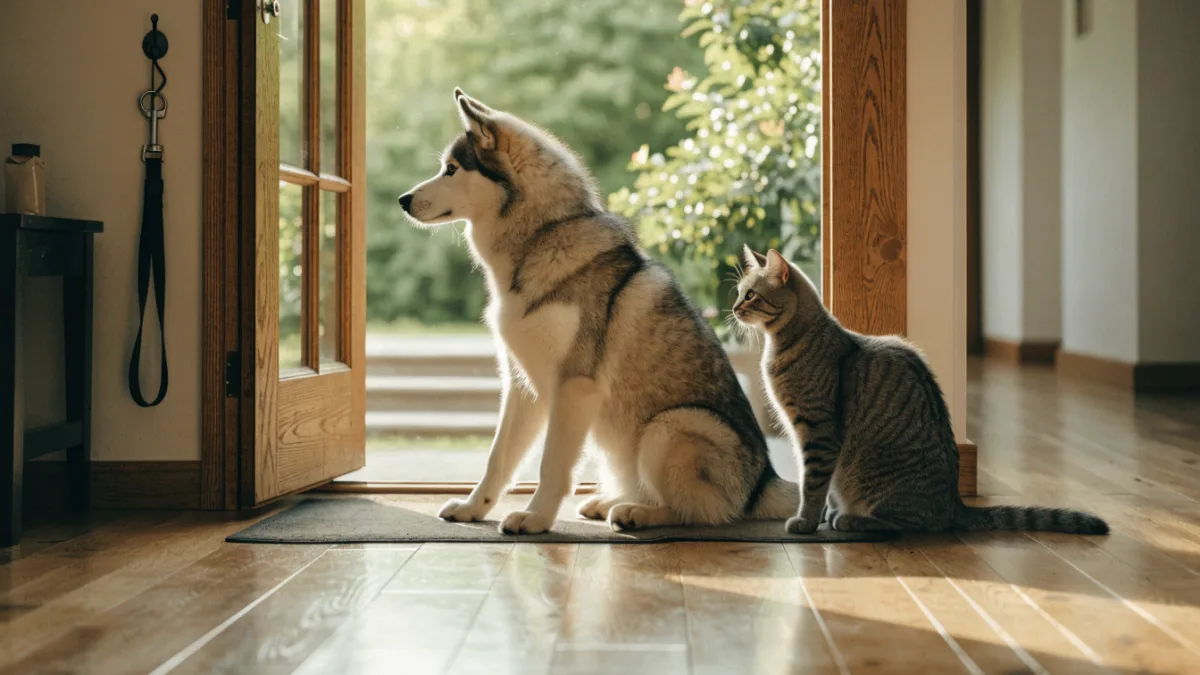
Picture this: You’re walking through your front door with a bag of groceries in each hand. The door swings open, and before you can even put the bags down, a blur of fur shoots past your ankles and heads straight for the horizon. If you have a pet, you’ve probably experienced that exact heart-stopping moment. We call it door-dashing, and while it’s easy to get frustrated, your dog or cat isn’t doing it to be stubborn or spiteful. They’re just doing what comes naturally.
Let’s look at the numbers. According to animal welfare studies, lost dogs are recovered by their owners around 70 to 90 percent of the time. Lost indoor cats? Their recovery rate sits at a dismal 5 to 10 percent. When an indoor cat gets out, they panic. They don’t act like street-smart strays; they tuck themselves under the nearest deck or car engine and freeze. That’s exactly why we need to get ahead of this behavior. Whether you’re dealing with a dog who wants to greet the whole neighborhood or a cat who treats the front door like a portal to an adventure, you need a game plan to prevent pet running away.
Why Your Pet Turns Into a Ninja at the Door
Before we fix the problem, we need to understand it. Pets dash for different reasons. Dogs usually bolt because of territorial excitement, a desire to go say hi to the mail carrier, or a strong prey drive triggered by a squirrel running across the sidewalk. They see an opening and take it.
Cats are a little different. A lot of cat escaping comes down to pure curiosity or unneutered territorial urges. If your indoor cat has never felt the grass under their paws, the outside world is a giant, fascinating mystery. The entryway is their only window to it, and when that door cracks open, their hunting instincts kick into high gear. They don’t know the dangers of traffic or local wildlife. They just see an opportunity and take it.
Management vs. Training: Don’t Skip the Setup
I used to tell people to just train their dog to sit when the door opens. I was wrong. Well, not entirely wrong—training matters—but relying purely on training when you have a busy entryway is a recipe for disaster. You have to separate your approach into two categories: management and training.
Management means physically altering the environment so your pet cannot make a mistake, even if they want to. Training means teaching your pet an alternative behavior so they choose to stay inside. If you skip management and go straight to training, you’re going to have a loose pet the next time your hands are full. You need both.
The “Airlock” Method
If you have an open floor plan, your front door probably opens right into the living room. That gives your pet a massive runway to build up speed. The best fix here is to create a secondary barrier. Set up a sturdy baby gate or a metal exercise pen a few feet back from the door. This creates an “airlock” or mudroom effect. When you come home, you step inside, close the front door, and then deal with opening the gate. Even if your dog lunges, they hit the barrier, not the street.
Deterrents and the Debate Over Aversives
For cats, physical gates don’t always work unless they’re ceiling-height, since most cats will simply scale a baby gate in two seconds flat. You’ll see people recommend motion-sensor air sprayers or static-correction mats to keep cats away from the threshold. While some owners swear by them, I don’t recommend starting there. Modern behavioral experts agree that these aversive tools cause stress, fear, and anxiety. You might stop the cat escaping, but you’ll likely create a cat who is terrified of the general vicinity of the front door. Stick to positive reinforcement and physical barriers first.
Training an Invisible Boundary
Now for the training part. We want to make staying inside a lot more rewarding than running outside.
The “Door is Boring” Routine for Dogs
Here’s a common mistake: owners only touch the door handle when they’re actually taking the dog for a walk. The dog hears the click of the leash, sees the hand on the knob, and their excitement hits maximum overdrive. We need to disconnect the door handle from the excitement.
Put your dog on a leash. Walk them to the door and ask them to sit on a specific mat placed about five feet back from the exit. Reach for the handle. If your dog breaks the sit, pull your hand away. Say nothing. Just wait. When they sit back down, reach for the handle again. You might spend ten minutes just reaching for the door before you can even open it a crack. That’s fine. You are teaching your dog that the door only opens when they are firmly planted on that mat. When they hold the stay while the door opens, the reward isn’t going outside—the reward is a piece of high-value meat, like chicken or liver, tossed right onto their mat.
The “Reward Zone” for Cats
You read that right—you can absolutely train a cat to stay away from the door. Clicker training isn’t just for dogs anymore. Pick a spot away from the entryway—maybe a cat tree or a specific shelf in the living room. Every time you walk toward the front door, toss a handful of your cat’s favorite treats onto that spot. Jackson Galaxy actually recommends throwing a “treat party” in the opposite direction of the door whenever you leave. Your cat will quickly learn that the sound of the door opening means amazing things happen on the cat tree, effectively neutralizing the urge to bolt.
Gear, Tech, and Handling Guests
Training takes repetition, but life is unpredictable. You need a backup plan for the moments your attention slips.
Secure Your Tech and Tags
Updated microchips and sturdy ID tags are non-negotiable. But we also have some amazing new tech on our side. GPS trackers that attach to your pet’s collar have revolutionized how we find lost pets. Look for trackers that offer real-time location tracking and allow you to set up a “virtual fence.” If your pet crosses the property line, you get an immediate alert to your phone. You’ll know the second they break the boundary, rather than finding out hours later.
If you have a busy household, smart home integration is also a lifesaver. Smart doorbells and remote locks let parents visually confirm that the dog is secured in another room before they remotely unlock the front door for a teenager coming home from school.
The Guest Protocol
Your training will fall apart if your guests undo it. You have to brief people before they come over. Don’t just say, “Make sure the dog doesn’t get out.” That puts the responsibility on someone who doesn’t know your dog’s cues. Give them a specific script.
Tell them: “When you arrive, text me instead of knocking. Wait about five seconds after I open the door before you step in, because I’m going to be putting my dog in the back room.” If you’re hosting a party, just crate your dog or put them in a bedroom with a stuffed chew toy. Don’t test their training against the temptation of five excited guests piling through the door at once.
Finally, remember that letting your cat explore the outdoors doesn’t have to mean a free-for-all. Providing safe outdoor access, like a securely enclosed patio area (often called a catio) or leash walking, can satisfy their curiosity and dramatically lower their drive to bolt. An enriched pet is a pet that stays put.
Keeping your pet from bolting isn’t just about keeping them safe—it’s about protecting the local environment. Outdoor and feral cats are responsible for billions of bird and small mammal deaths annually. By reinforcing boundaries and keeping your pets securely indoors, you aren’t just saving your best friend’s life. You’re playing a crucial role in protecting local wildlife populations, too. Set up the baby gate, grab the high-value treats, and start building that invisible boundary today.