

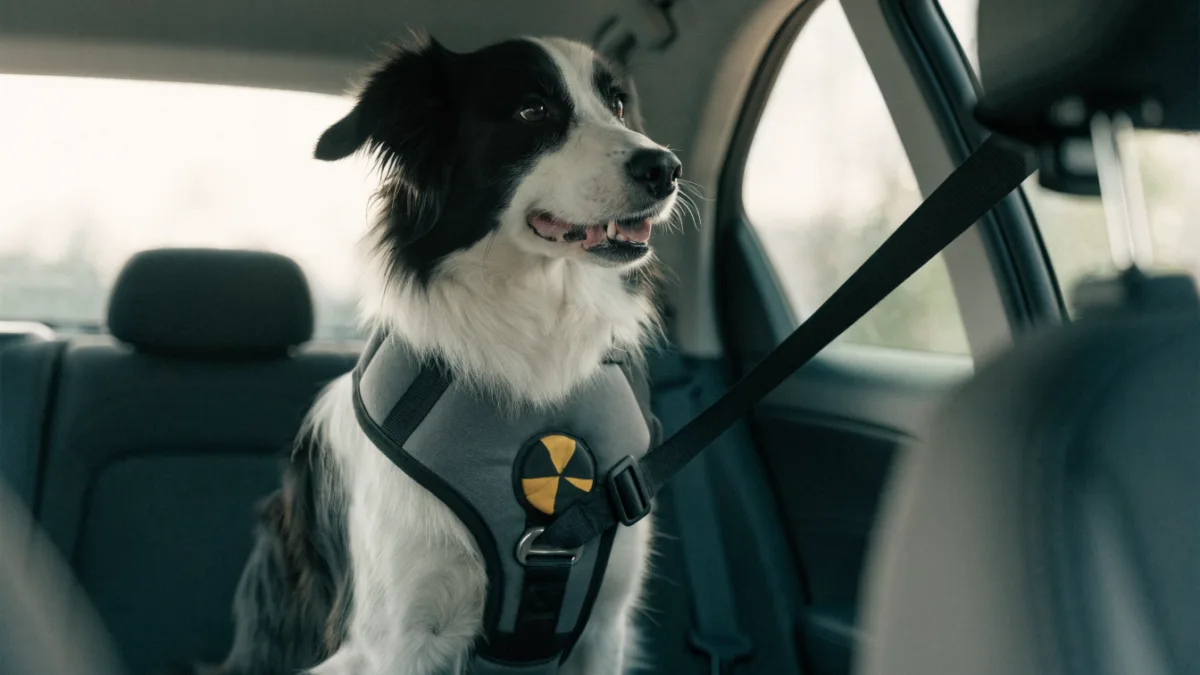
Just last month, I was treating a three-year-old Goldendoodle named Cooper. Cooper is a goofy, lovable 60-pound dog who usually spends car rides with his head out the window, ears flapping in the breeze. On this particular Sunday, Cooper’s owner was driving him to the local park when another driver ran a stop sign. The collision occurred at roughly 30 miles per hour—a relatively low-speed impact by automotive standards. While the car’s bumper was barely crumpled, Cooper, who was sitting unrestrained in the back seat, was launched into the front footwell. He was lucky to walk away with only a fractured radius and ulna (the two lower bones in his front leg) and some nasty bruising. “I always thought he was safe in the back,” his owner told me, tears in his eyes, as we wrapped Cooper’s leg in a splint. “I had no idea he’d turn into a missile.”
In my clinic, I see versions of Cooper’s story all the time. We eagerly buckle ourselves and our children into seatbelts, but we routinely let our pets roam freely in the cabin. We love having them ride shotgun or stick their noses out the window, but the physics of a car crash simply do not care about our good intentions.
The Physics of a Flying Dog
When we talk about car accidents, I always explain the concept of kinetic energy to my clients. In plain terms, an object in motion stays in motion until something stops it. When you are driving 30 miles per hour and suddenly hit the brakes or crash, your car stops, but everything inside the car that isn’t strapped down continues moving forward at exactly 30 miles per hour.
The force generated by that moving object is determined by its weight and speed—a calculation we call momentum.,[1] that in a crash at just 30 mph, an unrestrained 10-pound dog generates roughly 300 pounds of projectile force. An 80-pound dog, like a Labrador or a Shepherd, generates a staggering 2,400 pounds of force.
When you look at those numbers, the reality of the danger becomes clear. A loose dog isn’t just at risk of going through the windshield; they become a heavy, high-velocity projectile that can cause severe or fatal blunt force trauma to the driver or human passengers. Furthermore, an unrestrained dog doesn’t have to wait for a crash to cause an accident. A happy dog climbing into the front seat to lick the driver’s face, or a panicked cat scrambling under the brake pedal, is a massive distraction that heavily increases the risk of a collision in the first place.
The “Crash-Tested” Marketing Gimmick
If you browse online pet stores or [2] you will quickly find a lively debate. Many owners point out—quite rightly—that a standard nylon leash clipped to a dog’s collar, or a cheap elastic strap attached to a seatbelt buckle, won’t actually save a dog in a serious crash. In fact, a tether attached to a neck collar will almost certainly snap upon heavy impact. If it doesn’t snap, it will cause severe, potentially fatal cervical (neck) spinal injuries as the dog’s body weight is violently jerked against the restraint.
These owners are correct to be skeptical. Right now, there are no strict, federally mandated standards for pet car safety products. The market is flooded with cheap tethers legally labeled as “seatbelts” that offer a false sense of security.
However, I’ve changed my own mind on this over the years as the industry has evolved. The consensus among safety experts today is that you must look past the marketing buzzwords and rely on independent certification. In 2015, the Center for Pet Safety (CPS) conducted a [3] using specialized, weighted crash-test dog dummies to evaluate popular travel seats and harnesses.
What to Actually Look For
The primary function of any restraint is to keep the animal inside the vehicle during a collision. Ejection drastically reduces a pet’s chances of survival. But a truly high-quality harness does much more. It actively reduces the risk of injury by safely distributing the kinetic energy of the crash across the dog’s strongest skeletal points—the chest and back—rather than concentrating that force on their fragile neck.
When you are shopping for a restraint, skip the cheap straps. Look for harnesses, travel seats, or carriers that proudly display an independent “Certified” stamp of approval from a recognized testing facility. Reputable manufacturers now voluntarily submit their products to these independent labs, using realistic crash-test dummies to prove their designs will hold up to the immense forces of a collision.
Cats, Small Dogs, and the Backseat Rule
While dogs are usually the center of attention in car safety discussions, we cannot forget about our feline patients. Cats are equally at risk in a crash, but their natural response to stress makes them terrible loose passengers. A cat riding loose will almost certainly hide under a seat or pedal, and in a crash, they will be ejected just as easily as a dog. Cats should always be secured in a hard-shell, crash-tested carrier, and that carrier itself must be strapped into the back seat using the vehicle’s seatbelt.
For small dogs, dedicated pet travel seats (essentially elevated, padded baskets that clip into the car’s seatbelt system) are popular. Just ensure the seat itself is safety certified and that your dog is harnessed securely inside it.
Whether you have a Chihuahua in a carrier or a Mastiff in a harness, the golden rule of pet travel remains the same: the backseat is best. I’ve treated pets who were severely injured by front-seat airbags. Airbags are designed to deploy at staggering speeds to protect the chest and head of an adult human. If a pet is resting against the dashboard or sitting low in the passenger footwell, a deploying airbag can easily be lethal. Always secure your pets in the back seat.
What’s Changing on the Road
The good news is that both the law and vehicle engineering are finally starting to catch up with safety science. Following the push for transparency by organizations like CPS, we are now seeing legislative changes. More states and municipalities are actively passing distracted-driving laws that specifically classify unrestrained pets as hazards. In some jurisdictions, driving with a loose pet on your lap can result in heavy fines and points on your license.
We are also seeing incredible innovations from automakers. Some modern vehicles are now designed from the factory with built-in pet restraint systems. You can find rear-seat zippers designed for pet harnesses, dedicated cargo area tie-down anchors engineered to human automotive safety standards, and even climate-controlled cargo zones meant specifically to keep traveling pets safe and comfortable.
The Bottom Line
Treating Cooper’s fractured legs was a straightforward clinical process, but the emotional toll on his family was entirely preventable. While domestic dogs and cats are not part of the global endangered species list, our stewardship over these companion animals comes with a profound responsibility. We have bred them to trust us implicitly, to jump into our cars eagerly, and to look to us for protection. It is our duty to ensure that the metal boxes we drive at high speeds are as safe for them as they are for us.
Don’t wait for an accident to change your habits. Take the time to research independently certified harnesses and carriers. Ensure your pet is secured in the back seat, away from airbags, every single time you turn the key. A few minutes of preparation and a quality restraint are all that stand between a joyful weekend at the park and a devastating tragedy.
Sources
- Safety experts note — thecarseatlady.com
- discuss pet safety in owner forums — facebook.com
- pilot study — centerforpetsafety.org