

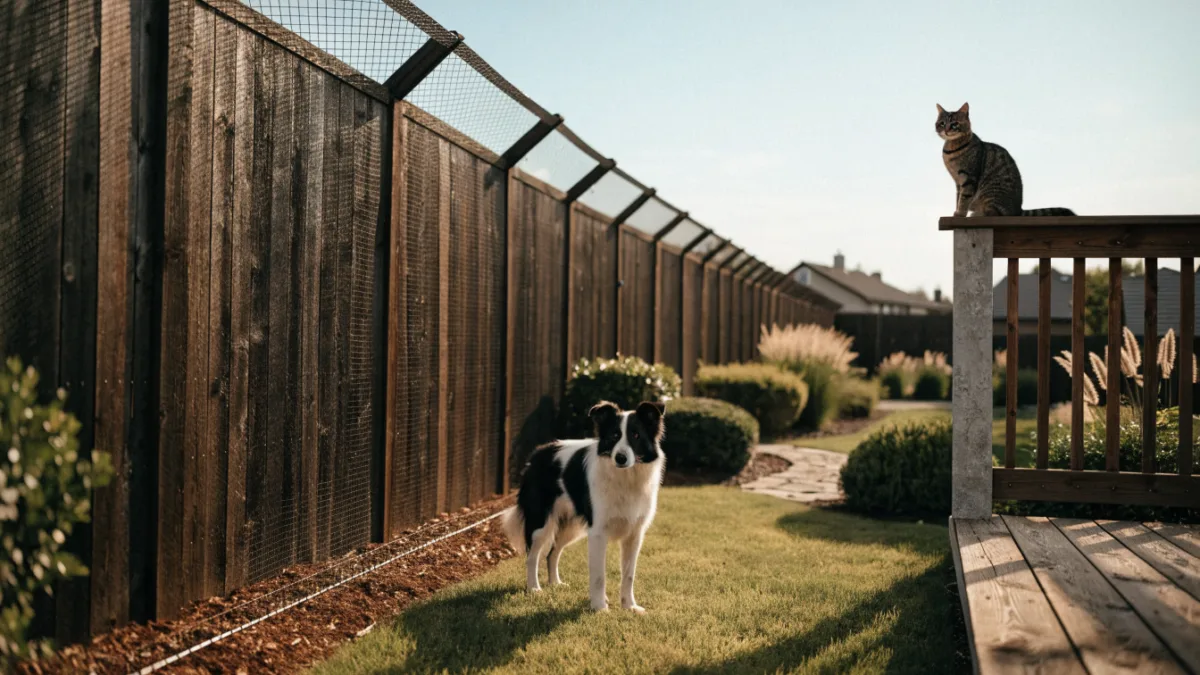
Last Tuesday, I watched my scruffy terrier mix, Leo, attempt to dig his way to the Earth’s core. He was covered in mud, entirely focused on his mission to tunnel under the cedar planks. Meanwhile, about six feet above his head, my calico cat, Cleo, was casually tightrope-walking along the top of our wooden privacy fence, judging the neighbor’s newly planted hydrangeas. It was a perfectly synchronized reminder that my backyard was entirely unprepared for a multi-species household.
If you have both a dog and a cat, you already know the fencing struggle is real. Dogs need a secure perimeter to run and play without bounding into the street, while cats require a system that accounts for their total lack of respect for gravity and their ability to squeeze through spaces the size of a toaster.
Designing a backyard barrier for both of them isn’t just a weekend project; it’s a psychological chess match. But it is possible to create a space that keeps both canines and felines safely contained without turning your beautiful yard into a scene from a sci-fi prison movie.
The Great Escape: Why One Fence Size Doesn’t Fit All
Dogs and cats have completely different philosophies when it comes to breaching a perimeter. Dogs are usually straightforward—they dig under, chew through, or just brute-force their way over a barrier. Cats, on the other hand, view fences as a fun vertical challenge. They climb, they balance, and they exploit the tiniest gaps with liquid-like flexibility.
If you’re relying on a standard wooden or chain-link fence, you’re basically leaving the door open for both of them. And for those wondering about invisible or electric fences? Let’s just clear the air: invisible fences do absolutely nothing to contain cats, and frankly, I’m not a fan of relying on electric shocks (or “hot tape”) to keep any of my animals in the yard. It doesn’t keep other animals or predators out, and the anxiety it causes just isn’t worth it to me. We want physical, humane barriers.
Ground Control: Defending the Perimeter
Before you worry about how high your pets can jump, you need to look down. Both dogs and cats are notorious for squeezing through gaps at the bottom of a fence, and dogs are champion diggers. If there is a gap under your gate, or the soil has eroded near the fence posts, it’s an open invitation.
The most straightforward fix here is wire mesh or chicken wire. You can attach it securely to the bottom rails of your fence, or—if your dog is a determined excavator like Leo—actually bury it a few inches into the ground. This creates a physical subterranean wall that stops digging in its tracks.
Making the Invisible, Visible
Here is where the science of dog vision comes in, and it’s fascinating. Dogs don’t see the world in just black and white, but they are red-green colorblind. They see the colors blue and yellow best. When you’re putting up wire mesh—especially if you have a dark-colored fence—it can be practically invisible to your dog, leading to painful collisions if they run at it full speed during a game of fetch.
To fix this, grab some blue or yellow surveyor’s tape and weave it through the wire mesh. It acts as a highly visible visual deterrent for your dog, preventing collision injuries while still keeping them safely contained. It might look a little quirky from the patio, but it’s a small price to pay for their safety.
Reaching New Heights: Foiling Jumpers and Climbers
Once the ground is secure, it’s time to address the acrobatics. If you have a dog that likes to launch themselves over the fence when they spot a squirrel, you have to mess with their runway.
The Landscaping Loophole
This is my favorite solution because it solves two problems at once. To successfully clear a fence, a dog needs to get a running start and launch from a specific distance. If you plant dense, bushy shrubs—like Boxwood—along the inside of your fence line, you force the dog to back up even further to make their jump. By increasing the distance of the leap, you make it significantly harder, if not physically impossible, for them to clear the fence. Plus, a row of lush Boxwood looks gorgeous and does wonders for your home’s curb appeal compared to a tangle of wire.
Stopping the Spider-Cat
Cats don’t need a running start; they just climb straight up the wood. To counter this, you need to break their vertical momentum. This is where overhang cat fence extenders come in.
These clever devices attach to your fence posts and angle inward, back toward your yard. When a cat reaches the top of the fence, they hit the angled overhang. Because they can’t climb upside down, it becomes physically impossible for them to scale over the top.
The best part? The fencing industry has moved away from purely custom, built-from-scratch jobs. You can now buy specific, modular hardware that makes this highly accessible for the average DIYer. You simply attach overhang extenders to your existing fence posts using self-tapping screws, securing them firmly into ground sleeves. And because these components are exposed to the elements 24/7, make sure whatever you buy emphasizes UV resistance. You don’t want your plastic components becoming brittle and snapping after one harsh summer in the sun.
The Magic Bullet: Rolling Bars
If you want the ultimate dual-pet fencing solution, let me introduce you to Coyote Rollers. These are rolling metal or heavy-duty plastic bars that you attach to the very top of your fence line. When a dog tries to jump over, or a cat tries to pull themselves up, the roller simply spins. This completely strips the animal of their leverage, safely dropping them back into the yard.
They are incredibly effective because they don’t care if your pet is a jumper or a climber—the physics work for both. And while they are a fantastic investment for keeping your pets in, they also serve a vital conservation role. Coyote Rollers were originally designed to keep wildlife, like coyotes and foxes, out of yards. By installing a physical barrier that keeps domestic pets inside, you are also keeping wild predators safely outside. This protects local wildlife populations from free-roaming pets (looking at you, cats with strong prey drives) and keeps your furry family members safe from becoming prey themselves.
Aesthetics vs. Functionality: The Great Debate
Here is the honest truth: highly secure DIY setups are rarely going to grace the cover of an architectural magazine. When you start combining chicken wire, zip-ties, blue surveyor’s tape, and angled extenders, your backyard can start to look a little utilitarian. Or, to put it bluntly, like a chaotic science experiment.
There is a constant debate in multi-pet households about whether to prioritize aesthetics or absolute security. Some homeowners try to hide ugly wire with fast-growing vines, while others just accept the “compound” look for the sake of their pets’ safety.
My advice? Lean into the modular, hybrid kits that are becoming increasingly popular. They are designed with both function and a cleaner aesthetic in mind. A neatly installed row of rolling bars or professionally coated overhang extenders look infinitely better than a wad of chicken wire held together by degrading plastic ties. You can absolutely have a secure yard without totally compromising your home’s curb appeal, but you might have to spend a little more upfront to get there.
Securing a backyard for both a dog and a cat is a unique challenge that requires a bit of creativity, some understanding of animal behavior, and a willingness to get your hands dirty. Whether you’re weaving blue tape through wire mesh to save your dog’s nose, planting shrubs to ruin their jump trajectory, or installing rollers to outsmart your cat, the goal is the same: creating a safe, contained environment where they can just be animals. By choosing physical barriers over invisible shocks, you’re doing more than just containing your pets. You’re creating a boundary that respects the local ecosystem, keeping wildlife safely out and your beloved, slightly chaotic indoor pets exactly where they belong.