

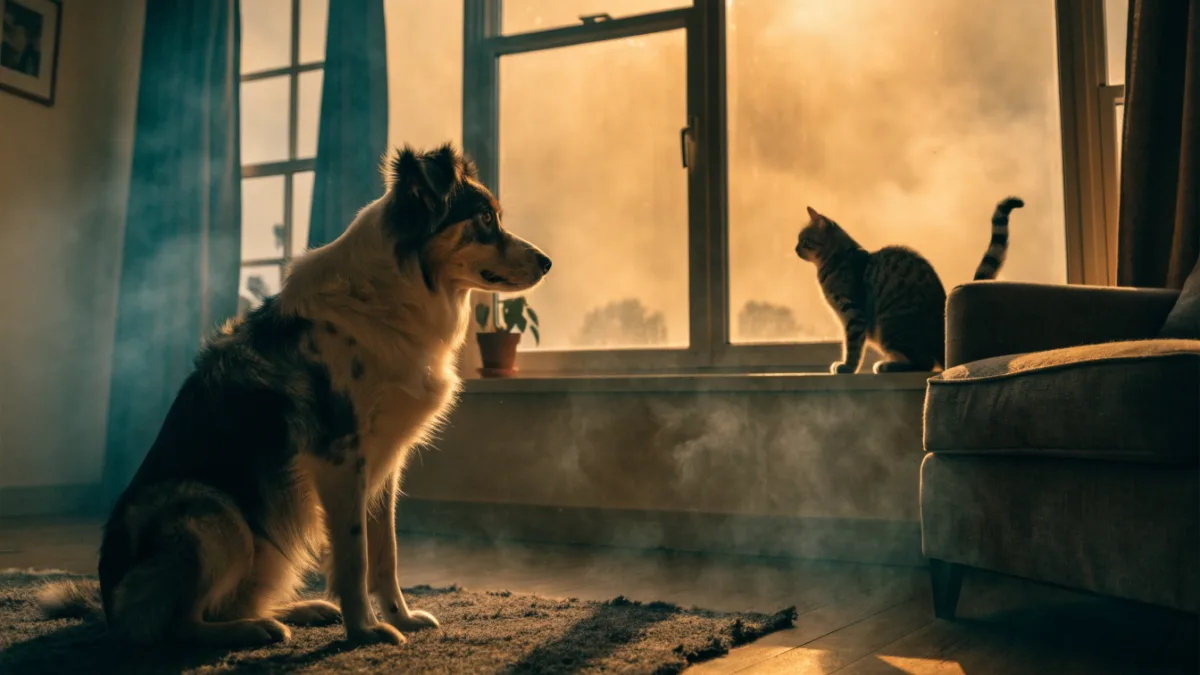
In June 2023, a client of mine in Chicago sent me a photo of her backyard taken at noon. The sky was amber, the sun a dim pink disk, and the answer to her question — “Is this safe for Benny?” — was clearly no. Benny is a 12-year-old Beagle with a mild heart murmur, and he lives more than a thousand miles from the nearest wildfire. But that’s the new reality of wildfire smoke: it doesn’t respect state lines or time zones. When Canadian smoke turned skies orange over New York and the Midwest that summer, millions of pet owners who had never thought twice about air quality were suddenly checking their phones and looking worriedly at their dogs. If that’s you — or if smoke season is simply a fact of life where you live — here’s the guidance I give my own clients, built around three questions: when to skip the walk, what symptoms to watch for, and how to make one room in your house genuinely safer.
When to Skip the Walk: A Simple Air-Quality Plan
In the United States, daily air quality is reported as the Air Quality Index, or AQI — most other countries publish an equivalent rating, so the same logic applies wherever you live. One honest caveat first: there is no official pet-specific AQI scale. The thresholds I use are adapted from human health standards, and while some of my colleagues rightly point out that extrapolation isn’t perfect, the.[1] and what I’ve seen in the exam room both support being cautious. Here’s the framework:
- AQI 0–50 (Good): Normal activity. Enjoy it.
- AQI 101–150 (Unhealthy for Sensitive Groups): Shorten walks, skip fetch and jogging, and keep at-risk pets indoors except for quick bathroom trips. “At-risk” includes flat-faced breeds like Pugs, Bulldogs, and Boxers, Persian cats, seniors, very young animals, overweight pets, and anyone with heart or lung disease.
- AQI 151–200 (Unhealthy): Everyone stays inside except brief, leashed bathroom breaks — even healthy adult dogs.
- AQI 201+ (Very Unhealthy to Hazardous): No outdoor time at all. For prolonged hazardous stretches, consider staying with friends or family in cleaner air, the same way you would for a young child.
Why does exercise matter so much? Because a panting dog moves an enormous volume of air — and with it, fine smoke particles that travel deep into the lungs. A client I’ll call Rachel kept her 3-year-old Weimaraner on their usual six-mile running route through a week of hazy “orange” days because he “seemed fine.” By Friday he had a honking cough that took three weeks to fully settle. He recovered, but he didn’t need to have that cough at all. Wildfire smoke and pets is a case where the cheapest medicine really is prevention: on smoky days, a bored dog is a healthier dog.
Spotting Smoke Inhalation in Cats and Dogs
Cats: the red flag you can’t ignore
Cats hide respiratory trouble well, but they also give you one unmistakable warning sign. Healthy cats breathe through their nose almost exclusively — so open-mouth breathing in a cat is always an emergency signal, never a quirk. The case that stays with me was Miso, a 7-year-old Persian whose owner called during a bad smoke week and said:
“She’s breathing with her mouth open, like a little dog. It scared me half to death.”
It scared me too. Persians already have compressed airways, and Miso spent two days on oxygen support. She pulled through, but she’s the reason I now tell every cat owner: mouth-open breathing, heaving flanks, or a stretched-out neck posture means go to a veterinarian immediately, don’t wait for morning. Two smaller feline notes — fine ash settles on fur, and cats groom it off, so wipe them down with a damp cloth after outdoor time; and a cat who suddenly parks herself in front of a fan or struggles with normal jumping is telling you something too.
Dogs: loud and, thankfully, obvious
Dogs tend to announce their problems. Watch for:
- Coughing, gagging, or a nasal discharge that wasn’t there before
- Sneezing, wheezing, or breathing that’s faster or more effortful than usual
- Red, watery, or squinty eyes
- Reduced appetite or thirst
- Lethargy, weakness, or seeming disoriented on familiar routes
My rule of thumb: any of these lingering beyond 24 to 48 hours earns a phone call to your vet, even if it seems mild. Anything that looks like real distress — labored breathing, bluish gums, collapse — is an emergency, full stop. Smoke inhalation in cats and dogs both respond best when we catch them early, and early usually means you noticed something small.
Build a Cleaner-Air Safe Room (It’s Easier Than It Sounds)
You don’t need to seal the whole house. One well-chosen room can cut your pets’ particle exposure dramatically during the hours that matter most:
- Pick an interior room with the fewest windows — often a bedroom, which works nicely since that’s where pets and people spend the night.
- Close it up and seal the drafts. A rolled towel at the door gap does more than you’d think.
- Run a true HEPA air purifier sized for the room’s square footage. Look for genuine HEPA certification and a clean-air delivery rating appropriate to the space — bigger rooms need bigger units. On a budget, a box fan secured to a MERV-13 furnace filter (there are widely available step-by-step designs) is a legitimate alternative, not a gimmick.
- Upgrade your central HVAC filter to MERV 13 or the highest rating your system can handle — check your manual first, since overly dense filters can strain some units.
- Remove indoor particle sources: no candles or incense, skip frying and grilling, and postpone vacuuming, which stirs settled particles back into the air.
Then deal with the behavioral fallout of cancelled walks, because a restless dog will invent their own exercise. Puzzle feeders, snuffle mats, hide-the-treat scent games, and deliberate stair-fetch sessions tire a dog out surprisingly well. For cats, wand toys and food puzzles do the job. Keep litter boxes clean and, if hazardous conditions drag on for days, have potty pads or an indoor grass patch as a backup. Time bathroom breaks for the cleanest window in the day — often early morning — and check the air quality reading right before you head out, not an hour before. One more note: consumer indoor air monitors vary widely in accuracy, so treat them as a helpful hint rather than gospel; the outdoor AQI is usually a good enough proxy for decisions about air quality and dogs and cats alike, as [2]
The Questions I Get Every Smoke Season
Should my dog wear a smoke mask?
I’ll be honest: when smoke masks for dogs started appearing a few years ago, I was genuinely curious whether they’d help. I’ve changed my mind, and so has most of the profession. The fit problems are real — muzzle shapes vary enormously, panting defeats the seal, and a panicking dog who can’t escape the strap inhales harder, not softer. The AVMA doesn’t endorse them, and improvised human N95s on a pet are a hard no. The deeper issue is what a mask licenses: it gives people confidence to take the very walk they should have skipped. The mask that works is your front door, closed.
My cat goes outside. Now what?
This is the one that causes friction, and I get it — transitioning a lifelong indoor/outdoor cat is genuinely hard, and organizations like [3] during smoke events. My advice: start before smoke season. Make the indoors worth staying for — a clean litter box, food puzzles, a perch by a (closed) window — and practice short indoor stretches during clear weeks. During a smoke event, even a few enforced indoor days meaningfully cuts exposure, and cats are more adaptable over 72 hours than owners fear. Make sure they’re microchipped and wearing ID in case they bolt.
What about birds and backyard animals?
Worth a sentence, because they’re so often forgotten: birds are extraordinarily sensitive to smoke — their air-sac respiratory system absorbs particles very efficiently — so a caged bird belongs in your cleanest sealed room with a HEPA purifier running. And if you keep backyard chickens, they’re covered under the same livestock guidance the AVMA publishes: close up the coop on the worst days, keep water fresh, and watch for lethargy or going off feed.
Here’s my final thought, and it’s less about checklists than about timing: the people who do best in smoke season made their plan while the sky was still blue. The purifier is bought, the MERV-13 filter is installed, the evacuation kit with carriers, medications, and vet records sits in the closet. Smoke seasons are getting longer and traveling farther, which means this is becoming a routine part of pet ownership rather than an anomaly. And the orange sky is worth pausing on for one more reason: the same air that makes your dog cough is being breathed by every creature that can’t come inside — the hawks and deer displaced by fire lines, the cattle standing in open fields, the backyard flocks with nowhere to seal. Caring for the animals who share our homes isn’t separate from that larger picture. It’s where that kind of attention begins.
Sources
- AVMA's wildfire smoke guidance — avma.org
- clinics in smoke-country Washington frame it in their own AQI safety plans — cascadevetclinics.com
- Best Friends Animal Society field this question constantly — facebook.com