

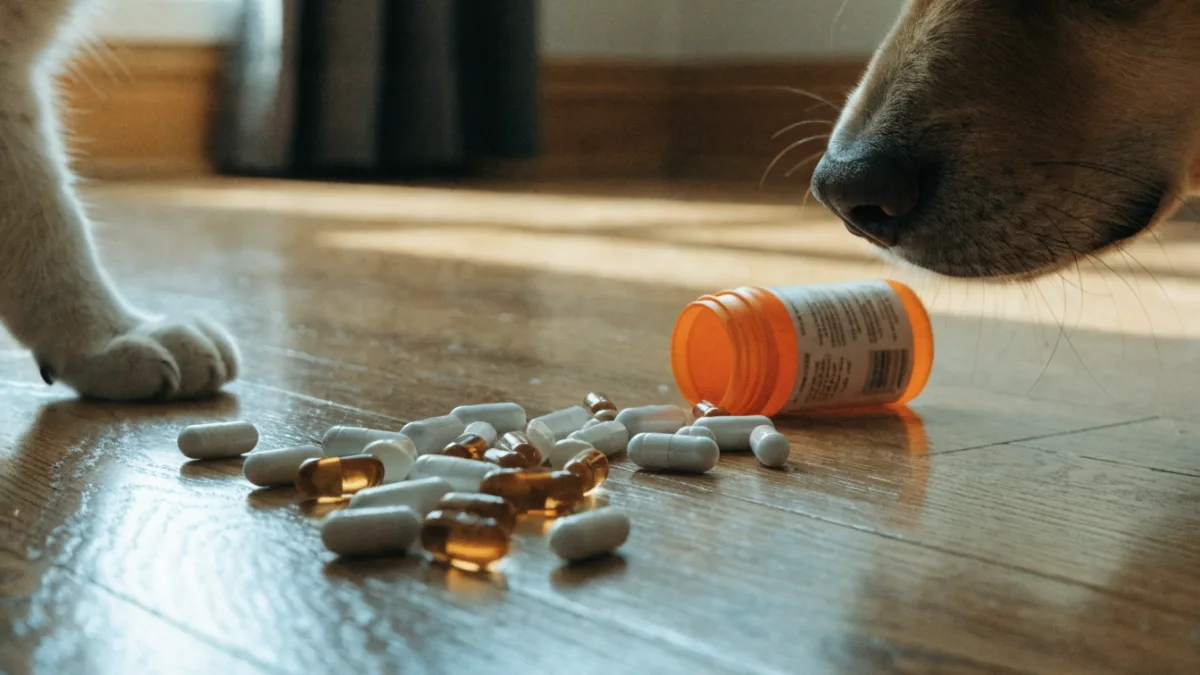
Marlene, a 67-year-old retired teacher with arthritis in both hands, fumbled her evening dose of ibuprofen last March. One gel capsule bounced off the counter, hit the kitchen tile, and rolled under the edge of the cabinet. She figured she’d find it later. Within forty minutes, her eight-year-old Beagle, Roscoe, was vomiting blood on the living room rug. By the time Marlene carried him through my clinic doors, his kidneys were already in acute failure. We saved Roscoe — but barely, and only because Marlene had the presence of mind to grab the pill bottle and drive immediately. That single dropped pill cost three days of hospitalization, intravenous fluids, and a medication called gastroprotectant that coats and shields the stomach lining. It also cost Marlene a realization I wish more pet owners understood before they ever open a medicine bottle.
Why Pets and Human Painkillers Don’t Mix
Human bodies and animal bodies process drugs through entirely different chemical pathways. It’s not just a matter of size or weight — though that matters enormously. The actual machinery inside a pet’s cells works differently than ours, particularly in the liver, where most medications get broken down and cleared from the bloodstream.
Cats, for instance, are missing a crucial liver enzyme called glucuronyl transferase. Think of this enzyme as a chemical hand-truck: in humans and dogs, it loads up drug molecules and ships them out of the body safely. Cats essentially don’t have this hand-truck for many human medications. So when a cat’s liver encounters acetaminophen or ibuprofen, the drug just sits there, circulating and accumulating, destroying cells from the inside out. Dogs have more of this enzyme than cats do, but they still metabolize NSAIDs — non-steroidal anti-inflammatory drugs — in ways that make human versions uniquely dangerous to them.
This is the fundamental problem with human medicine for pets: what’s a gentle, well-tolerated relief for your headache can be a biochemical assault on your pet’s organs. The dose that makes you comfortable can kill them. Not might. Can.
Ibuprofen Toxicity in Dogs: The Quiet Destroyer
Ibuprofen — sold under brand names like Advil and Motrin — works by blocking enzymes called COX-1 and COX-2. These enzymes produce prostaglandins, which are chemical messengers involved in inflammation and pain. In humans, blocking them brings down swelling and makes your back stop screaming. But prostaglandins also do something else, something the packaging doesn’t mention: they maintain the protective mucus layer that coats the inside of your stomach and intestines, and they help regulate blood flow to the kidneys.
When a dog ingests ibuprofen, that protective mucosal lining gets stripped away. Stomach acid, which is remarkably strong in canines, begins digesting the stomach wall itself. The result is ulceration — raw, bleeding sores in the gastrointestinal tract. Meanwhile, the kidneys, deprived of the blood flow regulation they depend on, begin to shut down.
I treated a four-year-old Labrador named Diesel whose owner had given him two adult ibuprofen tablets for what she thought was a sprained leg. “I just wanted him to feel better,” she told me, crying, as Diesel lay on a blanket in the exam room, his gums pale and tacky. Diesel was producing almost no urine, which meant his kidneys had essentially stopped filtering toxins from his blood. We spent five days on aggressive IV diuresis — running fluids through him at a rate that essentially flushed his kidneys like a clogged drain. He survived. Many dogs in his situation don’t.
The Kidney Damage Timeline
Here’s what makes ibuprofen toxicity in dogs so insidious: the initial symptoms often look like a mild stomach upset. Your dog might refuse dinner, seem a little quiet, maybe vomit once. Many owners — and I understand why — write this off as “he ate something outside.” By the time visible symptoms like bloody vomit, lethargy, or increased thirst and urination appear, substantial kidney damage may have already occurred. The window between ingestion and irreversible harm is measured in hours, not days.
Tylenol Poisoning in Cats: One Tablet Can Kill
If ibuprofen is dangerous for dogs, acetaminophen — the active ingredient in Tylenol — is catastrophic for cats. I need to be absolutely clear about this: one regular-strength acetaminophen tablet can be fatal to a cat. Not a large overdose. One tablet. That’s not a theoretical risk. That’s a clinical reality I’ve seen play out in my exam room more times than I care to count.
Acetaminophen destroys a cat’s red blood cells in a specific and devastating way. Normally, red blood cells carry oxygen throughout the body using a protein called hemoglobin — think of hemoglobin as a tiny oxygen delivery truck. Acetaminophen converts that hemoglobin into something called methemoglobin, which is essentially a broken-down truck that can’t carry oxygen anymore. This condition, called methemoglobinemia, literally starves the cat’s tissues of oxygen.
A cat with acetaminophen toxicity will struggle to breathe. Their gums and tongue — normally a healthy bubble-gum pink — turn brown or even bluish. Their paws may swell. A condition called edema, which is fluid accumulation in tissues, particularly affects the face and paws in cats with acetaminophen poisoning. I remember a gray tabby named Whiskers whose owner had crushed a quarter of a Tylenol into her food because the cat seemed to be favoring her front leg after a jump. “I only gave her a tiny piece,” the owner kept repeating. That tiny piece was enough to destroy a significant percentage of Whiskers’ red blood cells. We treated her with a medication called N-acetylcysteine, which acts as a chemical antidote by helping the body redirect the toxic byproducts of acetaminophen breakdown. She pulled through, but the owner now keeps all human medications in a locked kitchen cupboard.
Acetaminophen in Dogs: A Different Danger
Dogs handle acetaminophen slightly better than cats, but that’s not saying much. While cats primarily suffer red blood cell destruction, dogs tend to experience severe liver damage from acetaminophen ingestion. The liver, overwhelmed by the drug, begins to destroy its own cells. Red blood cell damage can also occur in dogs, particularly at higher doses. Symptoms include yellowing of the whites of the eyes and gums — a condition called jaundice, which signals that the liver is failing — along with vomiting, dark urine, and neurological symptoms like wobbliness or tremors.
The Dropped Pill: A Chronic Pain Sufferer’s Warning
If you manage chronic pain — whether it’s arthritis, fibromyalgia, a bad back, or anything else — this section is specifically for you. You are the pet owner at highest risk for accidental poisoning, and it’s not because you’re careless. It’s because you handle pain medication frequently, probably multiple times a day, and familiarity breeds complacency. That’s not a judgment. It’s human nature.
I’ve seen too many cases that started exactly the way Marlene’s did: a pill slipping from fingers that don’t grip like they used to, a capsule rolling off a table, a weekly pill organizer left open on a nightstand. Pets — dogs especially — are opportunistic scavengers. A pill on the floor isn’t a hazard to them. It’s a snack. Many human medications are coated in sugary or gelatin shells that actually taste appealing to animals. Some dogs will seek them out.
Here’s what I tell every client who takes regular medication:
- Take your pills over a sink or a large bowl. If one drops, it lands somewhere your pet can’t reach it.
- Close your pill organizer immediately after dispensing. Those daily organizers with flip-open compartments? A determined dog can nose those open in seconds.
- Store all medications in closed cabinets, preferably upper cabinets. Countertop storage is not secure enough. Cats are exceptional jumpers, and dogs are more creative than you think.
- Never keep loose pills in a purse, pocket, or bedside table without a secure container. I treated a Pug named Otis who found three ibuprofen tablets in his owner’s open purse. The owner had no idea how many were missing, which made calculating toxicity risk nearly impossible.
- If you drop a pill and can’t find it, assume your pet ate it. Secure the pet and search until you find it. If you can’t find it, call your vet.
“But I Only Gave a Little Bit”: Why Dosing by Guesswork Fails
I hear this frequently, and I understand the logic. If a pill helps a 150-pound human, surely a quarter-pill would help a 50-pound dog? The math seems reasonable. The biology disagrees.
Pet owners who attempt to dose human medications at home almost always get it wrong, and not because they’re bad at math. The problem is that safe therapeutic doses for animals — when they exist at all, which for many human painkillers they simply don’t — are calculated using specific milligram-per-kiligram ratios that account for species metabolism rates. A dog’s therapeutic dose of a medication might be one-tenth of what a human takes, but the toxic dose might be only slightly higher than the therapeutic dose. There’s almost no margin for error. Add in the fact that pet owners can’t always accurately weigh their animals, and you have a recipe for accidental overdose.
Baby aspirin is the medication I’m asked about most often. “Isn’t baby aspirin safe for dogs?” people ask. Here’s my honest answer: veterinary medicine has moved well beyond recommending any human aspirin product for dogs or cats. We now have FDA-approved, species-specific NSAIDs — medications like carprofen, meloxicam for specific uses, and grapiprant — that are formulated to work with your pet’s unique metabolism. These medications are designed to minimize the risks to the stomach lining and kidneys while providing effective pain relief. They require a prescription and veterinary supervision, yes. But they’re exponentially safer than anything in your medicine cabinet.
I’ll be candid: I’ve changed my position on this over my career. Early in practice, I occasionally told owners that a single low-dose aspirin was acceptable in a pinch. The research since then has shown me how wrong I was. The risks — particularly to the gastrointestinal tract — are simply too high compared to the excellent veterinary alternatives now available. If your pet is in pain, call your vet. We have better tools than you do.
Emergency Action Plan: What to Do If Ingestion Happens
Despite your best efforts, accidents happen. If you suspect — or know — that your pet has ingested any human pain medication, here’s exactly what to do:
- Do not induce vomiting unless specifically instructed by a veterinarian. I know this contradicts older advice. For years, the standard recommendation was to give hydrogen peroxide to make the pet vomit. The current veterinary consensus has shifted significantly. Inducing vomiting can cause aspiration pneumonia — where vomit enters the lungs — or severe burning of the esophagus, depending on what was swallowed. Some substances do more damage coming back up. Call a professional first.
- Call a poison control hotline or your emergency vet immediately. If you’re in North America, the ASPCA Animal Poison Control Center and the Pet Poison Helpline are staffed 24/7 by veterinary toxicologists. There is usually a consultation fee, but the guidance you receive could save your pet’s life and may prevent unnecessary emergency visits if the amount ingested turns out to be harmless.
- Grab the pill bottle and bring it with you. Not just the medication name — the actual bottle with the label. Your vet needs to see the active ingredient, the dosage in milligrams, and the number of pills originally in the bottle versus how many remain. This information helps us calculate how much your pet consumed and determine the severity of the toxicity.
- Note the time of ingestion as precisely as possible. The window for effective treatment narrows quickly. If we know your dog ate ibuprofen 30 minutes ago versus 6 hours ago, our treatment protocol changes significantly.
- Do not give your pet food, water, milk, or any home remedy. I’ve seen owners give milk to “coat the stomach,” charcoal from a fireplace, salt water, and raw egg. None of these help. Some make things considerably worse. The only safe thing to put in your pet’s body before reaching the clinic is nothing at all.
Recognizing the Signs: When You Didn’t See It Happen
Sometimes you don’t witness the ingestion. Your dog didn’t drop a pill in front of you. Your cat didn’t knock a bottle off the counter while you watched. You just come home to a pet who isn’t acting right. Here’s what toxicity from human painkillers can look like:
From NSAIDs like ibuprofen: Vomiting (particularly if you see blood or what looks like dark coffee grounds), diarrhea, black tarry stools, loss of appetite, extreme lethargy, increased drinking and urination or decreased urination, abdominal pain — your dog may adopt a “praying position” with chest down and rear end up, which is a classic pain posture.
From acetaminophen: Difficulty breathing, blue or brown gums and tongue, swelling of the face or paws, lethargy, weakness, dark or muddy-colored urine, jaundice. In cats, any breathing change after possible exposure to medication should be treated as a life-threatening emergency.
Neurological symptoms can appear with either type of poisoning: tremors, seizures, disorientation, stumbling. These indicate that the toxicity has progressed to affecting the nervous system, which is a dire sign.
Here’s the thing I want you to remember: if you even suspect your pet got into human medication, don’t wait for symptoms to appear. By the time symptoms are visible, significant internal damage may already be underway. Early intervention is the single most important factor in successful outcomes. I would rather see ten pets who turned out to be fine than miss one who needed immediate treatment.
Our pets depend on us entirely for their safety. They don’t understand that the pill on the floor is poison. They don’t know that the sweet-tasting coating on a gel capsule hides something lethal. They trust us to keep dangerous things out of their reach — and when we fail, they trust us to act fast. Secure your medications like your pet’s life depends on it, because genuinely, it does. And if the worst happens, don’t waste a single minute on guilt or hesitation. Pick up the phone, grab the bottle, and get to a vet. We can work miracles when we get there in time. The team that saved Roscoe, Diesel, Whiskers, and Otis — we’re ready to help yours too. But we need you to give us that chance.