

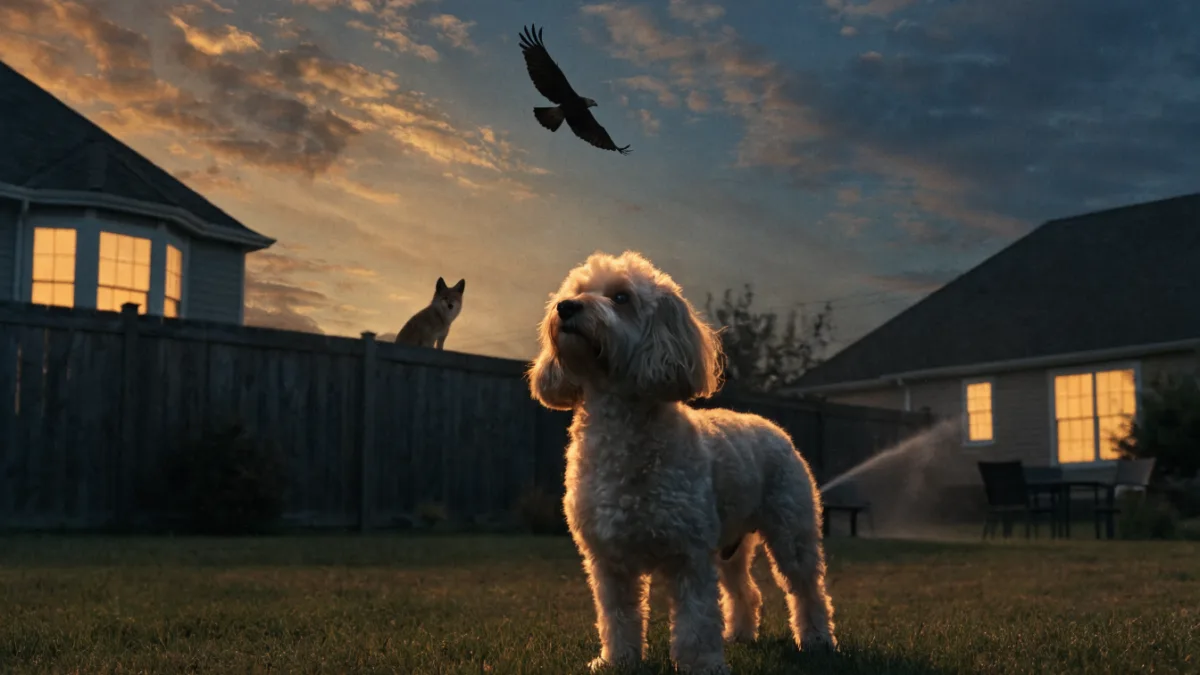
Moose is a seven-year-old, twelve-pound Cavapoo with the confidence of a dog five times his size. His owner, Denise, lives in a tidy subdivision about twenty minutes from a major downtown, and like a lot of suburban owners, she assumed her six-foot privacy fence made the backyard a sealed box. One morning at first light, she heard a single sharp yelp, ran out in her slippers, and found a coyote standing over her dog. It dropped Moose and cleared the fence in one easy bound. He survived — a puncture wound that abscessed, a drain placed under sedation, two weeks of antibiotics — but what Denise said afterwards has stayed with me: “I thought the fence meant safe.” It doesn’t. Coyotes now live in nearly every major American city and every state except Hawaii, and as one,[1] predators don’t need wilderness anymore — suburbs offer cover, food, and quiet hours in abundance. Here’s the reassuring part: nearly every one of these encounters is preventable with a few unglamorous habits.
Know the Threat Clock: Who Hunts When
I find it helps to think of predation risk as a clock that runs all day. Coyotes own dawn and dusk, hawks work the daylight shift, and owls take the night. Your pet’s size determines which shift should worry you most.
Street level: the coyote
Biologists call coyotes crepuscular — most active at dawn and dusk — and urban coyotes often slide into fully nocturnal schedules to avoid people. A coyote weighs 20 to 45 pounds, sprints up to 40 mph, and can clear a six-foot fence without touching it, which is why “my yard is fenced” and “my yard is safe” are two very different sentences. Cats and dogs under roughly 25 pounds are the prey-size target, though larger dogs can be treated as territorial rivals during breeding season (January through March) and pup-rearing season (spring into summer). This isn’t theoretical, either: a 2024 National Park Service study in Los Angeles found cat remains in roughly 20 percent of coyote scat collected in heavily residential neighborhoods. Fall brings its own spike, when young coyotes disperse into new territory — usually the kind of landscaped suburb where nobody expects them.
From above: hawks by day, owls by night
Physics is your friend here. Most raptors can’t lift much more than their own body weight, and a red-tailed hawk — the most common hawk in North America and the species most often implicated in pet incidents — weighs just two to four pounds. So no, a fifteen-pound dog is not getting flown away, regardless of what the viral video claims; most “eagle snatches dog” stories fall apart under scrutiny. The honest risk group for aerial attacks is puppies, kittens, rabbits, and toy-breed adults under about five pounds. Great horned owls, the other frequent culprit, hunt at dusk and night in near-total silence — their fringed flight feathers muffle sound, so pets get no warning — and their talons can kill prey heavier than they can carry. An owl strike can be lethal even when the bird can’t fly off with your pet. The closest aerial call I’ve handled: a great horned owl swiped at a client’s four-pound Yorkie puppy on her own back porch, and the puppy walked away with scratches only because the owner was three feet away and screamed.
My shorthand for worried clients: under five pounds, watch the sky; under twenty-five, watch the treeline.
Supervision Beats Every Gadget on the Market
When I review attack cases, one detail shows up in almost all of them: the pet was alone. Direct supervision is the highest-yield protection there is, and it costs nothing.
- Keep cats indoors. I’ll admit I’ve changed my mind here — early in my career I shrugged off indoor-outdoor arrangements. The lifespan data changed my advice: indoor cats commonly live 10 to 15 years or more, free-roaming cats average closer to two to five, and predation is a leading reason. If your cat craves the outdoors, a catio (a screened-in outdoor enclosure) or harness training delivers fresh air without the food-chain exposure.
- Go outside with small dogs at dawn, dusk, and after dark. Stand within grabbing distance, and keep dogs leashed on walks during high-risk hours and seasons.
- Never tie a pet out alone. A tethered animal can’t flee from anything — it’s visible from the air and defenseless on the ground, the worst of both worlds.
- Break up sightlines from above. Overhead netting or shade cloth above a small potty run denies raptors a clean dive path, and covered patios or dense shrubs give little dogs somewhere to duck.
A,[2] makes the same point I’d make in an exam room: predators don’t hunt pets who have a human standing next to them. They hunt opportunities.
Hardening Your Yard Without Turning It Into a Fortress
Start with the fence: six feet minimum, ideally topped with rollers — freely spinning cylinders mounted along the rail that deny a coyote the foothold it needs to vault over. If digging is your issue, bury an “apron” of wire mesh a foot or two deep, angled outward.
Next, remove the invitations. That means pet food bowls left outside, unsecured garbage, fallen fruit under trees, and — the one people resist — bird feeders. Feeders spill seed, seed attracts rodents, and rodents are precisely what draws coyotes and owls into a yard in the first place. Motion-activated lights add a layer of deterrence for nighttime coyote traffic.
For dogs in the under-ten-pound range, spiked protective vests and puncture-resistant capes exist. I was openly skeptical when these first appeared, and I’ll be honest that independent effectiveness data is still thin — but I’ve come around to viewing them as a reasonable extra layer for very small dogs in known hotspots. Look for rigid spikes along the neck and spine and genuinely cut-resistant fabric. Think of it as a seatbelt, not a force field: it buys seconds, and seconds matter.
And the folk remedies people ask me about — wolf urine, cayenger pepper, mothballs? I understand the impulse, and wolf urine in particular has a certain intuitive logic. But the evidence is weak to nonexistent, and mothballs are genuinely toxic to dogs and cats. Skip them. What does help is neighborhood intelligence: community groups, like this [3] can tell you when a coyote pair is denning two streets over. That should change your routine for a few weeks — and that’s usually all it takes.
What to Do When You Actually Meet One
If a coyote approaches, don’t run — running triggers the chase instinct. Instead, haze it:
- Stand tall, look big, and face the animal.
- Yell, clap, wave your arms — be loud and weird.
- Throw small objects (a tennis ball, a can of coins) toward the coyote, not directly at it.
- Pick up small dogs and back away slowly while keeping eye contact.
A coyote that trails you at a distance is often “escorting” you away from a den. Keep hazing and leave the area calmly.
If a raptor is mid-attack, do not grab the bird with your bare hands — a great horned owl’s grip has been estimated at several hundred pounds per square inch, strong enough to send you to the emergency room too. Use a jacket, a towel, anything as a barrier. And here’s the detail that surprises nearly everyone: in the U.S., all native hawks and owls are protected under the Migratory Bird Treaty Act. Killing, trapping, poisoning, relocating one, or disturbing an active nest is illegal even if the bird is attacking your pet — with fines that can reach five figures. You can defend your pet in the moment; you cannot take revenge afterward. If a raptor dive-bombs you on the same block every spring, you’re walking past an active nest. The fix is boring and temporary: change your route until the fledglings leave.
After any attack, bring your pet in even if the wounds look superficial. Punctures seal over and abscess — that’s exactly what Moose did — and talon injuries cluster dangerously near eyes and joints. Any bite from a wild mammal also warrants a conversation with your vet about rabies booster status.
One last thing I ask of every client: skip the rodenticides. Rat poison doesn’t stop at rats — the owls and coyotes that eat poisoned rodents die slowly and invisibly, and you lose the very animals keeping the rodent population in check. Coyotes, red-tailed hawks, and great horned owls are all thriving; they adapted to us, and a few small adjustments on our end is a fair trade. The goal was never a wildlife-free yard. It’s a yard where nobody — not your twelve-pound Cavapoo, not the owl in the oak — pays the price for our habits. Watch the clock, know your pet’s weight class, and don’t leave them out there alone.
Sources
- veterinary team in Texas warns — firehouseleander.com
- California clinic's wildlife-safety guide — myaltadenavet.com
- local safety page documenting predator sightings — facebook.com