

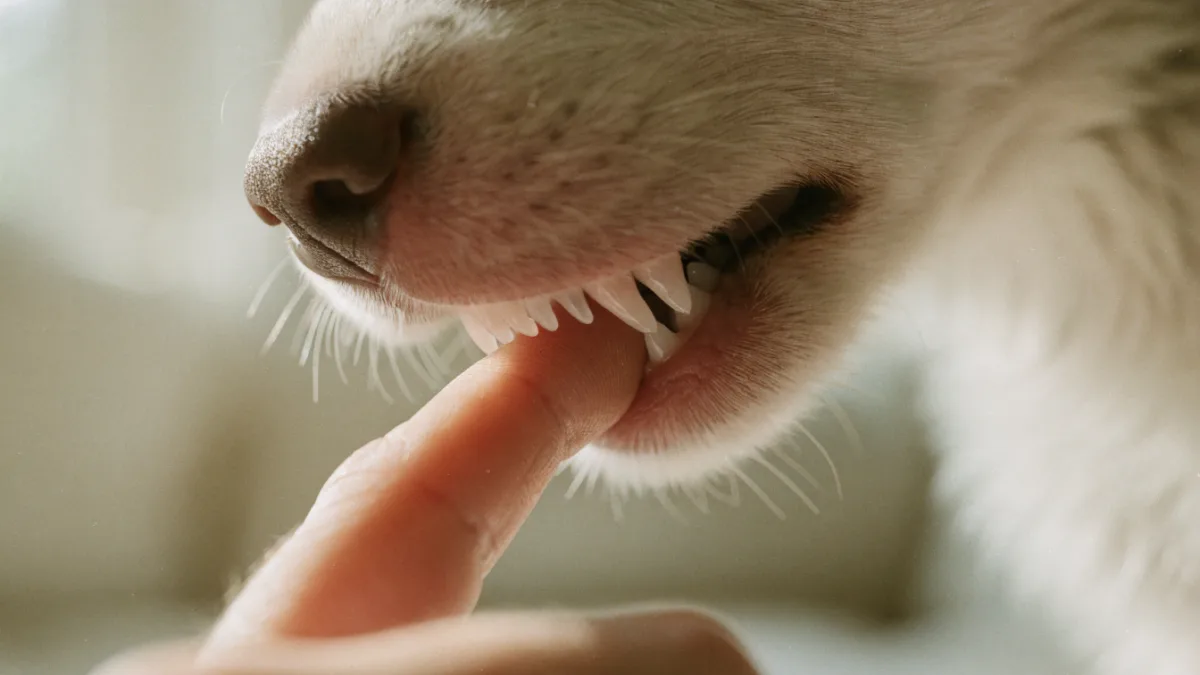
Those needle teeth driving you up the wall? Good — they’re doing their job. A puppy’s jaw muscles are barely warmed up at that age, so evolution compensated with 28 baby teeth thin enough to register on human skin like broken glass. That’s not a design flaw. That’s a feedback system, and it’s how puppies are supposed to learn how hard is too hard before their adult equipment arrives. The whole plan falls apart when an eight-week-old leaves the litter and lands with humans who either laugh, squeal, or just shove a toy at the problem. So let’s fix it properly — for the puppy, and for the kitten currently running ambush drills on your ankles.
Why Puppy Teeth Feel Like Hypodermic Needles
Start with the biology, because it changes how you see the biting. Weak jaws plus razor teeth equals instant feedback: the moment a puppy’s mouth closes too hard on a littermate, the bitten pup yelps and the game ends. No lectures, no drama — just cause and effect, repeated a few dozen times a day. That’s how a young dog calibrates his jaws while the stakes are still low.
The timeline matters more than most new owners realize. Mouthing typically peaks between 8 and 16 weeks. Teething — 28 baby teeth getting shoved out by 42 adult ones — runs roughly 12 to 24 weeks and cranks the chewing up another notch. And the soft-mouth lesson lands best before about 18 weeks of age, which makes this urgent rather than optional. So when someone in [1] asks whether eight weeks is too early to start bite inhibition work, the answer is no. That’s not a head start — that’s the schedule.
Bite Inhibition Training: Softer First, Then None
Bite inhibition is simply a dog’s ability to control the force of his mouth, and [2] is blunt about what’s at stake: a puppy who never learns it from people has no idea how sensitive human skin is. The classic protocol, popularized by trainer Jean Donaldson, runs in two stages — and the order is the part everyone gets backwards.
Stage one: teach gentle, not “never”
Here’s the counterintuitive part. In stage one, you deliberately let the puppy mouth you, because you can’t coach a behavior that never happens. When a bite comes in harder than your limit, mark it — a sharp, high-pitched “ouch,” your best littermate impression — then freeze the fun for a few seconds. As he figures that out, tighten the standard: hard bites first, then medium pressure, then any pressure at all. Only once his mouth is reliably soft do you move to stage two: teeth on human skin ends the interaction, every time. Force first, frequency second. Flip that order and you get a dog who was told “no biting” without ever learning how careful to be.
When the yelp makes it worse
Here’s where I admit I changed my tune. For years I told every client to yelp like a hurt littermate. Then I worked with a twelve-week-old terrier mix who heard “ouch!” and came back hotter — head low, butt up, absolutely delighted. To some puppies, that squeal sounds like prey. If yelping amps your puppy up, drop it. Say a calm, low “too bad,” stand up, turn away, or step out of the room for 20 to 30 seconds. Same lesson, boring delivery. Come back neutral and resume. Boring is the point.
When redirection alone fails
I used to think redirection was the whole answer: puppy bites, hand him a toy, done. I was wrong, and [3] explains why better than I can. Her puppy, even mid-play with toys in reach, went for hands, sleeves, and ankles — everything except the chew she’d just offered:
He bites everything but the toys.
A redirect answers what he chews, not how hard. Run the inhibition feedback and the redirection together and they cover each other’s weak spots. And don’t jerk your hand back when teeth connect — fast movement reads as fleeing prey and invites the chase. Go still, or ease out slow.
Head off the bitey hours
A lot of “biting” is a state, not a behavior. Track the pattern and you’ll find triggers: overtiredness (a cranky toddler with knives for teeth), overstimulation, hunger, the pre-bed zoomies. Enforced naps and a frozen stuffed chew fix more biting than any correction will. Bitter-tasting deterrent spray on hands and sleeves can help with pups who target clothing. And if you can arrange playtime with calm, healthy, vaccinated adult dogs or a well-run puppy class, take it — other dogs teach manners that human skin never can.
Kitten Attack Mode Is a Hunting Rehearsal
Same movie, different species. Stalk, butt-wiggle, pounce, grab, bunny-kick — that’s the complete predatory sequence, and your kitten is drilling it daily. He’s not angry and he’s not broken. He’s a small predator running ancestral software, and you’re the most entertaining prey in the apartment.
Now the uncomfortable part: most kitten play aggression is installed by humans. Every finger wiggled under the blanket, every “aw, he attacks my hand when I pet him, it’s so cute” moment teaches the same lesson — hands are toys. Single kittens get the worst of it because there’s no feline sparring partner absorbing that ambush energy. I fostered a singleton named Piston who treated my shoelaces, calves, and forearms as a personal hunting preserve until I changed my own behavior, not his.
Hunt, catch, kill, eat
The fix is scheduling, not suppression. Two or three times a day, run a real hunting session with a wand toy — the fishing-pole style that keeps your hands a full arm’s length from the action. Ten to fifteen minutes of stalking and chasing, and let him actually catch and “kill” the toy at the end. Then feed him a meal. You’ve just recreated the natural cycle: hunt, catch, kill, eat. In my experience, a kitten with a job has a lot less left over for the 3 a.m. ankle ambush.
Tools that keep your hands attached
- Wand toys for every interactive session — hands never become the prey object.
- Kicker toys — long, stuffing-soft shapes built for the grab-and-bunny-kick phase.
- Motorized or automated prey toys for the hours you’re at work or asleep.
- A second young kitten, if your situation allows — two kittens roughhouse each other and learn limits exactly the way puppy littermates do.
Whatever you do, don’t punish or hit. Fear doesn’t teach a small predator softness. It teaches him you’re dangerous, and defensive aggression is a much worse problem than normal play.
Skip the Old-School “Fixes”
You’ll still find them online: the nose tap, the muzzle clamp, the scruff-and-shake, the roll-and-hold. The American Veterinary Society of Animal Behavior’s 2021 position on humane training comes down firmly against punishment-based methods, and research backs the position — a 2020 University of Porto study found dogs trained with aversive methods showed more stress behaviors and more problem behaviors, not fewer. The logic is plain even without the citations: pain doesn’t teach a puppy that jaws have settings. It teaches him that you’re sometimes scary, and scary humans are worth biting harder around.
One honesty note while we’re here. The claim that soft-mouthed puppies grow into adults who do less damage if they ever bite is widely accepted in training culture but has thin direct research behind it. I still teach the protocol — the logic holds, the cost is zero — but you should hear the caveat from me rather than a stranger in a comment section.
Zoom all the way out and this gets easier to live with. The puppy gnawing your forearm and the kitten bombing your calves from under the couch are rehearsing the same skills their wild relatives — wolves, wildcats, everything in between — depend on to survive. Play-biting isn’t a defect someone accidentally bred into your pet. It’s raw material. Your job isn’t to delete it; it’s to teach your puppy that jaws have settings, give your kitten something worth hunting, and keep your skin intact while the lessons land. Do that before the window closes, and you’re not just raising a polite pet. You’re finishing the education their first family started.
Sources
- a puppy training group — facebook.com
- the ASPCA's guidance on puppy mouthing — aspca.org
- a post from the owner of a three-month-old pit bull mix — reddit.com