

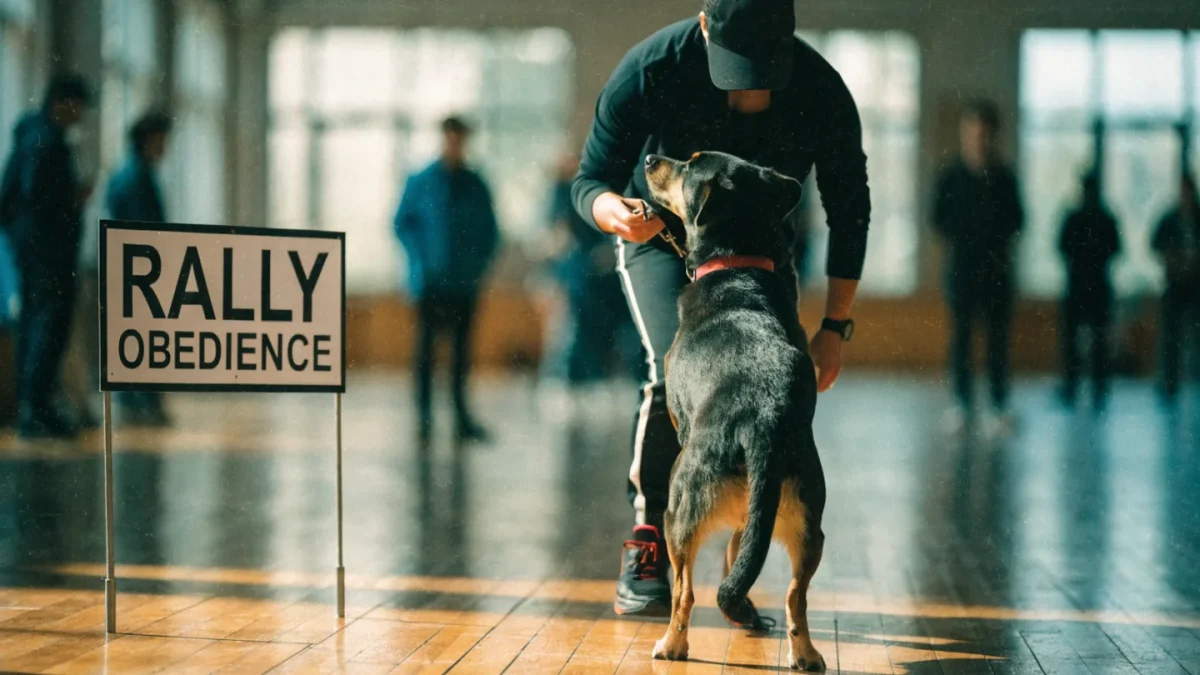
I have a soft spot for rally obedience. It's the sport that turned several of my clients — people who thought competing with their dogs was out of reach — into people who now train every day because they actually enjoy it.
The appeal is partly the format and partly the philosophy. Rally is meant to look like a team working together, not a handler trying to be invisible while their dog performs on command. You can cheer your dog on, help with hand signals, and have an obvious relationship with your dog on course. That's the point.
How It Works
A rally course consists of numbered signs arranged in a path through a ring. Each sign tells the handler and dog to perform a specific exercise — halt, about turn, down, sit, 360-degree turn, spiral, call front, and many others depending on the level.
Handler and dog move through the course in sequence, performing each station before moving to the next. There's no set time per station — you move at your own pace. Talking to your dog, using hand signals, and encouraging them verbally is not only allowed but celebrated.
Judges score deductions for errors: missed stations, sloppy performance, the dog leaving heel position. But the overall spirit is far more forgiving than competition obedience.
Rally vs. Competition Obedience
In competition obedience, the handler is expected to be relatively still and quiet. Talking to your dog, helping with hand signals mid-exercise, and any visible "commands" during performance are penalized.
Rally keeps all of that in. You're navigating a course together, communicating as you go. For most dogs and handlers, this creates a more natural and relaxed performance than the controlled stillness of formal obedience.
Advanced obedience training provides the skill foundation that makes rally flow, but the sport doesn't require competition-level precision to enjoy.
The Skill Foundation
To compete at entry-level rally, your dog needs:
- Reliable sit, down, and stand
- Basic loose-leash walking/heel
- Sit-stay and down-stay with moderate duration
- Recall (front and finish)
- Some comfort with crowds, other dogs, and indoor trial environments
Most dogs with six months of basic training have the raw skills for entry-level rally. The sport teaches you how to apply them on a course.
Levels of Progression
Organizations that sanction rally typically offer multiple levels — novice (no jumps, signs mostly familiar), intermediate, advanced, and masters or excellent. Each level adds more complex skills and challenges.
The novice level is genuinely accessible for most handler-dog teams. Many handlers complete their first title within three to six months of entering the sport.
Why It's Good for the Training Relationship
Rally courses reward the handler for staying engaged with the dog throughout the run — you can't zone out and hope the dog knows what to do. You're reading the sign, deciding your path, cuing your dog, and reading their responses simultaneously.
This creates a feedback loop that trains you as much as the dog. Handlers who compete in rally often say their everyday training improved dramatically because they got much better at timing, body language, and reading their dog's state.
Getting started in agility is often the next step for rally handlers who want a more physical sport — many of the handler skills transfer directly.
How to Get Started
Look for a rally class through a local training club. Many areas offer beginner rally workshops or classes specifically designed to prepare teams for their first trial.
Practice the novice signs at home before worrying about a course. Download a list of sign pictures (available from rally sanctioning organizations), and spend a few minutes each session on one or two stations. When the individual skills are fluent, putting them into a course flow is relatively easy.
Rally is competitive if you want it to be. It's also perfectly valid to enter one trial, get your dog comfortable with the environment, and never compete again. The training you built getting there doesn't disappear.