

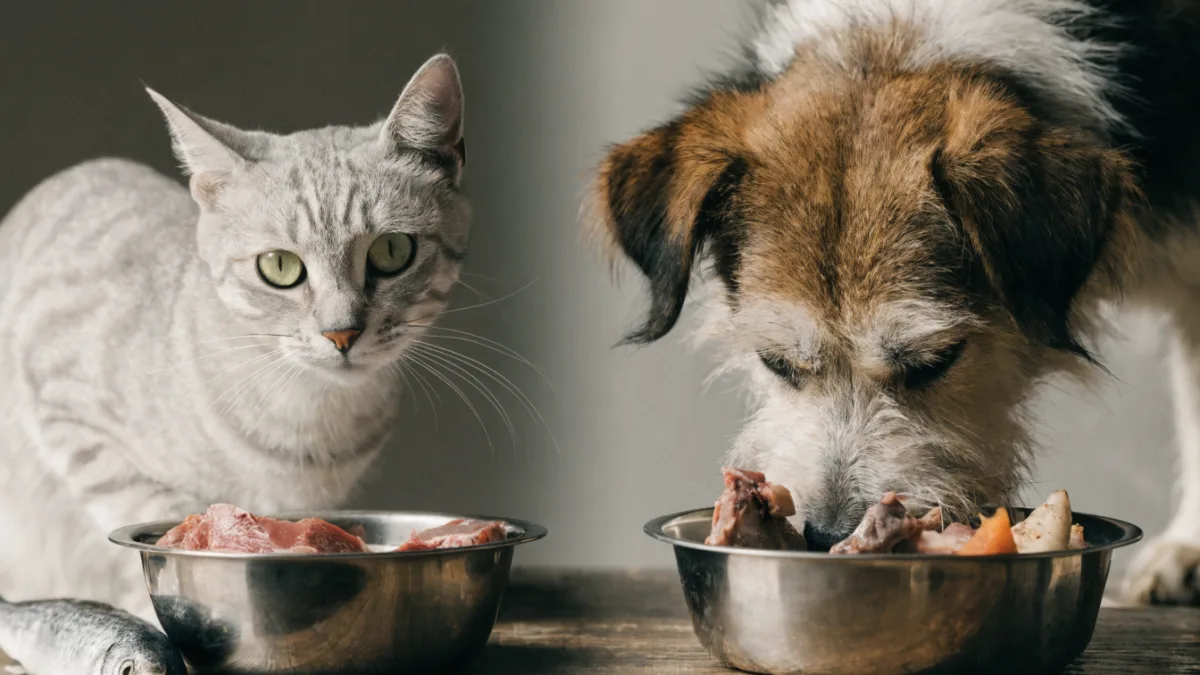
Just last week, I had a client named Margaret sit across from me with her nine-year-old Siamese cat, Oliver, cradled in her arms. Oliver had lost nearly two pounds over three months, and his once-glossy coat had turned dull and brittle. “I switched him to a raw chicken diet,” she told me, a little defensively. “My neighbor’s golden retriever thrives on it, so I figured it would be even better for a cat.” That assumption — understandable, common, and deeply flawed — sits at the heart of one of the most heated debates in modern veterinary nutrition. Cats and dogs may share our homes, our sofas, and sometimes our leftovers, but when it comes to what they should eat, they are fundamentally different creatures. And the raw diet conversation forces us to confront exactly how different they are.
Obligate vs. Scavenging: Two Very Different Evolutionary Paths
To understand why the raw diet debate plays out so differently for cats and dogs, you have to start with biology. Cats are obligate carnivores, sometimes called “true” or “strict” carnivores. That word “obligate” matters — it means they must consume animal flesh to survive. Their bodies are biologically locked into processing meat. Every enzyme, every metabolic pathway, every nutritional requirement has evolved around a single food source: prey animals.
Dogs, on the other hand, are classified as scavenging carnivores. They’re highly carnivorous, yes — far more so than humans — but they carry a dietary flexibility that cats simply don’t have. Thousands of years of living alongside humans, scavenging from our campsites and trash heaps, gave dogs the ability to extract nutrients from a wider range of sources, including some plant matter and carbohydrates. A dog can survive on a diet that would slowly starve a cat.
I often explain it to clients this way: if you left a cat and a dog in the wild with no prey, the dog could forage on berries, tubers, and whatever scraps it found for quite a while. The cat would die. Cats lack the digestive enzyme amylase, which is required to break down carbohydrates into usable energy. Feed a cat a bowl of rice or corn, and her body essentially has no idea what to do with it. Those carbohydrates pass through largely unprocessed — or worse, they contribute to metabolic stress over time.
The Carbohydrate Problem in Commercial Cat Food
This is where the raw diet movement gains real traction, and frankly, where I’ve had to change my own thinking over the years. When I graduated veterinary school, I was taught that dry kibble was perfectly adequate for cats. The science was settled, we were told. But two decades of clinical experience — and a growing body of research — have made me considerably more circumspect.
Here’s the uncomfortable truth: many commercial dry cat foods contain 30 to 50 percent carbohydrates. That’s because kibble manufacturing requires carbohydrates to hold the pieces together — you literally cannot make dry food stick without starch. Now think about what a cat eats in the wild: a mouse is roughly 55 percent protein, 35 percent fat, and only about 3 to 5 percent carbohydrates. That’s a staggering gap between nature and the food bowl.
Over time, this mismatch takes a toll. I’ve seen cats like Whiskers, an eleven-year-old tabby who came to me with early-stage diabetes, overweight and lethargic, eating a “premium” dry food that was nearly 40 percent carbs. His owner was stunned. “But it says complete and balanced on the bag,” she said. And she was right — it met the legal requirements. But meeting minimum standards isn’t the same as honoring biological design. When we shifted Whiskers to a high-protein, low-carbohydrate wet food, his blood glucose normalized within four months. I’ve seen this pattern enough times that I can no longer pretend it’s coincidence.
Why Dog Food Is Dangerous for Cats
If carbohydrates are the slow poison for cats, then dog food is the acute one. The nutritional profiles of cat and dog foods are vastly different — and not by accident. Cats require significantly more protein and calories per pound of body weight than dogs. More critically, cats need specific amino acids that dogs can synthesize on their own.
The most famous example is taurine. Dogs can manufacture taurine from other amino acids in their diet. Cats cannot. They must consume it directly from animal tissue — heart muscle, dark meat, and certain seafoods are rich sources. A cat fed dog food will develop taurine deficiency, and the consequences are devastating: a condition called dilated cardiomyopathy, where the heart muscle weakens and enlarges until it can no longer pump blood effectively, and central retinal degeneration, which causes irreversible blindness.
Before pet food regulations tightened, cases like Luna’s were more common than they should have been — a young cat surreptitiously eating the family dog’s food for months. Her owner thought she was being clever; Luna preferred the dog’s kibble to her own. By the time she reached a clinic, her vision was failing and her heart was struggling. It was caught in time, but barely. Those cases stay with you.
The Raw Diet Debate: Promise vs. Peril
So if cats are obligate carnivores who can’t process carbohydrates, and if commercial diets are often loaded with them, doesn’t raw feeding make perfect sense? Many pet owners — and an increasing number of breeders and holistic practitioners — say yes. A [1] notes that raw meat diets for companion animals have become a major focal point of veterinary research, driven largely by consumer demand for unprocessed, biologically appropriate foods.
The arguments in favor are compelling on their surface. Raw diets are naturally low in carbohydrates. They contain no highly processed ingredients, no artificial preservatives, no rendered meals that have been cooked at temperatures that destroy heat-sensitive nutrients. Proponents point to shinier coats, smaller and less odorous stools, cleaner teeth, and improved energy levels. I’ve met cats on well-formulated raw diets who look genuinely magnificent — lean, glossy, and bright-eyed.
Raw feeding honors the cat’s evolutionary design in a way that a bag of kibble simply cannot. The question isn’t whether raw food is biologically appropriate — it clearly is. The question is whether we can execute it safely and consistently in a home kitchen.
And that’s where my caution kicks in. The veterinary community’s concern with raw diets centers on two issues, both legitimate. The first is bacterial contamination. Raw meat — even human-grade, even organic — carries risk of Salmonella, E. coli, and Listeria. These pathogens don’t just affect the pet. They shed in feces and saliva, meaning they can spread to immunocompromised humans in the household: infants, elderly family members, chemotherapy patients. There are documented cases of cats developing serious bacterial infections from contaminated raw poultry, and of family members falling ill after handling raw pet food.
The second concern is nutritional imbalance. Muscle meat alone — even high-quality, hormone-free chicken breast — is not a complete diet. Wild cats consume entire prey: organs, bones, connective tissue, stomach contents. Each component provides essential nutrients. Calcium comes from bone. Vitamin A comes from liver. Taurine comes from heart tissue. An owner who feeds their cat ground chicken breast, even with the best intentions, is creating deficiencies that may take months or years to manifest.
I think of a client named David who was feeding his two Bengal cats a homemade raw diet of chicken thighs and a supplement powder he’d ordered online. The cats looked healthy initially, but six months later, one developed a subtle hind-leg weakness that turned out to be a calcium deficiency. The supplement he’d chosen didn’t contain the right form, or enough of it. He was devastated. “I was trying to do the best thing for them,” he said. And he was. Intention isn’t the problem — execution is.
What I Actually Recommend
Here’s where I’ve landed after years of wrestling with this question: the raw diet philosophy is sound, but the practice is where things get risky. For clients who are committed to raw feeding, I work with a veterinary nutritionist to formulate a complete and balanced recipe — one that includes the right ratio of muscle meat, organ meat, bone, and specific supplements. If you’re going to feed raw, look for commercial products that meet established nutritional standards (such as AAFCO or equivalent international certifications) and have undergone testing for pathogens. If that’s not available where you live, a high-protein, low-carbohydrate wet food is an excellent alternative that captures many of the biological benefits without the safety risks.
Never transition a cat to a raw diet — or any new diet — without consulting your veterinarian first. Every cat’s health status is different, and what works for a healthy two-year-old may be dangerous for a senior cat with kidney disease.
Understanding Is Half the Battle
The raw diet debate isn’t really about raw meat versus kibble. It’s about whether we’re willing to understand our companion animals for who they actually are — not as small, furry humans with preferences, but as species with specific, inflexible biological requirements shaped by millions of years of evolution. Cats are hunters. Dogs are scavengers. Honoring that distinction — in whatever form our feeding takes — is one of the most fundamental acts of care we can offer them.
Oliver, by the way, recovered fully. He was transitioned to a properly formulated, nutritionally complete raw diet designed specifically for cats, with the right balance of organ meats and taurine-rich tissue. At his last checkup, Margaret reported he was climbing the curtains again. She sounded exasperated. That was the best news anyone had heard all week.
Sources
- 2025 peer-reviewed paper published through the NIH — pmc.ncbi.nlm.nih.gov