

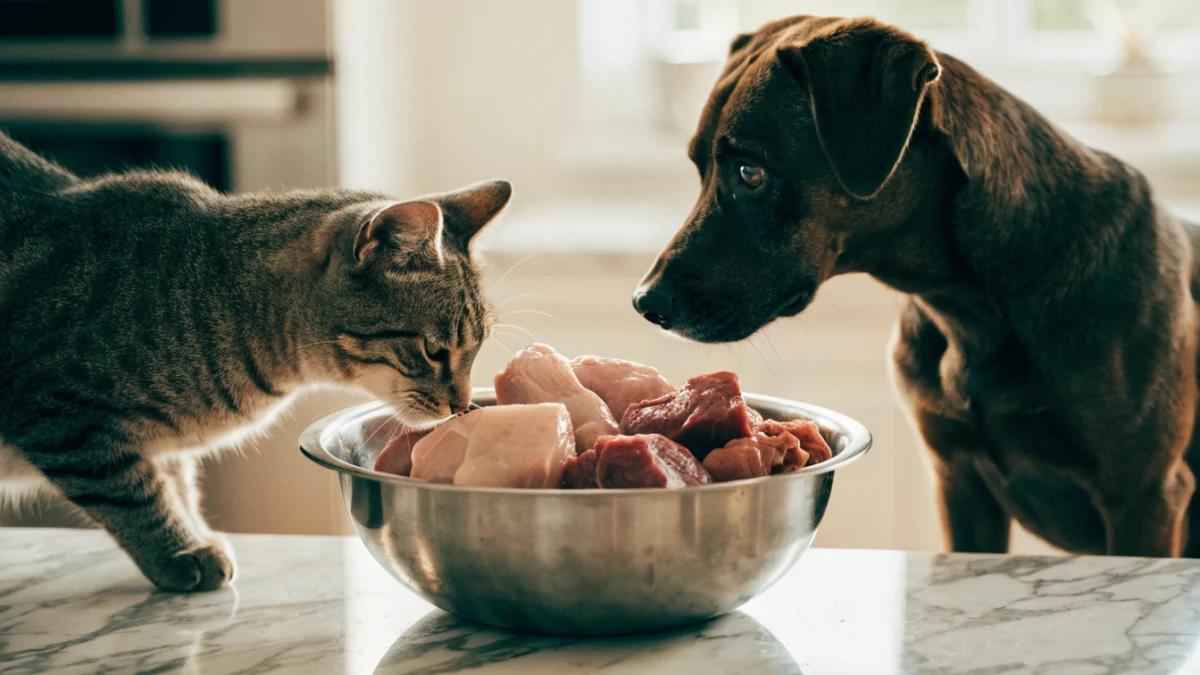
Scroll through pet TikTok for five minutes and you’ll find it: slow-motion clips of raw chicken thighs hitting stainless steel bowls, #rawfeeding videos racking up billions of cumulative views, and glossy before-and-after transformations that look almost too good to be true. Raw feeding has gone from fringe practice to full-blown movement, and I field questions about it in nearly every wellness exam these days. But the conversation shifted sharply in late 2024, when frozen raw cat food contaminated with H5N1 avian influenza was linked to domestic cat deaths, and roughly 20 big cats died at a Washington state wild felid sanctuary after eating infected raw poultry. Suddenly, “should I feed raw?” wasn’t just a lifestyle question — it was a public health one. Here’s what the evidence actually says about a raw diet for dogs and cats, and where I’ve landed after two decades in the exam room.
From a 1993 Bookshelf to a Billion-View Hashtag
The modern movement traces back to Australian veterinarian Ian Billinghurst’s 1993 book Give Your Dog a Bone, which argued dogs should eat like their ancestors: raw meat, bones, and organs. Today “raw feeding” covers a surprisingly wide spectrum:
- Commercial raw: frozen, freeze-dried, or dehydrated products, often marketed as complete diets
- Homemade BARF: “biologically appropriate raw food” recipes assembled in the owner’s kitchen
- Whole prey: entire carcasses — rabbits, chicks, quail — fed as nature intended
The explosion is no accident. The same generation that scrutinizes ingredient labels on its own food has turned that lens on pet bowls, and “ancestral diet” narratives are tailor-made for social media. Last month a client named Priya brought in Maya, her two-year-old Australian Shepherd, and told me plainly: “If I wouldn’t eat ultra-processed food every single day, why should she?” That’s a fair question, and I don’t roll my eyes at it — I used to, early in my career, and that was a mistake.
There’s also real distrust floating around. “Vets are paid by Big Kibble” gets repeated constantly online, and the uncomfortable truth is that pet food manufacturers do fund veterinary nutrition research and education, which gives the claim just enough traction to spread. Acknowledging that conflict of interest honestly, I’ve found, opens more doors than pretending it doesn’t exist.
What the Microbiology Actually Shows
The contamination data
Whatever you think of the philosophy, the bacterial numbers are consistent across studies and countries. An FDA retail survey of 196 commercially available raw pet foods (Nemser et al., 2014) detected Salmonella in roughly 8 percent and Listeria species in about 16 percent of samples. A Dutch study of 35 frozen raw meat products published in Veterinary Record went further: Listeria monocytogenes in 43 percent, E. coli O157 in 23 percent, Salmonella in 20 percent, and Toxoplasma gondii in 6 percent. A.[1] summarized the three best-documented risks: malnutrition, infection in the pets themselves, and shedding of bacteria — including antibiotic-resistant strains — into the home.
Who’s actually at risk
Here’s the part that surprises people: dogs and cats can shed Salmonella or resistant E. coli in their feces for days while looking completely healthy. The animal isn’t sick; the toddler crawling on the floor where the bowl was is who ends up in the ER. The highest-risk households include children under five, adults over 65, pregnant people, and anyone immunocompromised. This isn’t theoretical — in 2018, a Minnesota raw pet food company’s products were recalled after a Salmonella outbreak sickened people in several states, including children, and multiple FDA recalls involving raw products have followed since.
Two newer developments have raised the stakes. UK studies from 2022 onward found raw-fed dogs were significantly more likely to carry ESBL-producing E. coli — bacteria resistant to frontline antibiotics — with evidence of transmission between dogs and their humans. And the H5N1 cat deaths of 2024–2025 prompted the sharpest federal stance yet: FDA and CDC officials publicly advised against feeding raw meat and unpasteurized milk to pets. The Canadian Veterinary Medical Association’s position is blunt:
The scientific evidence of animal and human health risks in feeding raw meat-based pet food products outweighs any purported benefits.
The CDC, AVMA, AAHA, and most board-certified veterinary nutritionists [2]
The Benefits: Real Observations, Weaker Evidence
Now let me be fair to the other side, because owner reports aren’t fiction. Raw meat is highly digestible, so smaller, firmer stools are genuinely expected. Clients genuinely do report glossier coats — Biscuit, a five-year-old Corgi I see, transformed from dull to show-ring shiny within two months of switching, and his owner Heather mentions it at every visit. A University of Helsinki survey project found owners of raw-fed dogs reported fewer gastrointestinal and skin issues. And raw meaty bones do mechanically reduce plaque.
But here’s my honest read of that evidence pile: it’s nearly all surveys, testimonials, and plausibility — not controlled trials. The Helsinki data relies on owner reporting, which is prone to bias. Veterinary dentists will tell you bones also fracture teeth and cause GI obstructions often enough that they have a name for the crowns they repair. And when researchers have analyzed homemade raw recipes, the overwhelming majority were nutritionally inadequate — including recipes written by veterinarians. The case files are sobering: kittens fed all-meat diets developing nutritional secondary hyperparathyroidism (a calcium imbalance that softens growing bones), cats becoming hyperthyroid from thyroid tissue hiding in raw gullet treats, and vitamin E–deficiency pansteatitis in fish-heavy raw diets.
I’ve changed my mind on one thing: I no longer dismiss what owners observe. The real question isn’t whether those improvements happen — it’s whether live bacteria are the only route to them. “Gently cooked” fresh diets are booming precisely because they capture the freshness appeal without live pathogens, and that’s where I now steer most raw-curious clients.
Dogs vs. Cats: Two Different Debates
Cats give raw feeders their strongest argument. They’re obligate carnivores with an absolute dietary requirement for taurine, and many do metabolically poorly on high-carbohydrate foods. But:[3] they shed Salmonella asymptomatically, the Toxoplasma finding in the Dutch study matters enormously for pregnant owners, and cats were the ones dying in the H5N1 contamination events. Kittens are especially fragile — take Mochi, a six-month-old Bengal treated for lameness and a telltale caved-in chest wall after eight weeks on a homemade chicken-only diet. “The breeder said it was what nature intended,” his owner said, near tears. Nature intends kittens to eat whole prey, including bone and organs — not breast meat from a supermarket packet.
Dogs, frankly, are more forgiving. Their scavenger heritage means they handle nutritional slop better than cats do, and a nutritionally complete raw diet for a healthy adult dog is a different risk conversation than the same bowl in a house with a toddler or a chemotherapy patient. The debate differs by species, by life stage, and by who else lives in the home — which is exactly why one-size internet advice fails.
If You Feed Raw Anyway: Harm Reduction
Plenty of owners choose raw despite everything above, and lecturing them helps nobody. If that’s you, here’s how to shrink the risk:
- Choose commercially prepared “complete” diets that meet recognized nutritional adequacy standards (look for AAFCO statements in North America or FEDIAF compliance in Europe) rather than homemade recipes
- Consider high-pressure pasteurized (HPP) products — but know that freeze-dried raw is not pathogen-free; it has repeatedly tested positive for Salmonella and Listeria
- Treat raw meat in your kitchen like raw chicken for humans: dedicated utensils and surfaces, thorough handwashing, and disinfected bowls
- Skip raw pork and anything containing unpasteurized dairy
- If you’re committed to homemade, invest in a formulation from a board-certified veterinary nutritionist rather than a recipe from a Facebook group
- Reconsider entirely if anyone in the home is pregnant, very young, elderly, or immunocompromised
So, is raw pet food safe? The honest answer: the microbial risks are well-documented and consistent, the benefits are plausible but under-tested at the level science demands, and your household’s health picture should drive the decision as much as your pet’s. My takeaway after watching this debate evolve: our pets don’t need narratives about ancestral wolves — they need diets formulated to actual, measured nutrient requirements. And for a climate-aware generation, it’s worth remembering that raw feeding leans heavily on livestock products at a moment when a billion-plus dogs and cats share the planet’s resources. Feeding well and feeding lightly aren’t opposed goals — the most evidence-based diets tend to serve both. Whatever bowl you choose, choose it with your vet, your whole household, and honestly, the planet in mind.
Sources
- widely cited 2019 review — pmc.ncbi.nlm.nih.gov
- have taken similar positions — canadianveterinarians.net
- raw food for cats carries its own complications — fda.gov