
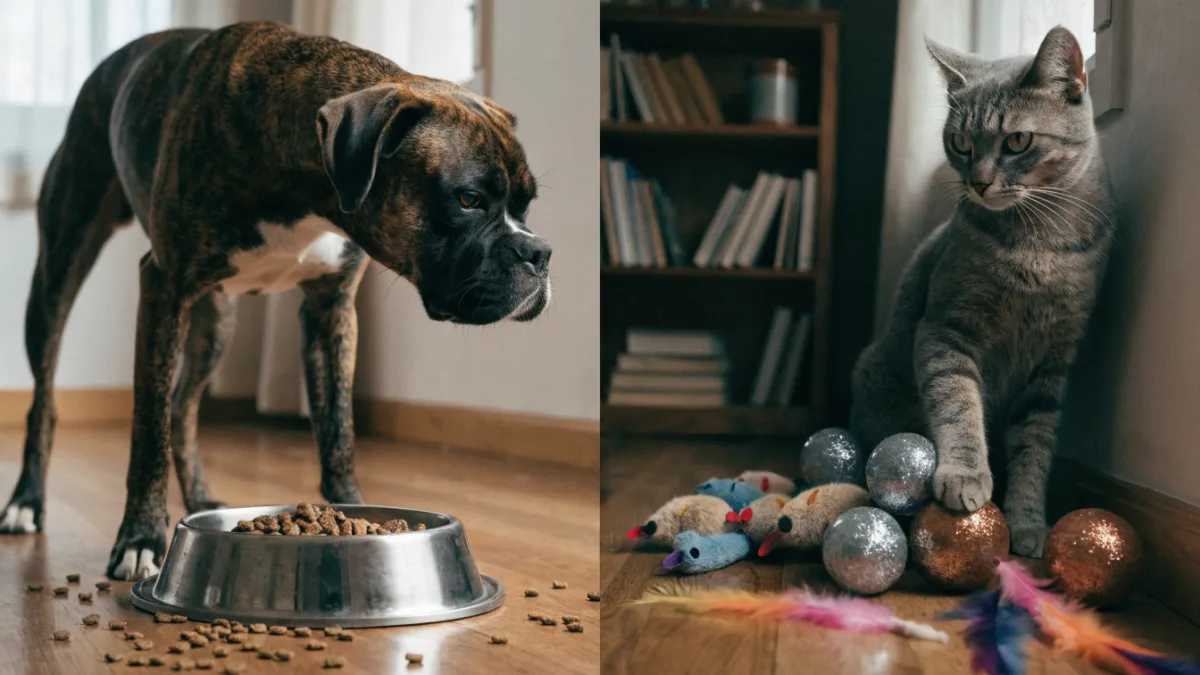
Picture this: you drop a scoop of kibble into your dog’s bowl, and the family cat wanders into the kitchen. Within a split second, your dog freezes. Their eyes go wide, their body stiffens like a board, and a low, rumbling growl shakes their chest. Now, picture a totally different scene. You’re doing your weekly cleaning, move the living room rug, and find a secret stash of fifteen catnip mice, plastic bottle caps, and stolen hair ties.
Both of these scenarios come from the exact same root cause: resource guarding. It’s one of the most common behavioral issues in multi-pet households, but dogs and cats handle it in completely different ways. Dogs usually get loud, reactive, and highly obvious about it. Cats? They turn into stealthy little hoarders, quietly moving their treasure to hidden lairs.
With the massive surge in pet adoptions over the last few years, more dogs are living indoors with free-roaming cats than ever before. That means shared living spaces are getting smaller, and resource-guarding triggers are firing off at record rates. If you’re dealing with friction between your pets, understanding the mechanics of “mine!” is the first step to getting everyone to just relax.
The Canine Escalation Ladder: Food Aggression in Dogs
Dogs wear their emotions on their sleeves. When a dog feels like someone is going to steal their stuff, they follow a highly predictable escalation ladder. It usually starts with a physical freeze. They stop chewing, get stiff over the food bowl, and might give a hard stare. If the perceived threat—say, your curious cat—gets closer, the dog will likely move straight into lunging, snarling, and barking.
I used to work with a German Shepherd named Gus who had recently transitioned from living with two other dogs to being the only dog in a house with three indoor cats. Before the move, Gus was fine. But in this new environment, he started aggressively guarding his food bowl, his high-value chew toys, and even his favorite spot on the couch from the feline housemates. It wasn’t that Gus suddenly hated cats. He just didn’t understand the new social dynamics and felt incredibly insecure about his resources.
Why You Never Punish the Growl
When a dog growls over a bowl of food, our first instinct is usually to tell them “No!” I used to do exactly that when I first started working with dogs, thinking I was correcting bad behavior. I was completely wrong.
When you punish a dog for growling, you don’t fix the underlying anxiety. You just teach them that you don’t like the early warning signs. The next time the cat walks by, the dog will skip the growl entirely and go straight to a bite. That growl is your dog’s way of saying, “I’m really uncomfortable right now, please back off.” Let them have their warning. It keeps everyone safe.
The Silent Guarder: Toy Hoarding in Cats
While dogs are noisy about their valuables, cats take a completely different approach. Feline resource guarding is usually stealthy. Instead of brawling over a food bowl, a cat will often carry their favorite toys to hidden spots—under the sofa, behind the refrigerator, or deep into a closet.
I remember walking into a client’s home where their Siamese cat had effectively claimed the entire downstairs hallway. The dog wouldn’t walk through it. The cat didn’t growl or bark. She just sat at the end of the hall, giving a hard stare, and would silently swat the dog on the nose if he tried to pass to get to his water bowl.
Feline hoarding and silent blocking happen when a cat feels a lack of environmental security. In a multi-pet home, a cat might feel like they have to compete with the dog for access to the good stuff. So, they take matters into their own paws. They hoard toys, block access to shared spaces, or guard the cat tree. It looks cute—until the dog decides he’s had enough and snaps back.
Managing Your Multi-Species Living Room
You cannot train a dog or a cat out of guarding if they are constantly put in situations where they feel they have to defend their stuff. Management is always your first line of defense. You have to set up the environment so the bad behavior can’t happen in the first place.
- Feed separately: This is non-negotiable. Your dog and cat should eat in completely separate rooms, ideally with a closed door between them. There should be no eyeballing each other’s bowls.
- Pick up the high-value stuff: If your dog gets weird about bones or pig ears, only give those to them when they are in their crate or locked in a separate room. If your cat hoards specific catnip toys, keep them put away and bring them out for supervised play sessions.
- Create separate highways: Make sure your cat has vertical space they can easily escape to. A high shelf, a dedicated cat tree, or window perch gives the cat a safe zone away from the dog’s floor-level world.
Changing the Mindset: The Trade-Up Game
Once you have the environment under control, you can start behavior modification. The goal here isn’t to show your dog who the “alpha” is. You want to change how your dog feels when the cat approaches their food. Right now, they think cat near food = food goes away. We need to flip that script to cat near food = amazing things happen.
This is where the “Trade-Up” game comes in. Let’s say your dog has a standard chew toy, and you want to take it away. Instead of just prying it out of their mouth—which will absolutely make their guarding worse—you offer them something better. You show them a piece of roasted chicken or a high-value meat treat. They drop the toy, you give them the chicken, and you return the toy.
You teach your dog that your presence (or the cat’s presence) doesn’t mean they lose their stuff. It means they get paid. You can start rewarding your dog with high-value treats the second the cat enters the kitchen while the dog is eating. If the dog stays calm, they get a jackpot of treats dropped right into their bowl.
Tackling Feline Insecurity
For the cats, the strategy is different. You have to build their confidence by making resources seem endless. A lack of perceived resources often triggers feline hoarding behaviors. If you have one cat and one dog, put out three water bowls, three scratching posts, and scatter toys all over the house. Once the cat realizes there is plenty to go around, the urge to secretly hoard them under the fridge usually fades away.
The “Fast Fix” Myth
If you spend five minutes on an animal forum like,[1] you’ll see a lot of desperate owners looking for quick solutions. There is a constant debate in the animal training community between trainers marketing “fast” fixes and veterinary behaviorists who rely on slow, systematic modification.
Don’t buy into the fast fixes. Resource guarding is deeply rooted in survival instinct. You aren’t going to fix it in a single weekend session. True modification requires slow, systematic desensitization. You work at the animal’s pace, rewarding calm behavior and backing off the second they show signs of stress.
Alongside behavior modification, don’t underestimate the power of physical and mental exercise. I saw this firsthand with Gus, the German Shepherd I mentioned earlier. Once his owners started enforcing consistent household boundaries and gave him an extra thirty minutes of intense mental and physical exercise every morning, his overall anxiety dropped. A physically and mentally tired dog is far less likely to feel the need to actively guard territory or resources from the house cat. [2] through purposeful, structured play establishes trust, and trust is the ultimate antidote to guarding.
At the end of the day, our pets aren’t trying to be stubborn or mean when they hoard toys or growl over kibble. They are just animals doing exactly what nature programmed them to do: securing their survival. When we stop viewing resource guarding as an act of defiance and start seeing it as an expression of anxiety, we can start making real progress. Creating a peaceful multi-species household isn’t about dominating your pets into submission. It’s about building an environment where the food never runs out, the toys are plentiful, and nobody ever feels the need to say “mine.”
Sources
- Reddit's reactive dogs community — reddit.com
- Building a stronger bond — doggoneproblems.com