

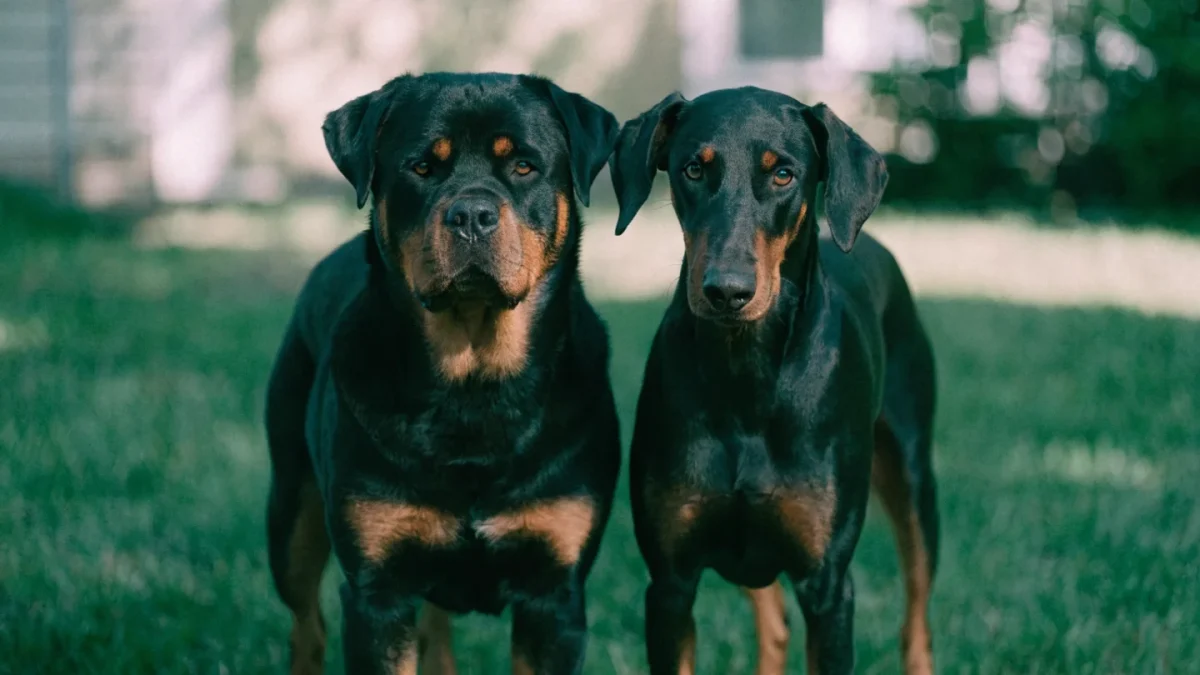
Karl Friedrich Louis Dobermann was a German tax collector in the 1880s who wanted a dog that would protect him on his rounds. He bred what became the Doberman Pinscher by combining several breeds — likely including the Rottweiler itself, along with Greyhounds, Weimaraners, and German Pinschers. So these two breeds share genetic history, but the Doberman was engineered to be a faster, leaner, more alert version of the guardian prototype the Rottweiler represents.
Both breeds carry unfair reputations shaped more by media portrayal than reality. Both deserve an honest, head-to-head look. For the evaluation framework I use across all breed comparisons, start with the breed comparisons guide.
Size and Build
| Trait | Rottweiler | Doberman Pinscher |
|---|---|---|
| Height (male) | 61–69 cm | 66–72 cm |
| Height (female) | 56–63 cm | 61–68 cm |
| Weight (male) | 43–60 kg | 34–45 kg |
| Weight (female) | 36–48 kg | 27–36 kg |
| Build | Massive, broad, heavy-boned | Tall, lean, athletic |
The Rottweiler is a tank. Wide chest, thick neck, heavy bone throughout. The Doberman is built like a sprinter — tall, narrow, and muscular without bulk. A Rottweiler's power comes from raw mass. A Doberman's comes from speed and agility.
Temperament
Rottweilers are calm, confident, and somewhat aloof with strangers. They assess situations before reacting, which gives them a steady, reliable presence. Well-socialized Rotties are gentle with their families — surprisingly goofy behind closed doors — but they project natural authority that doesn't require overt aggression.
Dobermans are more alert, more emotionally tuned to their handlers, and more reactive to environmental changes. They're often described as "velcro dogs" because they shadow their owners relentlessly. A Doberman left alone struggles more than a Rottweiler left alone. The Doberman's sensitivity makes them highly responsive to positive reinforcement but also more susceptible to anxiety if the household is chaotic or the owner is inconsistent.
Both breeds require thorough socialization from puppyhood. Under-socialized guardian breeds of any type become liabilities, not assets.
Exercise
Rottweilers need 60 to 90 minutes of daily exercise — walks, moderate runs, strength activities like cart pulling or weighted walks. They're not built for endurance running but excel in activities that leverage their power.
Dobermans need 60 to 90+ minutes and are more athletically versatile. They're faster, more agile, and better suited to running alongside a bicycle or participating in agility courses. The Doberman is a genuine athlete; the Rottweiler is a powerful workhorse. Different kinds of fitness.
Grooming
Both breeds have short, smooth coats that are low-maintenance. Weekly brushing, occasional baths. The Rottweiler sheds more than the Doberman — the Rottie's undercoat is denser — but neither requires anything approaching the grooming commitment of double-coated breeds.
Health
| Health Factor | Rottweiler | Doberman Pinscher |
|---|---|---|
| Top concern | Cancer (osteosarcoma, lymphoma) | Dilated cardiomyopathy (DCM) |
| Lifespan | 8–10 years | 10–12 years |
| Joint issues | Hip/elbow dysplasia (common) | Less common |
| Heart disease | Subaortic stenosis risk | DCM prevalence very high |
| Bloat risk | High | Moderate to high |
The health profiles are both serious but different. Rottweilers have high cancer rates, particularly osteosarcoma (bone cancer), and their lifespan is shorter than you'd expect for a well-bred purebred. Dobermans face dilated cardiomyopathy at alarming rates — a 2010 study published in the Journal of Veterinary Internal Medicine by Wess et al. reported a prevalence of 58% across various age groups, with approximately 50% of males and 33% of females developing DCM. Annual cardiac screening is strongly recommended for all Dobermans. Both concerns are life-limiting and should factor heavily into your decision.
Which Fits Your Life?
Choose the Rottweiler if you want a powerful, confident guardian that's relatively calm in the home, doesn't need constant emotional reassurance, and can handle moderate daily exercise. Be prepared for a shorter lifespan and the physical demands of managing a 50+ kg dog.
Choose the Doberman Pinscher if you want a more athletic, handler-bonded guardian and can provide the emotional consistency this breed needs. The Doberman is faster and more agile but demands a deeper emotional investment. Budget for cardiac screening as a routine expense.
For a comparison involving the Rottweiler against another powerful guardian, see the Cane Corso vs Rottweiler breakdown. For a deep-dive into the Doberman's history, cardiac health profile, and training requirements, the Doberman Pinscher complete breed guide covers the breed in full. For the Rottweiler's Roman drover heritage, osteosarcoma risk, and temperament profile in depth, the Rottweiler complete breed guide provides the full reference.