

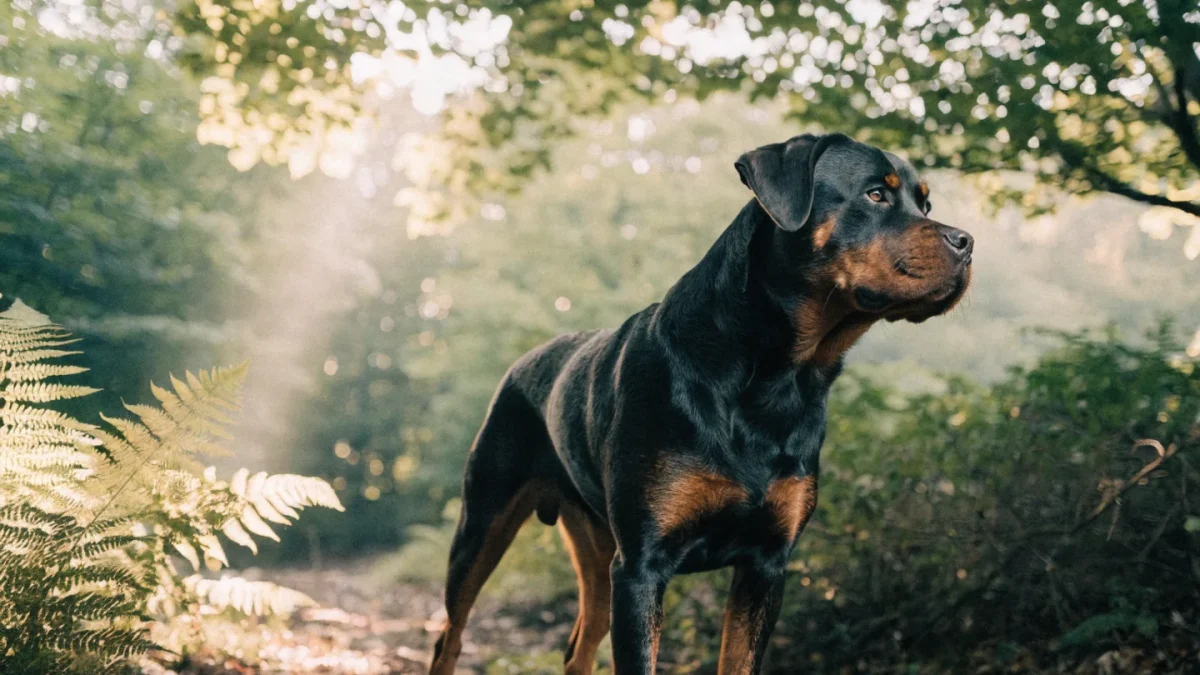
The rottweiler's resume is roughly two thousand years old. When Roman legions marched across the Alps into what is now southern Germany during the first century CE, they brought herding dogs to drive the cattle that fed the army. Those dogs settled with Roman colonizers in a small trading town that would eventually be called Rottweil — named after the red tiles ("rote Wil") of a Roman bathhouse excavated centuries later. The breed that emerged from those dogs became the butchers' companion, the drovers' enforcer, and one of the most misunderstood working breeds in the modern world.
Rottweilers are large, powerful working dogs with roots stretching back to Roman drover stock, refined over centuries in the German town of Rottweil as cattle drivers and guardians. They possess a calm yet watchful temperament, strong protective instincts, and a trainability that surprises people who've only encountered the breed through sensationalized headlines. This rottweiler breed guide covers the actual breed — history, structure, health predispositions, grooming realities, and an honest assessment of who should and shouldn't share a home with one.
And there's plenty that most people get wrong about rottweilers. The stereotype of an aggressive, uncontrollable dog says more about irresponsible ownership than it does about the breed. Let me walk through what the evidence and the breed's own history actually tell us.
Origins and History of the Rottweiler
Roman Roots
The ancestral dogs that traveled with Roman legions were a mastiff-type, broad-chested and endurance-built, capable of herding livestock over mountain passes and guarding camps at night. When the Roman Empire's reach contracted, those dogs stayed behind in settlements across what is now the Baden-Württemberg region of Germany. Rottweil became a thriving cattle market town by the medieval period, and the local butchers needed dogs that could drive cattle to market, pull carts of meat, and guard the proceeds on the way home.
These were working animals earning their keep. A Rottweil butcher's dog that couldn't manage an obstinate bull calf or deter a roadside thief didn't get bred. That selection pressure — practical, unromantic, and relentless — produced a dog that was physically powerful, mentally steady, and deeply attuned to its handler.
The Railroad Nearly Killed the Breed
By the mid-1800s, cattle driving by rail replaced overland droving, and the rottweiler's primary job evaporated almost overnight. The breed's numbers dropped sharply. By several historical accounts — documented in breed registry records and repeated across ADRK-affiliated sources — a dog show in Heilbronn in 1882 featured a single rottweiler, and that one was described as a poor specimen of the breed.
The breed survived because it found new work. Police forces and military units in Germany recognized the rottweiler's trainability and nerve in the early 1900s. The first breed standard was published in 1901, and breed clubs formed between 1907 and 1921, eventually consolidating into the Allgemeiner Deutscher Rottweiler-Klub (ADRK) in 1921, which remains the breed's governing club in Germany today.
Twentieth Century and Global Spread
Rottweilers spread across Europe and into North America throughout the twentieth century. Popularity surged in the 1980s and 1990s, which brought predictable consequences: indiscriminate breeding, dogs placed with unprepared owners, and a wave of bite incidents that cemented the breed's reputation as dangerous in the public imagination.
That popularity surge created two divergent populations — dogs bred for stable temperament and working ability, and dogs bred for exaggerated size and imposing appearance with temperament as an afterthought. The difference between a well-bred rottweiler and a poorly bred one is dramatic, more so than in most breeds. This distinction matters enormously when evaluating temperament data.
Physical Characteristics
Size and Build
Rottweilers are a medium-large to large breed. Males typically stand 61 to 69 cm at the shoulder and weigh between 43 and 61 kg. Females range from 56 to 63 cm and 36 to 45 kg. There's substantial variation — a lean, working-line female at 38 kg is a profoundly different animal than a heavy-boned show male at 58 kg, even though both are rottweilers.
The build is compact and powerful. The body is slightly longer than tall, with a deep chest that reaches approximately to the elbows, a strong level back, and well-muscled hindquarters. The head is broad with a defined stop, medium-length muzzle, and strong jaw. The overall impression should be of an athletic, capable animal — not an overinflated caricature. An obese rottweiler or one bred for extreme mass at the expense of mobility is a dog set up for orthopedic failure.
Coat
The coat is short, dense, and lies flat against the body with an undercoat that varies in thickness depending on climate. Color is always black with clearly defined mahogany to rust markings — over both eyes, on the cheeks, a strip on each side of the muzzle, on the throat, two triangular patches on the chest, on the forelegs from carpus to toes, inside the rear legs, and under the tail.
Shedding is moderate but consistent. The short coat doesn't mat, but it deposits fine black hairs on everything. Expect two heavier shedding periods per year as the undercoat turns over. Despite the shorter coat, rottweilers shed more than most people anticipate.
Tail
Historically, rottweiler tails were docked short — a practice tied to the breed's working history as a cart-pulling and cattle-driving dog. Tail docking is now prohibited in many countries and regions. Undocked rottweilers carry a natural tail that is medium-length, thick, and typically carried in line with the back or slightly above when alert. The natural tail doesn't change the breed's function or temperament in any way.
Temperament and Behavior
Here's the section where what most people get wrong becomes most consequential.
Rottweilers have a calm, confident baseline temperament. They are not nervous, not hyperreactive, and not inherently aggressive. A well-bred, properly socialized rottweiler is one of the steadiest dogs you'll encounter — quiet in the house, observant of strangers, and intensely bonded to its family. They have a wait-and-assess approach to new situations that's often misread as either stupidity or hostility. It's neither. The rottweiler is evaluating.
Protective Instincts
The breed has genuine guarding instincts. This is not the same as aggression. A rottweiler with sound temperament will position itself between its family and a perceived threat, become vigilant, and escalate only if the situation genuinely warrants it. This is exactly the behavioral profile that made the breed effective for centuries as a guardian of livestock and property.
But instinct without guidance is a liability in a domestic setting. A rottweiler that hasn't been socialized — one that hasn't learned, through repeated positive exposure, what constitutes a real threat versus a neighbor walking past the fence — can develop reactive behaviors. The breed's physical power means that poorly managed reactivity carries higher consequences than the same behavior in a smaller dog.
Trainability
Rottweilers rank among the most trainable breeds, and they thrive on having a job. They're perceptive, motivated by handler approval, and capable of complex task learning. That said, they're not Golden Retrievers — they won't offer blind, eager compliance. Rottweilers think. They assess whether what you're asking makes sense in context. Experienced trainers appreciate this; novice owners sometimes interpret it as defiance.
Training must start early and remain consistent throughout the dog's life. Positive reinforcement methods yield the best results with this breed. Harsh corrections tend to produce either a shut-down dog or one that pushes back — neither outcome is desirable.
With Families and Other Animals
Rottweilers can be outstanding family dogs. They're often remarkably gentle with children in their own household, with a patience that belies their size. However, their mass alone is a risk factor around very small children — a 50 kg dog that bumps into a toddler during play can cause injury without any aggressive intent.
Same-sex aggression is more common in rottweilers than in many breeds, particularly between intact males. Multi-dog households require careful management. Early socialization with other dogs is not optional — it's foundational. Interactions with unfamiliar dogs should always be supervised, especially during adolescence when boundaries are being tested.
Health Predispositions
Every breed carries a health profile shaped by its genetics and breeding history. Rottweilers are no exception, and responsible ownership means understanding what you're likely to encounter.
Orthopedic Issues
Hip dysplasia and elbow dysplasia are significant concerns in the breed. Screening of breeding stock via radiographic evaluation — through programs like the Orthopedic Foundation for Animals (OFA) or PennHIP — is standard practice, and any responsible breeder will have dysplasia scores available for both parents. Cruciate ligament injuries are also common, particularly in overweight or excessively exercised young dogs whose joints haven't fully matured.
Osteochondritis dissecans (OCD), a condition where cartilage doesn't develop properly in growing joints, shows elevated rates in rottweilers compared to the general dog population. It typically appears between 4 and 8 months of age and may require surgical intervention.
Cancer
Rottweilers have a higher incidence of certain cancers than many breeds. Osteosarcoma (bone cancer) is disproportionately represented, particularly in large males. Lymphoma and hemangiosarcoma also appear at elevated rates — a 2013 review in ISRN Veterinary Science by Dobson documented rottweilers among the breeds with established predispositions to multiple cancer types, with osteosarcoma incidence estimated between 5 and 12% of the breed population. Cancer is a leading cause of death in the breed, and awareness of early warning signs — unexplained lameness, sudden lethargy, abdominal swelling — is important for any rottweiler owner.
Cardiac Conditions
Subaortic stenosis (SAS), a narrowing of the area below the aortic valve, is a known inherited condition in rottweilers. Mild cases may go undetected without cardiac screening; severe cases can cause sudden death, particularly during exertion. A veterinary cardiologist can evaluate breeding stock via echocardiography.
Dilated cardiomyopathy (DCM) has also been documented in the breed, though at lower rates than in some other large breeds like Dobermans or Great Danes.
Other Conditions
Gastric dilatation-volvulus (GDV, or bloat) is a life-threatening emergency that affects deep-chested breeds including rottweilers. The stomach fills with gas and can rotate on its axis, cutting off blood supply. Recognizing early signs — unproductive retching, distended abdomen, restlessness — and getting to a veterinary facility immediately can be the difference between life and death. Some owners opt for preventive gastropexy during spaying or neutering — a procedure where the stomach is surgically tacked to the body wall to prevent torsion. A 2003 study in Preventive Veterinary Medicine by Ward, Patronek, and Glickman found that prophylactic gastropexy reduced GDV-related mortality 2.2-fold in rottweilers specifically, and the procedure can be performed laparoscopically alongside routine spay or neuter surgery.
Hypothyroidism appears at higher rates in rottweilers than in the general population, causing weight gain, lethargy, and coat changes. It's manageable with daily medication once diagnosed.
Lifespan
Average lifespan for rottweilers is typically reported at 8 to 10 years, which is consistent with other breeds of similar size. Some individuals live longer — reaching 12 or even 13 — particularly those from health-tested lines maintained at a healthy weight.
Exercise and Mental Stimulation
Rottweilers need daily physical exercise, but the common image of a rottweiler as a relentless athlete is somewhat overstated. They're working dogs, not endurance athletes. A mature rottweiler typically does well with 60 to 90 minutes of combined physical activity per day — walks, structured play, and training sessions.
Mental stimulation matters as much as physical exercise. Puzzle feeders, scent work, obedience training, and task-based play all engage the breed's problem-solving drive. A rottweiler that is physically exercised but mentally bored will find its own entertainment, and you probably won't appreciate its creativity.
Exercise Cautions for Young Dogs
Puppies and adolescents under 18 months need exercise restrictions to protect developing joints. Forced running, repetitive jumping, and extended play on hard surfaces should be avoided during the rapid growth phase. Free play on soft surfaces and short, positive training sessions are appropriate. Over-exercising a young rottweiler to "tire them out" is a fast track to orthopedic problems.
Activities
Rottweilers excel in structured activities: obedience, tracking, carting (the breed's historical job, adapted to sport), and search-and-rescue work. They can perform well in agility with proper conditioning, though they'll never match the speed of a Border Collie — they compensate with precision and determination.
Grooming
The rottweiler's short coat is comparatively low-maintenance, but "low-maintenance" is not "no-maintenance."
Coat Care
Weekly brushing with a rubber curry brush or bristle brush removes loose hair, distributes skin oils, and keeps the coat healthy. During the twice-yearly undercoat blowouts, you'll want to increase this to every other day. A de-shedding tool can help manage the undercoat during these periods, but use it gently — aggressive de-shedding strips can damage the topcoat.
Bathing should happen only when the dog is genuinely dirty or smells — roughly every 6 to 8 weeks for most rottweilers. Over-bathing strips natural oils from the coat and can cause dry, flaky skin.
Nails, Ears, and Teeth
Nail trimming is essential and often neglected. Rottweilers are heavy dogs, and overgrown nails alter gait mechanics, which compounds existing orthopedic risks. Trim every 2 to 3 weeks or whenever you hear clicking on hard floors.
Ears are pendant-style (folded), which restricts airflow and creates a warm, moist environment. Check ears weekly for redness, odor, or discharge. Clean with a veterinary-approved ear solution as needed.
Dental care deserves more attention than most owners give it. Regular brushing — ideally daily, realistically at least three times per week — reduces the risk of periodontal disease, which can have systemic health effects.
Nutrition
Rottweilers need a diet that supports their large frame and muscular build without encouraging excessive weight gain. Obesity is one of the most common and preventable health problems in the breed, and it exacerbates every orthopedic and cardiac risk already present.
Feeding Principles
Feed for the dog's ideal body condition, not by the chart on the bag. Body condition scoring — feeling for ribs with light pressure, looking for a visible waist from above and an abdominal tuck from the side — is more reliable than weight alone. A rottweiler that looks lean is almost certainly closer to its healthy weight than one that looks "filled out."
Puppies grow rapidly, and large-breed puppy formulations that control calcium-to-phosphorus ratios and caloric density are appropriate during the growth phase. Growing too fast is a genuine risk: excess calories during growth contribute to developmental orthopedic disease. Slow, steady growth is the goal.
For adults, two meals per day rather than one large meal is standard practice and may reduce GDV risk. A 2004 study by Raghavan and colleagues in the Journal of the American Animal Hospital Association found that dogs fed a larger volume of food per meal had significantly increased GDV risk regardless of meal count, with the highest risk in dogs fed one large meal daily — though the researchers noted that meal frequency alone was not the sole determinant, making the overall evidence on feeding frequency specifically somewhat mixed.
What to Look For
Choose a food appropriate for large breeds with an identifiable animal protein as the primary ingredient. Beyond that, avoid getting lost in marketing claims. Grain-free diets gained popularity in recent years, but the U.S. Food and Drug Administration opened an investigation in 2018 into a possible association between certain grain-free formulations — particularly those high in peas, lentils, and other legumes — and dilated cardiomyopathy (DCM) in dogs, including breeds not typically predisposed to DCM. No confirmed causal link has been established, but the investigation documented over 1,300 reports across dozens of breeds. Discuss diet choices with your veterinarian rather than relying on internet debates.
Breed-Specific Legislation
This needs addressing directly. Rottweilers are restricted or banned in some jurisdictions around the world. Breed-specific legislation (BSL) varies enormously — from outright bans to mandatory muzzling in public to insurance restrictions to no restrictions at all. The specifics depend entirely on your country, state or province, and sometimes your municipality.
If you are considering a rottweiler, research the laws that apply where you live before committing. This includes insurance implications — some property and liability insurance policies exclude certain breeds or charge higher premiums.
The effectiveness of breed-specific legislation is a separate and contentious debate. Both the American Veterinary Medical Association (AVMA) and the American Veterinary Society of Animal Behavior (AVSAB) have published position statements concluding that BSL is ineffective at reducing bite incidents and may create a false sense of community safety compared to breed-neutral dangerous dog laws. Regardless of where you stand on that debate, the legal reality in your jurisdiction is something you must navigate.
What Most People Get Wrong About Rottweilers
Three persistent misconceptions deserve direct correction.
"Rottweilers have locking jaws." No dog breed has a locking jaw mechanism. This is anatomically impossible. Rottweilers do have a strong bite relative to their skull size, but the jaw functions like every other dog's jaw. The persistence of this myth is remarkable given how easily disproved it is.
"Rottweilers turn on their owners." Dogs don't "turn" without warning. Aggression in any breed follows a behavioral escalation that typically includes signals the owner either didn't recognize or chose to ignore. Rottweilers that have bitten family members almost invariably have histories that include inadequate socialization, harsh handling, untreated pain, or resource guarding that was never addressed. The breed doesn't contain a hidden switch.
"Rottweilers are not good with children." This is a broad generalization that ignores both individual variation and the owner's role. Well-bred, well-socialized rottweilers living in responsible households are frequently excellent with children. The breed's risk factors with children relate to size, not temperament — a large, enthusiastic dog in tight quarters with small children requires management and supervision, same as any other large breed.
The Right Owner for a Rottweiler
Honesty here serves the breed better than flattery.
A rottweiler is the right dog for someone who has experience with large, strong-willed breeds or is genuinely committed to learning. This person understands that socialization is not a weekend project but a years-long process. They have the physical capacity to manage a powerful dog on leash — because even the best-trained rottweiler may lunge at a squirrel, and 50 kg of forward momentum requires a handler who can respond. They have a living situation that permits the breed, with adequate indoor and outdoor space.
A rottweiler is the wrong dog for someone who wants a low-effort pet, someone who intends to chain it in a yard as a deterrent, or someone attracted to the breed's intimidation factor. It's the wrong dog for a first-time owner who hasn't done serious research. It's the wrong dog for someone who can't commit to ongoing socialization, structured exercise, and veterinary care — including the potential for expensive orthopedic and cardiac conditions.
If the Lab is the friend who gets along with everyone at the party, and the German Shepherd is the one scanning the room with a plan, the rottweiler is the one standing near the door — relaxed, watching, perfectly content, and ready if anything goes sideways. That composure is what makes the breed exceptional. But composure in a powerful dog is only an asset in capable hands.
Frequently Asked Questions
Are rottweilers aggressive?
Rottweilers are not inherently aggressive. They have protective instincts that require proper socialization and training to manage appropriately. A large-scale 2022 study published in Science by Morrill and colleagues — analyzing over 18,000 dogs and 2,000 genomes — found that breed explained only about 9% of behavioral variation in individual dogs, with individual differences within any given breed often exceeding the average differences between breeds. A well-bred, well-socialized rottweiler is typically calm, confident, and stable. Aggression problems in the breed are overwhelmingly linked to poor breeding practices, inadequate socialization, or mismanagement by owners.
How much exercise does a rottweiler need daily?
A healthy adult rottweiler needs approximately 60 to 90 minutes of physical activity per day, split between walks, structured play, and training. Mental stimulation — puzzle toys, scent work, obedience drills — is equally important. Puppies and adolescents under 18 months should have restricted exercise intensity to protect developing joints, focusing instead on free play on soft surfaces and short training sessions.
How long do rottweilers live?
The average rottweiler lifespan is 8 to 10 years, consistent with other breeds of similar size. Individual longevity depends heavily on genetics, diet, exercise, and preventive veterinary care. Dogs from health-tested lines that maintain a lean body weight throughout life tend to be on the higher end of that range. Cancer and cardiac disease are the leading causes of premature death in the breed.
Are rottweilers good with other dogs?
Rottweilers can coexist well with other dogs when properly socialized from a young age, but same-sex aggression — particularly between intact males — is more common in this breed than in many others. Multi-dog households benefit from gradual introductions, consistent management, and respect for each dog's boundaries. Supervision during interactions with unfamiliar dogs is always advisable, regardless of your rottweiler's social history.
Do rottweilers shed a lot?
Rottweilers shed moderately year-round, with two heavier shedding periods during seasonal coat changes. The short, dense double coat releases fine black hairs that embed in upholstery and clothing. Weekly brushing with a rubber curry brush manages everyday shedding, while daily brushing during the biannual undercoat blowouts keeps hair accumulation under control. Despite having shorter fur than many breeds, rottweilers produce more shed hair than most first-time owners expect.