

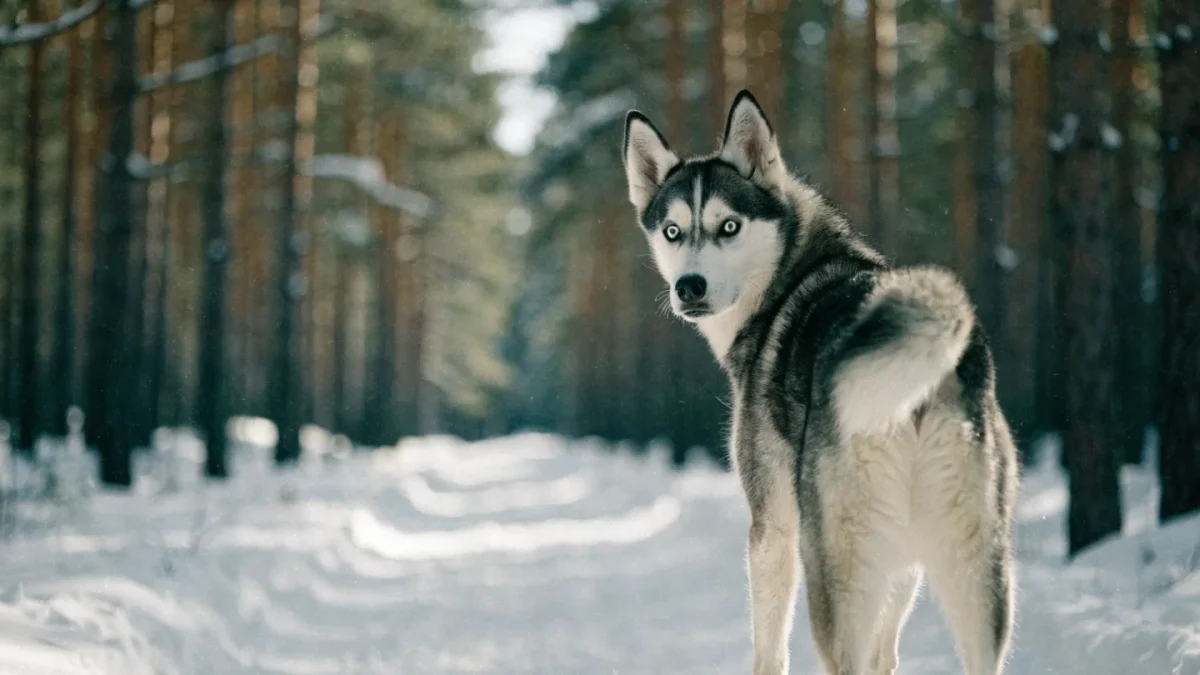
The first thing most people notice about a Siberian Husky is the eyes. That pale, piercing blue — sometimes in one eye, sometimes both, sometimes split within a single iris — is unlike anything in most dog breeds. For decades, the mechanism behind Husky eye color was poorly understood. Then a 2018 genome-wide association study published in PLOS Genetics — involving over 6,000 dogs genotyped through Embark Veterinary's consumer platform — identified the answer: a duplication on canine chromosome 18, near a gene called ALX4.
That discovery didn't just explain a cosmetic trait. It opened a window into how siberian husky genetics shape the breed's most distinctive features — and how those features differ, genetically, from superficially similar traits in other breeds.
Blue Eyes: The ALX4 Connection
In most dog breeds, blue eyes are associated with either the merle gene or with extensive white patterning (piebald) — both of which can carry associated health risks, including deafness and vision abnormalities. The Siberian Husky's blue eyes operate through a completely different genetic pathway.
The 2018 study, conducted by Embark Veterinary using data from 6,070 client-genotyped dogs, identified a duplication of 98.6 kilobases on chromosome 18, located near the ALX4 gene. This duplication appears to reduce pigment (melanin) deposition in the iris, producing the blue coloration. Critically, this variant is not linked to the merle gene, not associated with deafness, and does not appear to compromise vision. It's a separate genetic mechanism producing a similar visual outcome through a different biological route.
The blue doesn't come from blue pigment — there is no blue pigment in dog eyes. The color is structural: reduced melanin in the iris allows light to scatter in the stroma (the fibrous layer of the iris), producing blue through the same optical principle that makes the sky appear blue. More melanin produces brown. Less melanin produces blue. The ALX4-associated variant reduces the "more" to "less."
The intensity of the blue varies between individuals. Some Huskies have pale, almost ice-white blue eyes. Others have a deeper, more saturated blue. This variation likely reflects the degree of melanin reduction, which may be influenced by other modifier genes and the specific characteristics of the duplication. Brown eyes in the breed indicate that the melanin-reducing effect isn't present or is insufficiently expressed.
Heterochromia: One Blue, One Brown
Heterochromia — having two differently colored eyes — appears in the Siberian Husky at rates far higher than in most breeds. The trait is called complete heterochromia when the eyes are fully different colors and sectoral heterochromia (or parti-eye) when two colors appear within a single iris.
The mechanism is likely asymmetric expression of the ALX4-associated variant. If the melanin reduction affects both eyes equally, you get two blue eyes. If it affects one eye more than the other, you get heterochromia. If it affects only a sector of one iris, you get a parti-colored eye — brown with a wedge of blue, or vice versa.
Heterochromia in Huskies is not a health concern. Unlike heterochromia in some other species and breeds, the Husky version doesn't signal underlying developmental problems, doesn't affect vision, and has no association with deafness. The Husky breed standard accepts all eye colors and combinations, including heterochromia. This is consistent with the breed's long history of being judged on working performance rather than cosmetic uniformity.
Coat Color Genetics
The Siberian Husky's coat color range is impressively wide — from pure white to solid black, with grey, agouti, red, sable, and copper in between. Understanding the genetics behind this requires a quick primer on canine coat color genes.
Two primary pigments determine coat color in dogs: eumelanin (black/brown) and phaeomelanin (red/yellow). The interaction of several genes determines which pigment is produced, where it's deposited, and how intensely.
Agouti series (A locus). The agouti gene has the most visible impact on Husky coat patterns. The wild-type agouti pattern — alternating bands of eumelanin and phaeomelanin on individual hair shafts — produces the "wolf grey" coloring many Huskies display. Other agouti variants produce sable, tan-point, and solid black. Agouti Huskies often appear to change color seasonally as coats grow and shed — the banding pattern means the base of each hair differs from the tip, and the visible proportion shifts as the coat wears.
Extension series (E locus). The extension gene determines whether eumelanin can be deposited at all. The recessive "e" variant prevents eumelanin expression, producing a red or cream dog regardless of agouti. Pure white Huskies are often "ee" — genetically unable to produce black or brown pigment in the coat.
Other contributing genes. Dilution converts black to blue-grey. White patterning — responsible for the facial mask, chest markings, and leg markings — operates as a separate genetic system. The Husky's distinctive facial mask varies enormously: full symmetrical masks, open faces, cap-like patterns. This variety is normal within the breed standard, and predicting a puppy's adult markings from neonatal coloring is unreliable.
What This Means for Buyers and Breeders
Eye color and coat color in Siberian Huskies are cosmetic traits. They have no bearing on the dog's health, temperament, or working ability. The complete breed guide covers the health and temperament factors that actually matter when evaluating a Husky.
Blue eyes are not rare in this breed. They're common. Charging premium prices for blue-eyed puppies, heterochromic puppies, or puppies with unusual coat patterns is a marketing practice, not a reflection of the dog's value or quality. Similarly, no eye color or coat color combination is "more pure" or "better bred" than any other. The Chukchi didn't select for coat aesthetics. They selected for survival. The historical context makes clear that function drove every breeding decision for millennia.
The genetics are fascinating — the ALX4 pathway for blue eyes is genuinely novel among domestic dogs, and the agouti system produces some of the most visually striking coat patterns in any breed. But fascinating genetics and good breeding are two different conversations. Health clearances, temperament, and structural soundness matter. Color doesn't.