

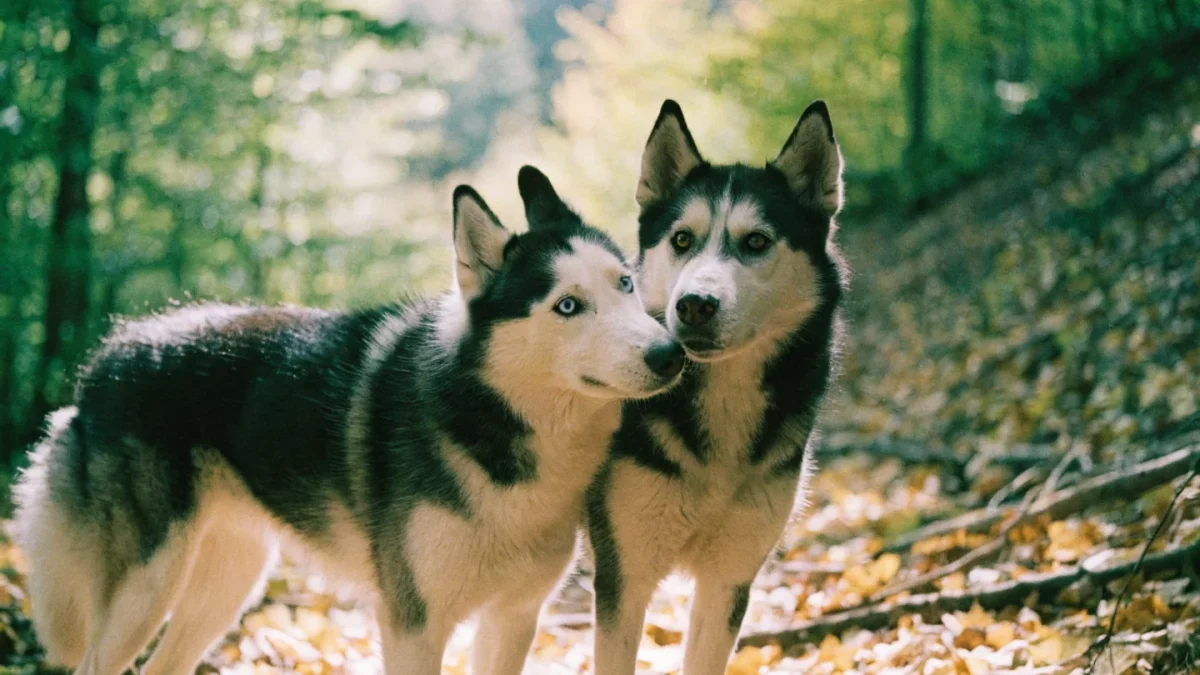
Most dog breeds were developed to work with a handler standing right there, giving directions in real time. The Siberian Husky was developed to work 80 km ahead of anyone who could issue a correction. That single fact explains almost everything about this breed's temperament.
The Chukchi people of northeastern Siberia didn't breed their dogs for obedience. They bred them for judgment. A sled team running across sea ice needs a lead dog that can detect thin ice, refuse a dangerous command, and reroute the team on its own authority — even when the musher is shouting to go straight. That capacity for independent decision-making was a survival trait. Three thousand years of that selection pressure doesn't vanish because the dog now lives in a house.
If you're evaluating siberian husky temperament and personality before bringing one home, understanding this independence — what it looks like, where it comes from, and how it plays out in daily life — is the most important thing you can do. For the full breed profile including health, grooming, and lifestyle fit, see the complete Siberian Husky breed guide.
Independence Is Not Stubbornness
The most common complaint from first-time Husky owners is some version of "my dog knows the command but ignores me." This framing misunderstands what's happening. The Husky isn't ignoring you. It heard you, it understood you, and it made a decision — which happened to differ from yours.
This is genuinely different from stubbornness. A stubborn dog resists because it doesn't want to comply. An independent dog evaluates whether compliance makes sense in the current context. Huskies are constantly running a cost-benefit analysis. If the recall command is competing with a squirrel at full sprint, the squirrel wins the analysis almost every time. This isn't a training failure. It's a breed characteristic that 3,000 years of survival-driven breeding installed.
Experienced Husky owners learn to work with this rather than against it. Training a Husky means making cooperation more rewarding than the alternative — consistently, in every context. It requires patience, creativity, and a genuine respect for the dog's intelligence. People who need instant, reflexive obedience should look at other breeds. People who enjoy the challenge of earning a thinking dog's cooperation find Huskies deeply rewarding.
Vocalization: The Breed That Talks Back
Siberian Huskies are among the most vocal breeds alive. They rarely bark in the conventional sense — instead, they produce an extraordinary range of sounds including howls, yodels, woos, grumbles, screams, and extended vocal sequences that genuinely sound like the dog is trying to form sentences.
This isn't random noise. Sled dog communication evolved for distance. A bark dissipates quickly in open, frozen terrain. A howl carries for kilometers. The Chukchi dogs needed to coordinate as a team and signal to handlers across vast stretches of ice and tundra. Modern Huskies retain this vocal wiring completely.
What triggers it varies by individual. Common triggers include sirens, other dogs howling, the owner leaving, the owner returning, hunger, excitement, boredom, and — in cases that defy explanation — nothing at all. Some Huskies hold full vocal conversations with their owners, modulating tone and volume in ways that are almost conversational. Video compilations of "talking Huskies" are popular for a reason: the vocal range is remarkable.
The practical impact is significant. This is not a quiet breed. In apartments or houses with shared walls, Husky vocalization is a genuine neighbor issue. The howling cannot be trained out. Triggers can be managed — reducing boredom, providing exercise, minimizing isolation — but the underlying vocal instinct is hardwired. You either find it charming or you don't, and you should know which camp you fall into before you commit.
Pack Mentality and Social Structure
Siberian Huskies are deeply social, pack-oriented dogs. They were bred to work cooperatively with other dogs in harness teams that could include a dozen or more animals. This pack heritage shows up in several ways.
Huskies generally get along well with other dogs, particularly dogs of similar energy and size. They play with an intensity that can overwhelm calmer breeds — lots of body-slamming, chasing, and vocal sparring that looks alarming but is typically normal pack interaction. They tend to establish hierarchies quickly and maintain them without much conflict once the social order is clear.
The pack orientation also means Huskies genuinely dislike being alone. This is a breed that was never isolated — Chukchi dogs worked in teams, lived in family dwellings, and slept in groups. A Husky left alone for extended periods doesn't just get bored. It gets anxious. And an anxious Husky is a destructive Husky. The howling, the digging, the fence-testing — much of what people label as "bad behavior" is actually a social animal in distress.
For context on how the breed's pack working structure directly connects to its history and development among the Chukchi people, the historical timeline makes the social traits easier to understand.
Prey Drive: The Non-Negotiable Trait
This is the temperament characteristic that causes the most real-world problems, and it needs honest treatment. Siberian Huskies have high prey drive toward small animals. Cats, rabbits, squirrels, rodents, small dogs, and poultry can all trigger a chase-and-grab response.
The origin is practical. The Chukchi allowed their dogs to free-range and hunt during summer months when sled travel wasn't needed. Dogs that could supplement their own diet through hunting were more likely to survive and breed. The result is a breed with a persistent, strong chase instinct that kicks in when small, fast-moving animals enter its awareness.
Some individual Huskies coexist with cats — particularly when raised together from a very young age. But the breed-level tendency is strong enough that treating any individual Husky as reliably safe with small animals without extensive, verified evidence is irresponsible. Indoor tolerance doesn't necessarily predict outdoor behavior either. A Husky that ignores the family cat on the couch may chase the neighbor's cat in the yard.
Managing prey drive means managing the environment. Secure fencing, leash control in unfenced areas, and honest assessment of the individual dog's behavior around small animals are all essential. Wishing the trait away doesn't work. Acknowledging it and planning around it does.
Escape Behavior: The Great Houdini of Dogs
If the independence, vocalization, and prey drive don't convince you that this is a breed requiring active management, the escape artistry will. Siberian Huskies are widely regarded as the most escape-prone breed in existence, and the reputation is earned.
They dig. They climb. They squeeze through gaps that appear far too small for their body. They learn to operate gate latches, door handles, and crate mechanisms. They test the same fence section daily until they find or create a weakness. A Husky that wants to leave will devote genuine problem-solving intelligence to the project, and their capacity for creative escape is impressive in a way that's very inconvenient to live with.
The behavior has roots in the breed's ranging instincts. Chukchi dogs traveled enormous distances and were released to hunt independently during summer. The drive to move, explore, and cover ground is deeply embedded. A secure yard with a 1.8-meter fence and buried dig guards is the minimum. Regular fence checks are not paranoia — they're maintenance.
What the escape behavior really tells you is that containment alone isn't enough. A Husky that's getting sufficient exercise, mental stimulation, and social time is far less motivated to break out than one that's bored and under-stimulated in a yard. The exercise needs of this breed aren't just about physical health — they're directly tied to containment reliability.
Gentleness With People
After cataloging the independence, the noise, the prey drive, and the escape tendencies, it's important to balance the picture. Siberian Huskies are remarkably gentle with people. The Chukchi selection for family compatibility — dogs that slept with children, lived inside dwellings, and were handled by everyone in the community — produced a breed with very low human aggression.
Huskies tend to greet strangers with enthusiasm rather than suspicion. They are typically patient with children, though their energy level and size make supervision necessary with small kids. They almost never resource-guard food or toys. Bite incidents involving Huskies and humans are uncommon relative to the breed's popularity numbers.
This gentleness is exactly why the breed makes a terrible guard dog. A Husky confronted with an intruder is far more likely to solicit attention than sound an alarm. If home security is part of your dog criteria, look elsewhere.
Living With the Temperament
The Siberian Husky temperament isn't difficult in the sense that it's unpredictable or dangerous. It's difficult in the sense that it demands respect, accommodation, and active engagement. This is a dog that was designed to think, to move, to vocalize, and to operate with a degree of autonomy that most pet breeds don't possess.
People who thrive with Huskies tend to share certain traits: they're active, they're patient, they appreciate intelligence even when it's inconvenient, and they don't need a dog that worships them. The relationship with a Husky is more partnership than hierarchy — and the best Husky owners genuinely prefer it that way.
People who struggle with the breed tend to want a dog that matches the aesthetic — the striking eyes, the wolf-like appearance — without accepting the behavioral package that comes with it. The appearance and the temperament are inseparable. The beauty exists because the function demanded it.