

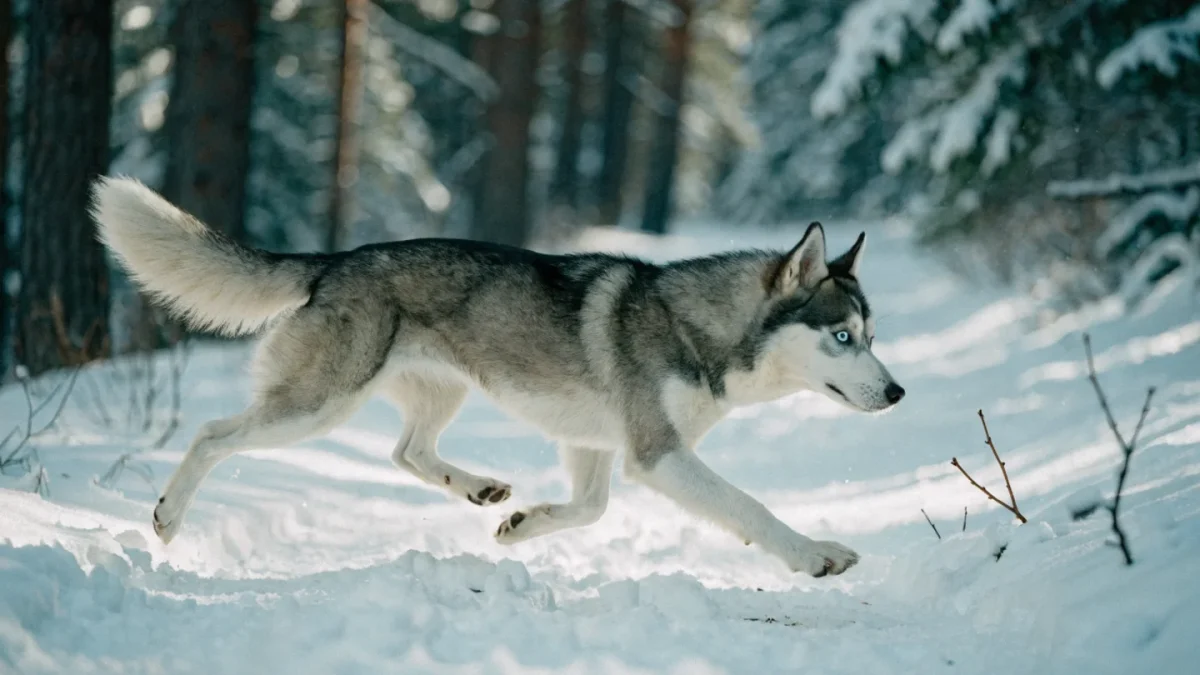
A Siberian Husky's idea of a light warm-up would leave most dogs — and most owners — completely spent. This is a breed that was selectively bred over roughly 3,000 years to trot at moderate speed across frozen terrain for 50 to 100 km per day, hauling loads, in temperatures that would shut down most mammals. That heritage doesn't switch off because the dog now lives in a suburban house.
Understanding siberian husky exercise needs isn't about finding ways to tire the dog out. It's about recognizing that physical output is as fundamental to this breed's wellbeing as food and water. A Husky that doesn't move enough doesn't just get restless — it deteriorates behaviorally in ways that look like disobedience but are actually distress.
The Minimum: 90 Minutes of Real Exercise
The baseline for an adult Siberian Husky is 90 minutes of vigorous, structured exercise per day. This isn't a generous estimate. It's the floor.
"Structured" matters here. Letting the dog into a fenced backyard doesn't count. Most Huskies in a yard will stand at the fence, dig a hole, or lie down and wait for something interesting to happen. They won't self-exercise the way some terrier breeds will. Huskies are built for sustained forward movement — covering ground with purpose. Without a destination, a job, or a running partner, they simply don't engage.
A 30-minute walk at human pace is warm-up. It has value — every bit of movement helps — but it cannot be the primary exercise for this breed. The complete Siberian Husky breed guide covers why the breed's metabolic efficiency means they need proportionally more physical output to reach genuine satisfaction than breeds of similar size.
Activities That Actually Work
Not all exercise is equal for a Husky. The breed responds best to activities that involve sustained movement, engage their instincts, and challenge them mentally alongside the physical demand.
Running and canicross. Huskies are natural running partners for humans who can maintain a reasonable pace. Canicross — where the dog runs in harness ahead of the runner — is ideal because it taps into the pulling instinct. Wait until the dog is at least 18 months old with confirmed joint health before sustained running on hard surfaces.
Bikejoring and scootering. The dog runs in harness attached to a bicycle or kick scooter. This is the closest approximation to sled work available in non-snow conditions. It covers ground quickly, satisfies the pulling drive, and provides the sustained forward movement the breed craves.
Hiking. Long-distance trail work is perhaps the most natural fit outside of mushing. Huskies handle varied terrain well and have the endurance for full-day hikes. Carry water — they overheat faster than their cold-adapted physiology suggests, particularly in warm or humid conditions.
Mushing and carting. If you have access to snow and equipment, this is what the breed was literally designed for. Dryland alternatives — wheeled carts, rigs, and sleds on dirt — work in warmer climates. Even a small setup gives the dog a job, and a Husky with a job is a fundamentally different animal than a Husky without one.
Structured play with other dogs. Huskies are pack animals that play hard. A compatible play partner of similar size and energy level provides both physical exercise and the social stimulation the breed needs. Monitor the play — Husky play style is intense and vocal, which can intimidate less robust dogs.
The Mental Component
Physical exercise alone leaves the job half done. A Husky that's been on a two-hour run but hasn't engaged its brain will still find ways to cause problems. The breed's independent, problem-solving temperament means they need mental challenges alongside physical ones.
Puzzle feeders, snuffle mats, scent-detection games, and training sessions all provide mental load. Novel environments — new trails, new terrain — engage the brain through sensory stimulation. The most effective routines combine physical and mental demands simultaneously: a hike on a new trail, a scent game followed by a run, a training session built into a bike ride.
Puppy Exercise: Calibrated, Not Restricted
Husky puppies are bundles of chaotic energy, but their growing bodies can't handle adult-level exercise. Forced repetitive exercise — jogging on pavement, extended fetch sessions, long leash runs — stresses developing joints and growth plates.
The general guideline of five minutes of structured exercise per month of age, twice daily, provides a reasonable framework. A four-month-old puppy gets about 20 minutes of structured activity per session. Free play on soft surfaces — grass, sand, dirt — is different from forced exercise and can be more generous.
The transition to adult exercise levels happens gradually between 12 and 18 months, ideally with veterinary confirmation that growth plates have closed. Resist the temptation to push a young Husky too hard because it seems to want more. They always seem to want more. Protecting their joints now preserves their mobility for the next 12 to 14 years.
What Under-Exercise Looks Like
The warning signs of an under-exercised Husky are hard to miss — but they're routinely misidentified as behavioral problems rather than exercise deficits.
Destructive digging is the classic. Huskies dig naturally, but a dog excavating systematic trenches along fence lines or demolishing garden beds is usually burning unspent energy. Excessive howling and vocalization — beyond the breed's already generous baseline — often signals frustration. Fence-testing, escape attempts, and counter-surfing all escalate when the dog isn't getting enough physical output.
The most insidious sign is a Husky that seems calm but is actually shut down — a dog that's given up on getting its needs met. This masks underlying stress that surfaces as compulsive behaviors, leash reactivity, or sudden destructive episodes.
The exercise commitment is non-negotiable. Owners who meet it describe their Huskies as wonderful, charismatic companions. Owners who don't describe the same dogs as nightmares. The dog is the same. The variable is the exercise.