

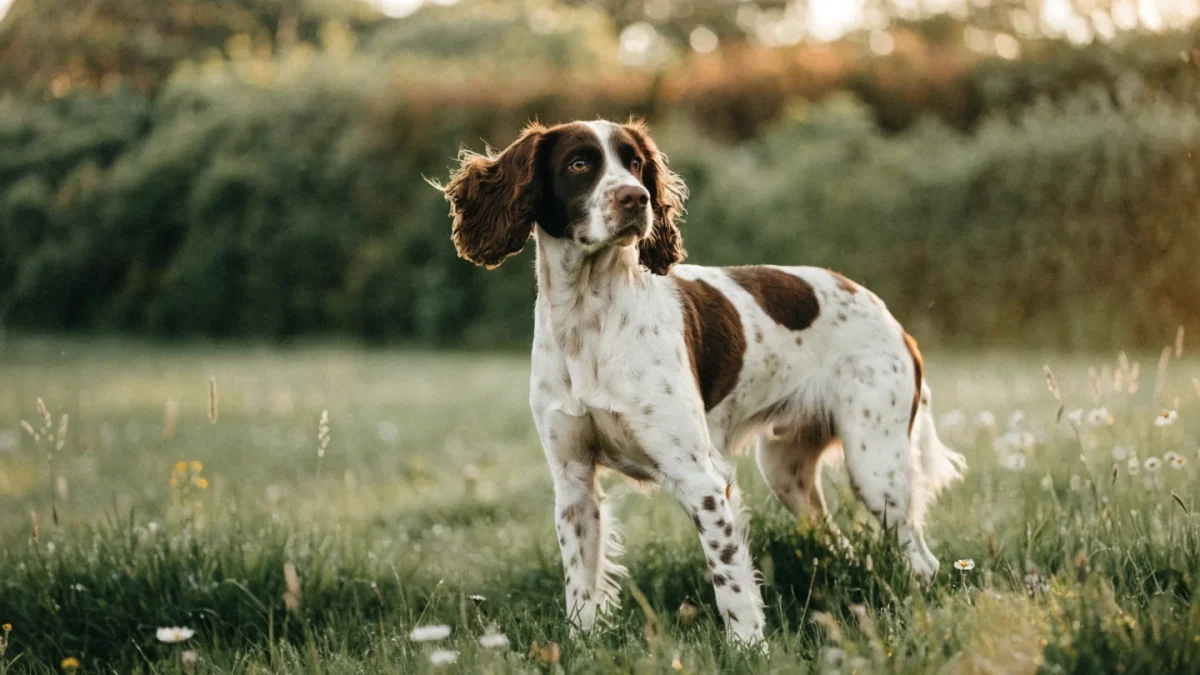
Before the Kennel Club existed, before breed standards were written, and before anyone bothered separating spaniels into distinct breeds, there were just "springing spaniels" — dogs that flushed game birds from dense cover so hunters could catch them with hawks or nets. That was the 1500s. The English Springer Spaniel has been doing the same job, with remarkably little change in purpose, for over five hundred years. The shotgun replaced the hawk, and the breed adapted. Everything else stayed.
English Springer Spaniels are medium-sized sporting dogs bred to work closely with a handler in the field, covering rough ground at speed to flush birds within shooting range and then retrieve them. They combine an athletic, tireless physicality with an intense desire to work alongside their person — a bond that makes them outstanding partners in the field and demanding companions at home. If you're looking for an english springer spaniel breed guide that covers what actually matters — the split between field and show lines, the health realities, the exercise commitment, and who this breed actually suits — this is it.
This breed sits in an unusual position among sporting dogs. It's been functionally divided into two populations for over seventy years, and that split shapes almost everything about ownership. Most breed guides gloss over it. I won't.
Origins: The Oldest Sporting Spaniel
The word "spaniel" almost certainly derives from "Espagnol" — Spanish — reflecting the widely held belief that spaniel-type dogs originated on the Iberian Peninsula before spreading across Europe. By the late 1300s, Gaston Phoebus described spaniel-type flushing dogs in his hunting treatise Livre de la Chasse (1387), and by the 1500s, British estates employed spaniels as a standard part of their hunting operations.
For centuries, "springer" and "cocker" spaniels weren't separate breeds. They were size classifications within the same litters. Larger puppies that could spring game from heavy cover were called springers. Smaller littermates used on woodcock were called cockers. Same parents, different jobs, different names. This practice continued until the early 1900s. The Cocker Spaniel diverged from that common stock and developed its own distinct breed characteristics, but the shared origin still shows — in coat type, working style, and several shared genetic predispositions.
The Kennel Club in Britain recognized the English Springer Spaniel as a distinct breed in 1902. The first breed standard was adopted in 1903. In North America, the breed gained recognition in 1910, with serious breeding programs establishing themselves through the 1920s and 1930s. The English Springer Spaniel Field Trial Association, founded in 1924, became the primary breed club in the United States and has shaped the breed's trajectory ever since.
The Field-Show Split
This is the single most important thing to understand about the English Springer Spaniel, and most people considering the breed don't know it exists.
Starting in the 1940s and accelerating through the 1950s and 1960s, breeders began specializing. Some bred for conformation showing — selecting for coat density, head shape, and adherence to the written standard. Others bred exclusively for field performance — selecting for speed, prey drive, stamina, and nose. By the 1970s, the two populations had diverged enough that they are, in practical terms, different dogs sharing a breed name.
Field-Bred Springers
Field-bred English Springer Spaniels are lean, moderate in coat, and built for sustained work in rough terrain. They typically stand 46 to 51 cm at the shoulder and weigh 18 to 23 kg. Their coats are shorter and less dense — functional protection rather than a showpiece. Their heads are narrower with a more pronounced stop. Their drive is intense.
These dogs were selected for generations to work at high speed for hours. A field-bred Springer on a hunt quarter-casts ahead of the handler in a windshield-wiper pattern, covering ground at a pace that would exhaust most people trying to keep up on foot. They flush, mark the fall, and retrieve — all at speed, all with precision.
In a home environment, that drive doesn't vanish. It redirects. A field-bred Springer without sufficient outlets is a dog that will reorganize your house according to its own priorities.
Show-Bred Springers
Show-bred English Springer Spaniels carry heavier bone, longer and denser coats, broader heads, and a more substantial build. They typically stand 48 to 53 cm and weigh 23 to 27 kg. The coat feathering on the ears, chest, legs, and belly is significantly more profuse than in field dogs.
Show lines retain the breed's sociable, eager temperament but with lower working drive. They are generally calmer indoors, less intense in their need for structured activity, and more adaptable to a typical household routine. That said, "calmer" is relative. A show-bred Springer still needs substantially more exercise and mental engagement than many other breeds of similar size.
Why It Matters
If you acquire a field-bred Springer expecting show-line energy levels, you will be overwhelmed. If you acquire a show-bred Springer expecting field-trial competitiveness, you will be disappointed. Knowing which population your dog comes from is not optional information — it determines your entire ownership experience.
Physical Characteristics
Size and Build
The breed standard describes a medium-sized, compact, strong dog — slightly longer than tall. Males typically stand 51 cm at the shoulder, females around 48 cm, with weight ranging from 18 to 25 kg depending on line and build.
The body is designed for endurance and agility rather than raw power. The chest is deep enough for lung capacity without being so broad that it impedes movement through dense cover. The legs are straight and moderately boned. The feet are round and compact with thick pads — built for hours on uneven terrain.
Coat
The double coat consists of a medium-length, flat or slightly wavy outer coat and a shorter, dense undercoat. Coat colors are typically liver and white or black and white, with or without tan markings (tricolor). Blue roan and liver roan patterns also occur.
The feathering on the ears, chest, legs, and belly is moderate in field lines and considerably heavier in show lines. The coat is water-resistant but not waterproof — functional enough for a dog that regularly works in wet cover and retrieves from water.
Ears
The ears are long, set at approximately eye level, and hang close to the head. They're one of the breed's most recognizable features and one of its most high-maintenance. Those pendulous ears create a warm, enclosed environment that traps moisture — a setup that practically invites ear infections.
Tail
Historically, English Springer Spaniels had their tails docked — a practice that remains legal in some countries and prohibited in others. Undocked Springer tails are medium-length, set low, and carried at or slightly above the back line. In the field, the constantly wagging tail serves as a visible signal to the hunter of the dog's activity and proximity in heavy cover.
Temperament
If the Labrador Retriever works for the team and the Pointer works for the horizon, the English Springer Spaniel works for its person. The breed's defining behavioral trait is handler focus — an almost gravitational pull toward the human it considers its partner. This creates a dog that is remarkably responsive, deeply affectionate, and profoundly unhappy when ignored.
Energy and Drive
This is not a moderate-energy breed by any reasonable standard. Springers were developed to work all day in demanding terrain, and their stamina reflects that breeding. Young Springers — anything under four years — are especially intense. The breed matures slowly, and the first three years often involve an energy level that new owners describe as "relentless."
The intensity varies between lines. Field-bred Springers have been described by trainers as having an "on switch with no off switch," while show-bred dogs typically cycle between high activity and genuine rest more naturally. Both types, however, need structured outlets for their drive.
What Most People Get Wrong About This Breed
The most common misconception: "English Springer Spaniels are a perfect family dog."
They can be. But "can be" requires context. A Springer in a household that provides 90 or more minutes of daily exercise, consistent training, and genuine companionship is a fantastic family dog — playful with children, social with other dogs, endlessly enthusiastic about shared activities. A Springer in a household where everyone works full time, exercise is a twenty-minute walk, and the dog spends most of its day alone will develop behavioral problems that range from destructive chewing to separation anxiety to excessive barking.
The breed's people-orientation cuts both ways. It makes them responsive and trainable, but it also makes them psychologically dependent on human interaction to a degree that many owners underestimate.
Social Behavior
Springers are generally sociable with other dogs, particularly when socialized young. They tend to approach new dogs with confidence and playfulness rather than anxiety or aggression. With children, they are typically patient and enthusiastic — though their energy level means they can easily knock over toddlers without any ill intent.
Their reaction to strangers varies. Most Springers are friendly and welcoming, though some individuals — particularly from field lines — can be initially reserved. Aggression toward people is not a normal breed trait and should be treated as a behavioral concern, not a personality quirk.
Health Profile
English Springer Spaniels are generally a sturdy breed, but they have specific genetic predispositions that responsible ownership requires acknowledging.
Phosphofructokinase (PFK) Deficiency
PFK deficiency is an inherited metabolic disorder specific to English Springer Spaniels and a small number of other breeds. Dogs with two copies of the defective gene lack adequate phosphofructokinase enzyme, which is essential for red blood cell energy metabolism. Affected dogs experience intermittent hemolytic crises — episodes where red blood cells are destroyed faster than they can be replaced, causing anemia, dark-colored urine, lethargy, and fever.
A DNA test has been available since 1992, making PFK deficiency entirely preventable through screening. Any breeding program that does not test for PFK is cutting a corner that has no excuse.
Hip and Elbow Dysplasia
Both hip and elbow dysplasia occur in the breed at moderate rates. Screening through standardized evaluation programs is recommended for all breeding stock. The condition is polygenic and influenced by environmental factors — growth rate, diet during development, and exercise intensity on immature joints all play roles alongside genetics.
Eye Conditions
Progressive retinal atrophy (PRA) is the most serious hereditary eye condition in the breed, leading to progressive vision loss and eventual blindness. A DNA test exists for the cord1 form of PRA common in Springer Spaniels. Retinal dysplasia and glaucoma also occur in the breed at lower but notable frequencies.
Entropion — inward rolling of the eyelid — appears in some lines, particularly in show-bred dogs with heavier facial skin. Surgical correction is straightforward when needed.
Ear Infections
The breed's long, pendulous ears create an environment prone to chronic otitis. Regular cleaning and monitoring are not optional — they are baseline maintenance. Dogs that swim frequently or work in wet conditions need ears checked and dried after every water exposure.
Autoimmune Conditions
English Springer Spaniels have a documented predisposition to several autoimmune conditions, including immune-mediated hemolytic anemia (IMHA) and immune-mediated thrombocytopenia. The UFAW lists primary IMHA as a recognized welfare concern in the breed, and the University of Minnesota's Canine Genetics Laboratory has identified English Springer Spaniels among the most commonly affected breeds, alongside American Cocker Spaniels and Poodles. These conditions can be life-threatening and require immediate veterinary intervention. No genetic test currently exists to predict susceptibility, and selective breeding from lines with low IMHA incidence remains the primary mitigation strategy.
Lifespan
The average English Springer Spaniel lifespan is approximately 12 to 14 years. This is relatively good for a breed of this size. Field-bred dogs, having been selected for performance and subject to less extreme conformation pressure, often fall at the longer end of this range.
Grooming Requirements
Coat Maintenance
The grooming commitment depends heavily on whether you have a field-bred or show-bred dog. Field-bred Springers with their shorter, less profuse coats need thorough brushing two to three times per week, with attention to the feathering on the ears, belly, and legs where mats form.
Show-bred Springers need more frequent brushing — often daily — because of the heavier coat. The longer feathering tangles more easily, and mats can develop rapidly behind the ears, in the armpits, and on the chest if neglected for even a few days.
Both types shed moderately year-round with heavier shedding during seasonal coat blows in spring and fall.
Ear Care
This cannot be emphasized enough: ear care in English Springer Spaniels is not an occasional task. It is a weekly commitment at minimum. The long ears restrict airflow to the ear canal, and the hair that grows inside the ear traps moisture and debris. Clean the ears weekly with an appropriate ear cleaner, dry them thoroughly after swimming or bathing, and learn what a healthy ear looks like so you can spot infections early.
Chronic ear infections that go undertreated lead to thickened ear canals, reduced hearing, and potentially surgical intervention. Prevention is incomparably easier than treatment.
Professional Grooming
Most Springer owners benefit from professional grooming every six to eight weeks for coat trimming and tidying. The breed requires trimming of excess hair on the ears, feet, hocks, and around the head to maintain a neat appearance and prevent matting. Show dogs require more extensive and specific trimming patterns.
Exercise and Activity
Daily Minimums
An adult English Springer Spaniel needs a minimum of 90 minutes of exercise daily, and many individuals thrive on more. This is not a breed where you can substitute a backyard for structured activity. Springers need to move at speed, use their noses, and engage with their handler during exercise.
Two sessions per day work better than one long outing — a morning walk or run of 45 minutes and an afternoon session of similar length, with at least one session involving off-leash running in a secure area. Springers that get only on-leash walks become frustrated and under-stimulated regardless of the distance covered.
Activities That Work
- Retrieving: The breed's primary function. Ball launchers, bumper training, and water retrieves satisfy deep instinctive needs.
- Scent work: Springers have excellent noses and take naturally to nose work, tracking, and search activities.
- Swimming: Most Springers love water and are strong swimmers. Swimming combines exercise with cooling and is easy on joints.
- Agility and flyball: The breed's speed, responsiveness, and handler focus make them natural candidates for these sports.
- Hiking: Springers are tireless trail companions with excellent stamina over varied terrain.
Puppy Exercise
Growing Springer Spaniels need activity calibrated to their developmental stage. Avoid forced repetitive exercise — distance running, intensive retrieving drills, or sustained hard-surface work — until growth plates close at approximately 12 to 18 months. Short, frequent play sessions on soft surfaces are appropriate. Let the puppy set its own pace.
Nutrition
English Springer Spaniels are active dogs that need adequate caloric intake to fuel their energy output, but they are also a breed that can gain weight when exercise decreases — particularly after spaying or neutering, or as activity naturally declines with age.
Feed measured meals twice daily. Caloric needs vary significantly based on whether your Springer is a working field dog burning 2,000 or more calories a day or a moderately active companion needing 1,000 to 1,400. Monitor body condition rather than following bag recommendations, which tend to overestimate. A Springer at proper weight has ribs you can feel easily without pressing, a visible waist from above, and an abdominal tuck from the side.
Training
Springers are among the most trainable sporting breeds. Their handler focus and desire to work cooperatively make them responsive to positive reinforcement training, and they retain learned behaviors well.
The priorities:
- Recall: Critical for a dog that works at a distance. A reliable recall is the most important command a Springer can learn, and it needs to be trained early and reinforced constantly.
- Impulse control: Springers get excited. Teaching "wait," "leave it," and steadiness around birds or other triggers prevents a responsive dog from becoming an out-of-control one.
- Settle: Teaching the off switch. Springers don't naturally decompress well, especially field-bred dogs. Place training — teaching the dog to settle on a mat — builds a skill the breed doesn't come with naturally.
- Leash manners: A Springer pulling on leash at full drive will drag you. Teach this before the dog reaches adult strength.
Harsh training methods produce anxiety in this breed. Springers are sensitive to handler displeasure and respond to corrections with stress behaviors — lip licking, avoidance, displacement sniffing — rather than improved compliance. Firm, fair, and consistent works. Punitive does not.
Living Situation
English Springer Spaniels adapt to a range of living situations provided the exercise commitment is met. A house with a fenced yard is ideal but not essential — apartment-dwelling Springers can thrive if their owner is genuinely committed to daily off-leash exercise elsewhere.
What is essential: the dog cannot be left alone for extended periods. Springers are not independent dogs. They bond deeply to their household and deteriorate behaviorally and psychologically when isolated for more than four to five hours regularly. If everyone in your home works full-time with no midday break, this breed will struggle.
The coat provides moderate weather tolerance. Springers handle cold weather well and are generally comfortable working in rain and cold water. They are not well-suited to extreme heat and need shade, water, and reduced activity in hot conditions.
The Right Owner for This Breed
I'll be direct. An English Springer Spaniel is the right dog for you if:
- You can commit to 90 or more minutes of real exercise daily — not just a walk, but running, retrieving, swimming, or structured activity
- You want a dog that is actively engaged with you, not one that entertains itself
- You have experience with sporting breeds or are willing to invest seriously in training
- You can provide consistent companionship — this breed does not tolerate being alone
- You're prepared for regular grooming, ear maintenance, and veterinary screening
- You understand the field-show split and have chosen the type that matches your lifestyle
An English Springer Spaniel is the wrong dog for you if:
- You want a calm, low-energy house dog
- You're away from home most of the day without a plan for the dog
- You expect a dog that is content with minimal exercise and a backyard
- You're not prepared for the grooming commitment, especially with show lines
- You want a dog that can be left alone in a crate for eight or more hours
The English Springer Spaniel is one of the great sporting breeds — athletic, devoted, intelligent, and tireless. It is also a breed that will punish neglect with behavioral problems and reward commitment with a partnership that few other breeds can match. Choose it honestly, and it will give you everything.
Frequently Asked Questions
What is the difference between field and show English Springer Spaniels?
Field-bred Springers are leaner (18 to 23 kg), shorter-coated, and bred for high-drive hunting performance. Show-bred Springers are heavier (23 to 27 kg), carry denser and longer coats, and have broader heads. The two populations have been bred separately for over seventy years and differ substantially in energy level, working drive, and grooming requirements. Neither type is more "correct" — they serve different purposes and suit different owners.
How much exercise does an English Springer Spaniel need?
Plan for a minimum of 90 minutes daily, split across at least two sessions. This should include opportunities for off-leash running in a secure area, retrieving, swimming, or other activities that let the dog work at speed and use its nose. On-leash walks alone are insufficient for this breed. Puppies need shorter, more frequent sessions calibrated to their age and developmental stage.
Are English Springer Spaniels good with children?
Springers are generally excellent with children — playful, patient, and eager to participate in family activities. Their energy level matches well with active kids. The caution is that young Springers are exuberant and can knock over small children without meaning to. Supervision is necessary with toddlers, and children should learn appropriate interaction with the dog. The breed's sensitivity to rough handling means teaching mutual respect benefits both child and dog.
Do English Springer Spaniels have serious health problems?
The breed has specific genetic predispositions including PFK deficiency (a metabolic disorder with a DNA test available since 1992), hip and elbow dysplasia, progressive retinal atrophy, and chronic ear infections related to their ear structure. Autoimmune conditions also appear in the breed at elevated rates. Health screening of parent dogs significantly reduces risk. The average lifespan of 12 to 14 years is good for the breed's size.
Can English Springer Spaniels live in apartments?
Yes, if — and this is a significant "if" — the owner commits to daily off-leash exercise elsewhere. The dog's physical space matters less than its daily activity and companionship. A Springer in a small apartment with a dedicated, active owner will be happier than a Springer in a large house with a sedentary one. The breed's need for human proximity actually works in favor of apartment living, since the dog wants to be near you regardless of space.