

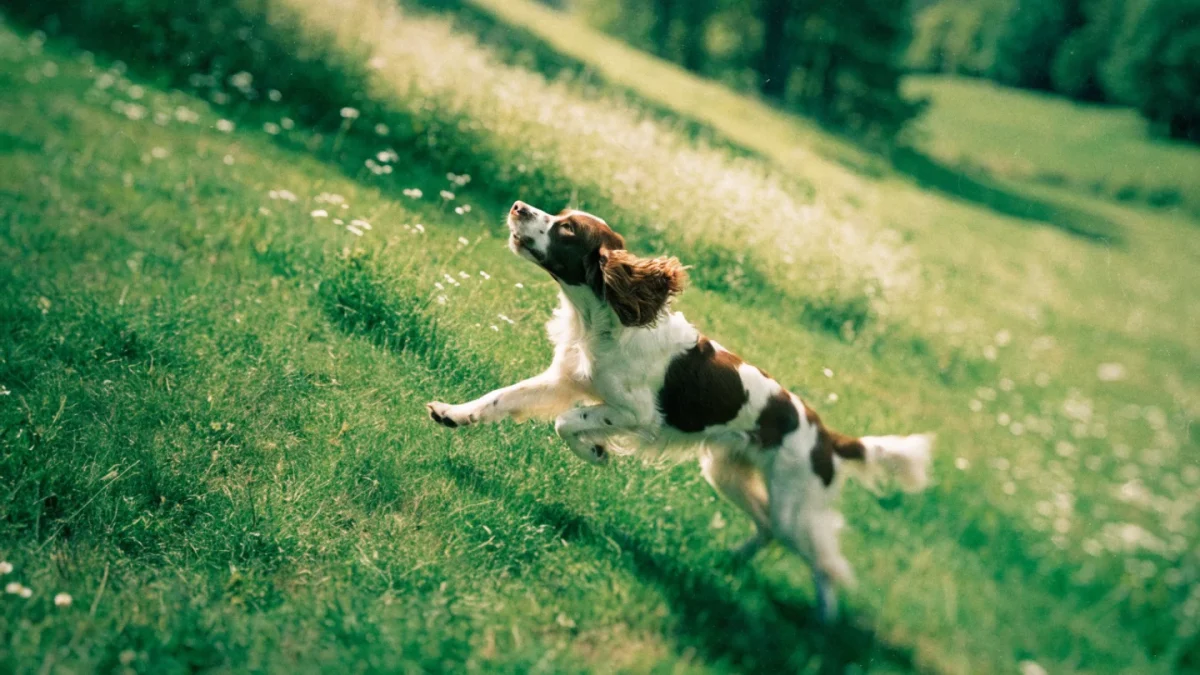
The PFK test for English Springer Spaniels is one of the rare genuine success stories in canine genetic health. A metabolic condition that causes intermittent red blood cell destruction — serious, debilitating, and entirely hidden in carriers — became testable in 1992. Responsible breeders adopted the test. Breed clubs pushed education. And adoption rates climbed high enough that PFK-affected puppies, once a real probability in untested litters, have become uncommon. That's how it's supposed to work: identify the mutation, build a test, use it consistently, and gradually remove the allele from breeding populations.
It's worth knowing that story because it stands in sharp contrast to how other breed health issues have gone. PFK is the benchmark. The Springer community did it right, and the breed is measurably better for it. But PFK isn't the whole picture of English Springer Spaniel genetics — and some of the other pieces don't have the same happy ending.
PFK Deficiency: The Breed's Signature Genetic Condition
Phosphofructokinase is an enzyme essential for glycolysis — the metabolic pathway that converts glucose into energy within cells. In red blood cells, which lack mitochondria and depend entirely on glycolysis for energy, PFK deficiency is catastrophic. Without adequate PFK enzyme activity, red blood cells become fragile and break down prematurely.
The mutation responsible is autosomal recessive, meaning a dog must inherit two copies of the defective allele (one from each parent) to be affected. Dogs with one copy are carriers — clinically normal but capable of passing the mutation to offspring. Dogs with zero copies are clear.
Affected dogs experience intermittent hemolytic crises: episodes of red blood cell destruction that produce dark brown or red-tinged urine, lethargy, fever, muscle weakness, and pale gums. These episodes can be triggered by strenuous exercise, stress, or elevated body temperature. Between crises, affected dogs may appear normal, which can delay diagnosis if the owner isn't aware of the condition.
The DNA test identifies clear, carrier, and affected dogs from a simple blood or cheek swab sample. The breeding math is straightforward:
- Clear x Clear = all puppies clear
- Clear x Carrier = no affected puppies (50% clear, 50% carriers)
- Carrier x Carrier = 25% affected, 50% carriers, 25% clear
- Any breeding involving an affected dog = all puppies are carriers at minimum
There is no treatment for PFK deficiency beyond managing crises as they occur. Prevention through testing is the only responsible approach. The complete breed guide covers the full health profile, but PFK testing is the single most important genetic screening specific to this breed.
Coat Color Genetics
English Springer Spaniel coat patterns are controlled by the interaction of several gene loci, producing the breed's characteristic liver-and-white, black-and-white, and tricolor patterns.
The E Locus (Extension): The E locus controls whether black or liver pigment is deposited in the coat. The dominant E allele allows full pigment expression. The recessive e allele, in the homozygous e/e state, restricts dark pigment deposition and produces a lemon, orange, or red-tinted coat depending on phaeomelanin intensity. Lemon Springers do occur — they carry the e/e genotype that can be inherited from two carrier (E/e) parents — though they are uncommon and considered a non-standard color variant in the breed (UC Davis Veterinary Genetics Laboratory; Coats and Colors breed reference).
The B Locus (Brown): This determines whether dark pigment is black or liver (brown). The dominant B allele produces black pigment. The recessive b/b genotype produces liver. This is why Springers come in black-and-white or liver-and-white as their primary color divisions — the B locus is the switch.
The S Locus (White Spotting): The S locus controls the distribution of white areas on the coat. English Springer Spaniels carry the parti-color pattern — large areas of white interspersed with colored patches. The precise genetics of white spotting remain more complex than a single gene with simple dominance, and modifying genes influence the extent and distribution of white.
The T Locus (Ticking): Ticking — small spots of color in white areas — is common in Springers, particularly on the legs and muzzle. The T allele produces ticking, while the recessive t/t genotype produces clear white areas. Ticking intensity varies considerably between individuals and often develops progressively as puppies mature.
Tan Points and Tricolor: Tricolor Springers (black or liver with white and tan points) carry the at/at genotype at the A (agouti) locus, which produces the tan markings above the eyes, on the cheeks, under the tail, and on the legs. The tan points are visible only when the K locus allows the agouti pattern to express — Springers typically carry the ky/ky genotype at K, permitting agouti expression.
Roan patterns — intimate mixing of white and colored hairs rather than distinct patches — also appear in the breed. Blue roan (black-based) and liver roan occur and are accepted within breed standards. Spaniel coat genetics across the group share many of these same loci; the Cocker Spaniel genetics article examines color and health genetics in the closely related spaniel branch.
The Field-Show Genetic Divergence
The history of the breed describes the functional split between field and show populations beginning in the 1940s. From a genetic perspective, this split has produced two populations with measurably different allele frequencies, though they remain genetically one breed.
Studies examining genetic diversity within English Springer Spaniels have found that field and show populations cluster separately in genetic analyses, reflecting decades of breeding within rather than between the two groups. Research by Calboli et al. (Genetics, 2008) found that the English Springer Spaniel showed the highest population structure estimate (0.55) of all breeds studied, with ancestral sire lineages clustering strongly into separate field and show populations. The degree of genetic differentiation is not large enough to constitute separate breeds, but it is significant enough that crossing field to show lines produces offspring with intermediate characteristics that may not excel in either domain.
This population structure has implications for health. If a disease-associated allele becomes concentrated in one population through founder effects or genetic drift, it can reach high frequency within that population while remaining rare in the other. Monitoring genetic diversity within both populations — not just across the combined breed — is important for long-term breed health management.
Progressive Retinal Atrophy: cord1 PRA
The most common heritable form of progressive retinal atrophy in English Springer Spaniels involves a mutation in the RPGRIP1 gene, designated cord1 (cone-rod dystrophy 1). This mutation causes progressive degeneration of the retinal photoreceptor cells, leading to declining vision and eventual blindness.
The cord1 mutation is autosomal recessive. A DNA test is available, and the testing and breeding logic mirrors PFK deficiency: clear-to-clear and clear-to-carrier breedings prevent affected offspring. Carrier-to-carrier breedings produce a 25% chance of affected puppies.
The age of onset for cord1 PRA varies. Some affected dogs show detectable vision changes by three to five years, while others retain functional vision significantly longer. Research has identified a second genetic factor — a deletion at the MAP9 locus on chromosome 15 — that acts as an age-of-onset modifier. Dogs homozygous for both the RPGRIP1 mutation and the MAP9 deletion develop disease earlier (often before age 3), while those carrying only the RPGRIP1 mutation may not show clinical signs until age 6 or later (Forman et al., Mammalian Genome, 2016). This modifier effect adds complexity to predictions based on cord1 status alone and is why some genetic testing panels now include MAP9 alongside RPGRIP1.
Rage Syndrome Research
The investigation into possible genetic components of "rage syndrome" — episodes of sudden, apparently unprovoked aggression — in English Springer Spaniels has been ongoing for decades without producing a definitive answer.
Early hypotheses proposed a link to epileptiform brain activity, suggesting that rage episodes might represent a form of partial seizure. Some researchers investigated possible associations with coat color, noting an apparent over-representation of solid-colored Springers among affected dogs compared to parti-colored dogs. However, the sample sizes in these studies were small, and the association has not been established as causal.
More recent approaches have examined the serotonin system, which plays a central role in aggression modulation across species. Preliminary research has investigated polymorphisms in genes involved in serotonin transport (SERT) and dopamine receptor function (DRD4) as potential risk factors, with some evidence suggesting a serotonin-dopamine imbalance may contribute to the episodes. However, no specific gene variant has been conclusively linked to rage syndrome in Springers through peer-reviewed large-scale genetic studies. The rarity of confirmed cases continues to limit statistical power in genetic research.
The rarity of the condition makes large-scale genetic studies difficult. Affected dogs are uncommon, and the episodic nature of the behavior complicates phenotyping — distinguishing true rage syndrome from other forms of aggression requires careful behavioral assessment, and misclassification muddies the data.
What is established: rage syndrome is not a defining genetic characteristic of the breed. It occurs in a very small number of individuals. Research continues, but current understanding does not support the use of genetic testing to predict or prevent the condition.
Practical Genetic Testing Priorities
For English Springer Spaniel owners and breeders, the actionable genetic tests — the ones with clear results and direct breeding implications — are:
- PFK deficiency DNA test: Mandatory. Available since 1992. No responsible breeding program omits this.
- cord1 PRA DNA test: Strongly recommended. Prevents the most common heritable form of blindness in the breed.
- Hip and elbow evaluation: Not a DNA test, but a phenotypic screening with strong genetic relevance.
- Ophthalmologist examination: Annual screening catches conditions that DNA testing alone does not cover.
The genetic tools available for this breed are better than for most. Using them consistently is the single most effective action breeders can take to protect the health of future generations.