

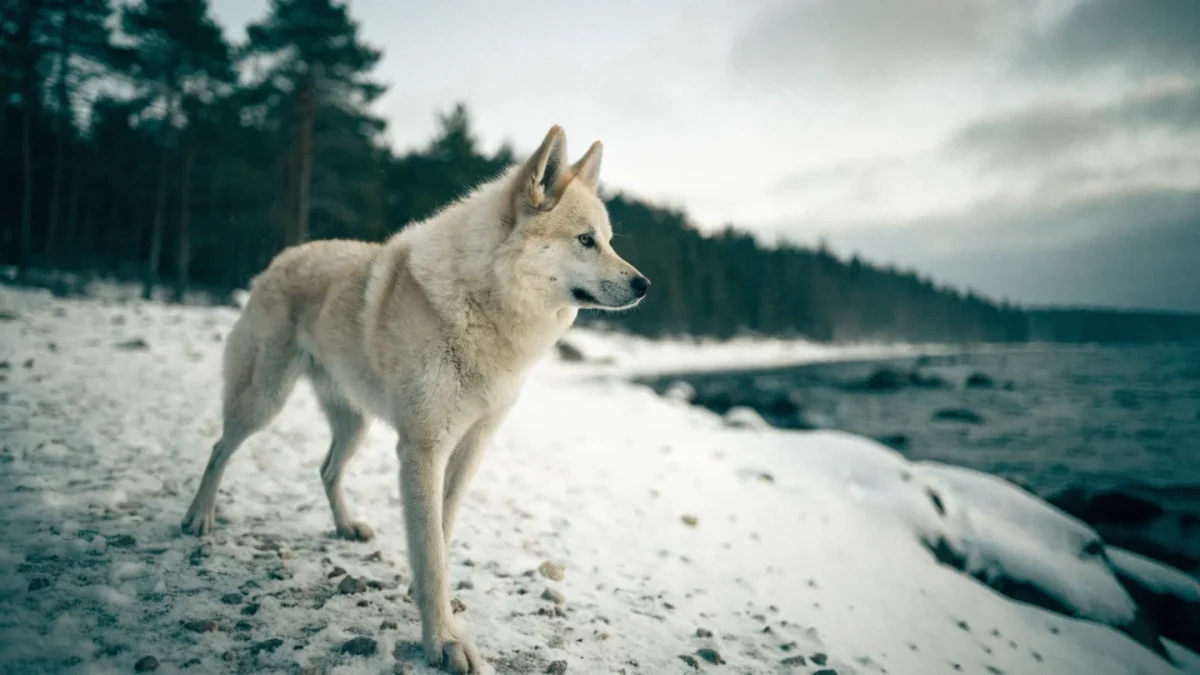
The dog that would become the Pomeranian started life pulling sleds across ice. Not metaphorically — the breed's direct ancestors were large spitz-type working dogs of the subarctic, animals weighing 14 kilograms or more that earned their keep hauling loads, guarding camps, and herding reindeer across Scandinavia and Iceland. If you put a modern 2.5-kilogram show Pomeranian next to one of its 18th-century predecessors, you'd struggle to believe they share a lineage. They do. The pomeranian history origins spitz connection is direct and well-documented, and the journey from working dog to toy companion is one of the most dramatic transformations in canine history.
The Spitz Root
The word "spitz" describes a family of dogs characterized by thick double coats, wedge-shaped heads, erect pointed ears, and curled tails carried over the back. The type is ancient — spitz skeletal remains have been identified at archaeological sites dating back thousands of years across northern Europe and Asia. These dogs were generalists: sled pullers, herders, hunters, watchdogs. They thrived in cold climates because their dense coats provided insulation, and their alert, independent temperaments made them useful across multiple working roles.
The German Spitz — the Pomeranian's immediate ancestor — existed in several size varieties across central and northern Europe. The largest versions, sometimes called Wolfspitz or Keeshond, weighed upward of 20 kilograms and served primarily as watchdogs on farms, barges, and estates. The smallest were lap-sized companions, and between them lay a continuous size gradient with no hard boundaries. The eventual Pomeranian emerged from the smaller end of this gradient, but "smaller" in the 1700s still meant 9 to 14 kilograms — roughly the size of a modern Shetland Sheepdog.
Pomerania: The Region and the Name
Pomerania stretched along the southern coast of the Baltic Sea, covering territory in what is now northeastern Germany and northwestern Poland. The region gave the breed its name, though the dogs were not unique to the area. Spitz-type dogs were common throughout Germanic territories. What Pomerania contributed was a concentration of breeding — enough dogs of consistent type that travelers and naturalists began associating the regional name with the breed.
By the mid-1700s, references to "Pomeranian dogs" appear in British and European texts. The naturalist Thomas Pennant described Pomeranian dogs in his 1769 work, noting them as white, medium-sized animals kept as companions. Johann Friedrich Gmelin classified the entire Spitz family as Canis pomeranus in his 1788 edition of Systema Naturae. These early descriptions consistently portray dogs larger than the modern breed, reinforcing that the miniaturization was still decades away.
Arrival in Britain
Spitz-type dogs reached Britain in the mid-18th century, brought by merchants, diplomats, and aristocrats who encountered them on the continent. Queen Charlotte, wife of George III, is documented as owning white Pomeranian-type dogs in the 1760s, and the painter Thomas Gainsborough included them in portraits of the period. These dogs were emphatically not the tiny breed we know today — contemporary descriptions and artwork suggest animals of 9 to 14 kilograms with moderate coats.
The breed gained slow, steady traction among the British upper classes through the late 1700s and into the 1800s. They were valued as companions and parlor dogs, but they hadn't yet become a breed sensation. That required a very specific catalyst.
The Victoria Effect
In 1888, Queen Victoria traveled to Florence, Italy, and encountered a small red sable Pomeranian named Marco. She acquired him and brought him back to England. Marco reportedly weighed around 5.4 kilograms — notably smaller than the breed norm of the era.
What happened next reshaped the breed permanently. Victoria didn't just keep Marco as a pet. She established a breeding kennel at Windsor, showed her dogs in competition, and openly favored smaller specimens. In 1891, she entered six Pomeranians in the Crufts dog show. Her involvement brought enormous public attention to the breed, and breeders — sensing both royal endorsement and market demand — began aggressively selecting for smaller size.
The complete Pomeranian breed guide notes that between 1888 and 1901, the breed's average size dropped by an estimated 50 percent. That figure reflects the power of concentrated selection pressure when guided by a clear size target. Breeders kept the smallest puppies from each litter, bred them to other small dogs, and within a remarkably few generations pushed the breed from medium-small into the toy category.
Victoria owned as many as 35 Pomeranians over her lifetime. On her deathbed in 1901, she reportedly requested that her favorite Pomeranian, a dog named Turi, be brought to her bedside. Whether or not the story is precisely accurate in its details, it cemented the breed's association with royal devotion in the public imagination and guaranteed continued demand for smaller specimens.
From Medium Dog to Toy
The miniaturization of the Pomeranian was not simply a matter of selecting small dogs and waiting. It required sustained effort across multiple generations and inevitably involved trade-offs.
As size decreased, certain physical characteristics changed. Muzzles shortened relative to skull size. Coat volume increased disproportionately — the breed's selection for showiness amplified the double coat to the extravagant profusion seen in modern specimens. The skeletal structure became more delicate. The fontanel (soft spot on the skull) began appearing more frequently, as it does in many toy breeds pushed toward smaller sizes.
Behaviorally, the core spitz temperament persisted despite the size change. The Pomeranian temperament profile traces how the alertness, vocal tendencies, and territorial instincts of the larger ancestors carried forward intact into the miniaturized breed. This is typical of size reductions in dogs — body dimensions respond to selection pressure much faster than behavioral traits, which are controlled by a larger number of genes with more complex interactions.
By the early 1900s, the breed standard had shifted decisively toward the toy size. Dogs over 3.5 kilograms were increasingly penalized in the show ring. The medium-sized Pomeranian of the 1860s was essentially extinct as a recognized type, absorbed into the broader German Spitz classification while the tiny version claimed the Pomeranian name exclusively.
Recognition and Spread
The breed gained formal recognition in 1898 in England. In the United States, the first Pomeranian was registered with the AKC in 1898, and the breed was formally recognized in 1900, with early imports coming primarily from British show lines that had already undergone significant miniaturization.
Through the early 20th century, Pomeranian breeding continued to refine the type toward smaller size, heavier coat, and more compact proportions. Orange and red sable became the dominant colors — partly because Victoria's Marco was red sable, and partly because these colors showed the profuse coat to dramatic effect in the show ring.
The breed maintained steady popularity through the mid-1900s without the explosive growth that some breeds experienced. It was a consistent presence at dog shows and in pet ownership, but it hadn't yet achieved the cultural ubiquity that would come later.
The Modern Pomeranian
The breed's cultural profile shifted dramatically in the late 20th and early 21st centuries. Social media gave Pomeranians an outsized platform — their photogenic coats and expressive faces translated exceptionally well to visual media. The Pomeranian named Boo, who accumulated over 16 million likes on Facebook after rising to viral fame in 2009, became one of the first "celebrity dogs" of the internet age and drove a measurable increase in breed demand.
This renewed popularity brought the same challenges that follow any breed's fame surge: increased breeding volume, decreased average breeding quality, and a growing gap between what buyers expected and what the breed actually demanded. The "teddy bear" Pomeranian — bred for a shorter muzzle and rounder face than the breed standard calls for — emerged as a market response to social media aesthetics, despite concerns from breed preservationists that the shorter muzzle moves the breed toward brachycephalic problems.
"Teacup" Pomeranians — dogs deliberately bred below 1.5 kilograms — represent the extreme end of the miniaturization trend that Victoria initiated. No breed registry recognizes "teacup" as a legitimate variety. These extremely small dogs face elevated risks of hypoglycemia, liver shunts, fragile bones, and significantly shortened lifespans. The demand for them persists because the market rewards novelty, even when novelty comes at a medical cost.
What the History Tells Us
The Pomeranian's history is a case study in what selective breeding can accomplish — and what it can't. Two centuries of deliberate size reduction created a toy breed from a medium working dog, a transformation that is genetically remarkable and historically well-documented. What that same period could not accomplish was removing the behavioral core of the spitz: the alertness, the independence, the vocalization, the territoriality.
Every Pomeranian alive today carries the psychological inheritance of dogs that guarded farms, patrolled borders, and barked at predators in the Arctic dark. That inheritance doesn't care that the body is now small enough to fit in a coat pocket. The personality remains outsized, and the owners who understand why — who know where the breed came from and what it was built to do — are the ones who appreciate the temperament rather than fighting it. For readers curious about related spitz descendants that retained the original working size, the Samoyed breed guide covers another branch of the Arctic spitz lineage that traveled a very different path through history.