

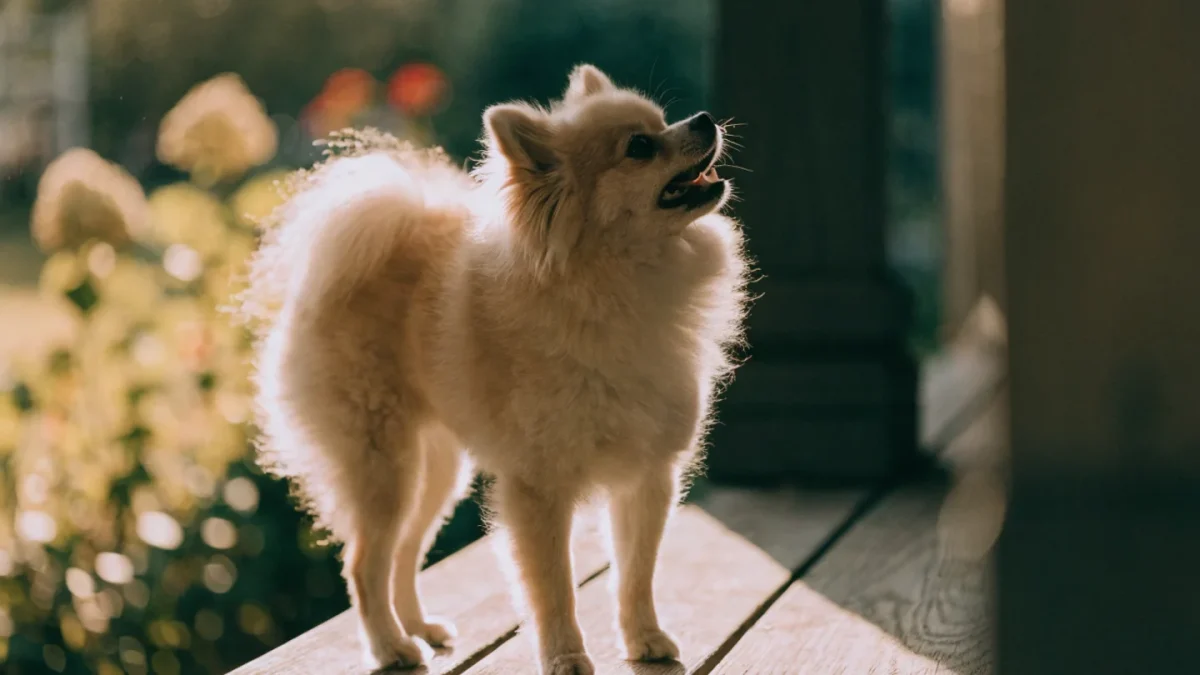
I covered a regional specialty a few years back and spent most of a Saturday afternoon talking to a Pomeranian breeder who'd been in the breed for twenty-something years. At one point her 4-kilogram champion — best of breed that day, spectacular coat, the whole picture — got into a stare-down with a passing Standard Poodle. The Poodle was maybe eight times its weight. The Pom did not blink. Did not back up. Did not, in any observable way, acknowledge the size difference. The Poodle eventually looked away first.
The breeder shrugged. "They genuinely don't know," she said.
That's the whole story of Pomeranian temperament, really. These dogs have no accurate self-concept when it comes to size. They operate with the confidence of a 30-kilogram working dog in a 3-kilogram body, and no amount of evidence to the contrary has ever gotten through to the breed collectively. This is partly funny and partly a management challenge, and understanding which one it is on a given day requires understanding where that confidence actually comes from.
The Confidence Problem
Pomeranian confidence is the breed's most defining personality trait, and calling it a "problem" is deliberate. Confidence in a 30-kilogram German Shepherd is an asset. Confidence in a 2.5-kilogram Pomeranian is a management challenge, because the dog's self-assessment and its physical reality are completely disconnected.
A typical Pomeranian approaches the world as though it weighs 25 kilograms. It will challenge larger dogs, stand its ground against unfamiliar humans, guard its food bowl, its favorite spot on the couch, and its person with an intensity that reads as aggressive but is actually territorial. The dog isn't trying to hurt anyone — it's asserting boundaries that, in its own mind, are perfectly reasonable.
This becomes dangerous in two directions. First, a Pomeranian that confronts a larger dog can be seriously injured or killed by an animal that wouldn't have bothered it had the Pomeranian not initiated the conflict. Second, a Pomeranian whose territorial assertions go unchecked by its owner escalates. The growling that was tolerated at eight months becomes snapping at twelve months. The snapping becomes biting. And suddenly you have a 3-kilogram dog that people are genuinely afraid of — which sounds absurd until you've seen the hand of someone who took a Pomeranian bite to the finger.
The solution isn't suppressing the confidence. It's channeling it through training and consistent boundaries from puppyhood, so the dog learns where its territory ends and where the human's authority begins.
Loyalty That Borders on Obsession
Pomeranians don't distribute their affection evenly. They pick a person — usually the one who feeds them, trains them, or simply spends the most time with them — and attach with a devotion that can only be described as intense.
This manifests as following that person from room to room, positioning themselves as close as physically possible during rest, visibly distressing when the person leaves, and displaying obvious preference that other household members notice and sometimes resent. A Pomeranian in a family of four will be friendly to everyone, but it will love one person with a ferocity that makes the relationship look less like pet ownership and more like a small, furry shadow that happens to have opinions.
The flip side of this loyalty is separation difficulty. Pomeranians left alone for extended periods often develop anxiety-driven behaviors: excessive barking, destructive chewing, house-soiling. These are not discipline problems. They're genuine distress responses from a dog whose primary emotional anchor has disappeared. Gradual desensitization to absence, crate training, and enrichment during alone time help, but a Pomeranian that spends eight or ten hours alone daily is a Pomeranian whose temperament is being stressed beyond its design parameters.
The Bark
There is no honest discussion of Pomeranian temperament that skips the barking.
Pomeranians bark. They bark at the doorbell, at passing pedestrians visible through a window, at other dogs on walks, at unusual sounds, at the general passage of time. The bark itself is sharp, high-pitched, and carries further than you'd expect from a dog this size. In acoustic terms, a Pomeranian bark registers at roughly the same decibel level as many medium-sized breeds — the small body does not produce a small sound.
This is not a behavioral disorder. It's a spitz trait. The ancestors of the Pomeranian were valued as alert dogs precisely because they barked at approaching strangers, unfamiliar animals, and environmental changes. Centuries of selective pressure reinforced the tendency. Modern Pomeranians carry that alert-barking firmware, and it runs constantly.
Training can modify the behavior. Teaching a "quiet" command, managing triggers (closing blinds, using white noise), and avoiding inadvertent reinforcement (responding to barking by giving attention) all reduce frequency. What training cannot do is eliminate the instinct. A Pomeranian that never barks at anything is either unwell or exceptionally unusual.
For the full breed profile, barking management is covered in the context of living situation compatibility. The short version: if you need a quiet dog, this is not the breed.
With Other Dogs
Pomeranian social dynamics with other dogs are shaped almost entirely by that misplaced confidence. A well-socialized Pomeranian can coexist peacefully with other dogs of similar size, and many do well in multi-dog households where the other residents are calm, respectful of space, and not inclined to play rough.
The risk emerges with size mismatches. A Pomeranian that postures, barks, or resource-guards around a tolerant Labrador may get away with it for months — until the day the Labrador's patience runs out. The injuries from even a single correction by a larger dog can be catastrophic for an animal weighing under 3 kilograms.
Same-sex aggression between Pomeranians is documented and seems more prevalent than in many toy breeds. Two intact males, or two females of similar assertive temperament, can develop a rivalry that escalates over time. This isn't universal — many Pomeranian pairs live in harmony — but it's worth evaluating individual temperaments carefully before adding a second Pom to a household.
With Children
This is where I have to be particularly straightforward. Pomeranians and young children are a difficult combination.
The issue isn't temperament in the abstract — Pomeranians can be patient and playful with children who understand gentle handling. The issue is physics. A dog that weighs 2 to 3 kilograms is fragile. A toddler who drops a Pomeranian from waist height, sits on it, or squeezes it too hard during a hug can cause fractures, internal injuries, or worse. The dog's response to rough handling — snapping — then gets the dog labeled as aggressive, when in reality it was defending itself from pain.
Families with children over seven or eight who can reliably follow instructions about gentle handling can make this work. Families with toddlers should wait, or accept that the dog and the child will need to be separated whenever direct supervision isn't possible. This isn't optional caution. It's the physical reality of mixing a very small animal with very young humans.
What Most People Get Wrong
The biggest misconception about Pomeranian temperament is that small size means simple needs. People assume the temperament scales with the body — that a 3-kilogram dog has one-tenth the behavioral complexity of a 30-kilogram dog.
It doesn't. A Pomeranian's drive to guard, to alert, to bond, and to assert itself is running on the same spitz operating system as a Samoyed or an Alaskan Malamute. The body got smaller. The personality didn't. Owners who understand this — who train their Pomeranian with the same structure and consistency they'd apply to a larger, more "serious" breed — end up with a remarkable companion. Owners who dismiss the behavior as cute because it comes in a small package end up with a dog that runs the household.
As the Pomeranian's history from Arctic working dogs to toy breed makes clear, the behavioral hardware in these dogs predates their current size by a wide margin. Treating a Pomeranian like a stuffed animal ignores everything that makes the breed what it is.
The Right Temperament Match
The person who thrives with a Pomeranian is someone who enjoys a dog with presence — a dog that has opinions, preferences, and a vocal willingness to share both. You need patience for the barking, consistency for the boundary-testing, and enough ego resilience to be outsmarted by a dog that weighs less than a house cat.
If you want a dog that quietly follows your lead and doesn't assert itself, the Pomeranian will frustrate you daily. If you want a dog that engages with life at maximum volume, guards you like a personal security detail it appointed itself to, and loves you with a focus that borders on possessive — and if you can manage all of that with training and humor — the Pomeranian temperament is one of the most rewarding in the toy group.