

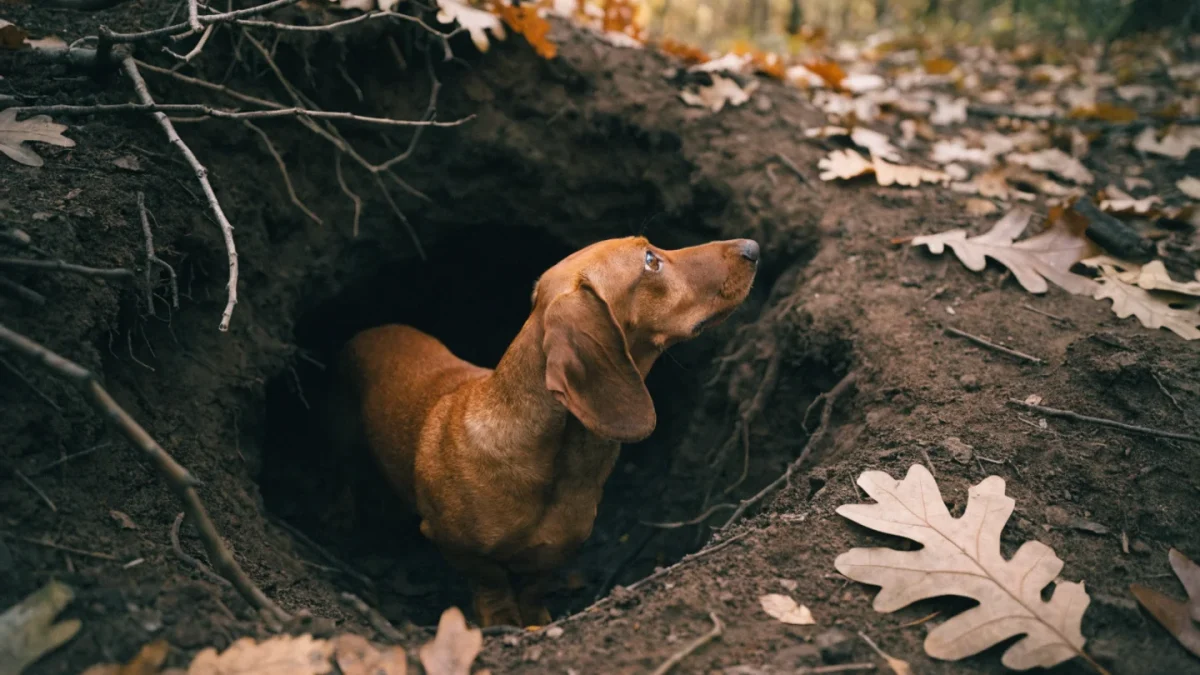
Why does a dog have a chest that wide and legs that short? If you look at a dachshund — really look, not with the "sausage dog" novelty reading — that body is clearly built for something specific. The deep, barrel-shaped chest creates lung capacity. The short, powerful forelegs are paddles designed to dig and brace. The elongated spine lets the dog fold into a burrow and still turn around. The loose skin doesn't catch on underground roots. Even the large, shovel-shaped paws make sense the moment you know what the dog was originally digging toward.
This is a hunting machine built for underground work against badgers and foxes. Every feature that looks unusual above ground was a functional advantage below it. The dachshund's history is the story of how those traits got selected, formalized, spread across Europe, and ultimately stripped of their original purpose — without losing the attitude that came with them.
The Underground Origins
The dachshund's history origins badger dog story starts, as the name declares, with badgers. "Dachs" is the German word for badger. "Hund" means dog. The breed's name is its original job title.
European badgers are formidable animals — muscular, equipped with powerful claws built for excavating complex den systems, and capable of inflicting serious wounds when cornered. German foresters and gamekeepers in the 15th and 16th centuries needed a dog that could enter a badger's underground sett, navigate narrow tunnels, and either drive the badger toward waiting hunters above ground or hold it at bay until the hunters could dig down.
The physical requirements were specific. The dog needed a long, narrow body to fit through tight passages. Short, powerful legs to move efficiently in confined spaces without getting stuck. A deep, barrel-shaped chest to house large lungs — oxygen is scarce in underground tunnels, and a dog fighting or tracking in a burrow needs sustained respiratory capacity. Loose, thick skin that wouldn't tear easily when the dog scraped through rough earthen walls or took bites from its quarry. And a bark loud enough to be heard through several feet of packed soil.
Written references to dogs matching this description appear in German hunting texts from the 1400s, using terms like "Dachskrieger" (badger warrior) and "Dachsfinder" (badger finder). These early dogs weren't a standardized breed in the modern sense — they were a type, selected for function rather than appearance. A forester bred whichever dogs produced the best underground workers, without concern for consistent looks.
From Type to Breed
The deliberate, systematic breeding that transformed the dachshund from a functional type to a recognizable breed intensified during the 17th and 18th centuries. German gamekeepers began keeping records of lineage and selecting for consistent physical traits alongside working ability.
By this period, the dachshund's working role had expanded well beyond badgers. Standard-sized dachshunds tracked and pursued foxes, which used similar den systems. Smaller specimens were bred down to hunt rabbits and weasels — animals that used tighter tunnels requiring an even more compact dog. In some regions, packs of dachshunds worked together to flush wild boar from dense undergrowth, using their low profile to move through brush that taller dogs couldn't penetrate and their loud voices to drive panicked boar toward waiting hunters.
This versatility made the dachshund one of the most popular hunting dogs in the German states. Unlike specialized hounds that served a single purpose, a dachshund could go underground after a badger in the morning and track a wounded deer through a thicket in the afternoon. For rural gamekeepers who needed a single working dog rather than a kennel of specialists, the dachshund was the practical choice.
The size split formalized during this period. Standard dachshunds — heavy enough to confront a badger and strong enough to hold their ground — remained the primary working type. The smaller miniature dachshund emerged as a dedicated rabbit hunter, bred down from the lightest standard specimens over several generations. Some German breed registries eventually recognized a third size category, the "kaninchen" (rabbit), smaller still than the miniature, though this classification never gained universal acceptance.
Three Coats, Three Purposes
The original dachshund was smooth-coated — a short, dense, water-resistant coat that required minimal maintenance and didn't snag on underground roots or tunnel walls. This remained the only coat variety for centuries.
The longhaired dachshund likely emerged in the 18th or early 19th century through crosses with small spaniels. The longer coat provided better insulation for working in cold water and cold weather — useful for dachshunds that doubled as retrievers of shot waterfowl in colder German regions. Longhaired dachshunds were never as common as the smooth variety for underground work, since the longer coat was more prone to tangling in burrows. But for above-ground tracking and retrieving in harsh climates, they had an advantage.
The wirehaired dachshund appeared later, in the mid-to-late 19th century, through deliberate crosses with wire-coated terriers and rough-haired pinschers. The harsh outer coat and dense undercoat provided weather resistance and protection from thorny underbrush — important for dogs working above ground in thick bramble and scrub. The terrier influence showed up in more than just the coat. Wirehaired dachshunds tend to carry a slightly different temperament — more outgoing, more clownish, more overtly bold — which many breed historians attribute to that terrier heritage.
Each coat type bred relatively true by the late 1800s, and the three varieties were formally recognized as separate breeding lines within the same breed.
The Companion Transition
The dachshund's shift from working hunter to companion dog happened in stages across the 19th century.
In Germany, the breed had already been kept as a household dog alongside its hunting role — German foresters' dachshunds lived in the home, played with the children, and went to work when needed. The concept of a purely ornamental pet didn't exist in the same way it would later, but dachshunds had always been more domestic than most working hound breeds.
Queen Victoria's adoption of the breed in 1839 accelerated the transition dramatically in Britain. The royal association made dachshunds fashionable among the British upper class. By the 1860s, dachshunds were appearing at British dog shows, and the breed had acquired a following that had nothing to do with badger hunting. The first breed standard was drafted in Germany in 1879, and the Deutscher Teckelklub was founded in 1888 to oversee the breed's development.
In North America, dachshunds arrived with German immigrants in the mid-1800s. The American Kennel Club recognized the breed in 1885 — one of the earliest breeds in its registry. By the turn of the century, dachshunds had established themselves as popular companion dogs on both sides of the Atlantic.
For a deeper look at how these historical working traits manifest in the modern pet, the dachshund complete breed guide covers the full behavioral profile.
The War Years
The two World Wars inflicted a strange and painful chapter on dachshund history. As a conspicuously German breed, the dachshund became a target for anti-German sentiment in Britain, the United States, and other Allied nations.
During the First World War, dachshunds were used in propaganda cartoons to represent Germany and the Kaiser. The association was so strong that dachshund owners in Britain and America reported their dogs being kicked, stoned, and killed in the streets. Some owners stopped walking their dachshunds in public. Breed club registrations plummeted. In Britain, the Kennel Club reportedly considered dropping the breed from its registry. In the United States, some owners took to calling their dogs "liberty pups" or "liberty dogs" to avoid the German name, according to breed history accounts from the period.
The pattern repeated during the Second World War, though with somewhat less violence directed at the dogs themselves. Registrations dropped again, public sentiment turned hostile again, and the breed's popularity suffered — again.
Both recoveries were remarkably complete. Within a decade of each war's end, dachshund registrations rebounded to pre-war levels and beyond. The breed's personality — that combination of stubbornness, loyalty, and sheer force of character — apparently proved more durable than political prejudice.
The Modern Dachshund
By the mid-20th century, the dachshund had become one of the most popular companion breeds worldwide, ranking consistently in the top ten most registered breeds across multiple countries. The functional hunting dachshund didn't disappear entirely — in Germany and some other European countries, dachshunds still work as tracking dogs, following blood trails to locate wounded game — but the vast majority of the breed's global population now serves as companion animals.
The modern dachshund retains the physical hallmarks of its hunting ancestry: the elongated body, the short legs, the deep chest, the large paws. It retains the behavioral hallmarks too — the independence, the prey drive, the unreasonable bark-to-body-size ratio, the conviction that it is substantially larger and more dangerous than it actually is. These traits, which made the breed effective underground in the 1500s, now make it one of the most characterful companion dogs alive.
Understanding the dachshund's temperament and personality becomes considerably more intuitive once you know what the breed was built to do. Every behavioral trait that confuses or frustrates a new dachshund owner has a direct line back to a German forester's practical need, five hundred years ago, for a dog brave enough to fight a badger in the dark.
The Right Appreciation for This Breed
The dachshund's history is, at its core, a story about a dog that was built to do something extraordinarily difficult and dangerous — and then, when the job disappeared, adapted to domestic life without losing a single ounce of the character that made it good at the work. That's the part I find most remarkable after years of researching breed histories. Most breeds soften when the working pressure lifts. The dachshund just redirected its intensity from badger setts to the household, and carried on with the same energy it always had.