

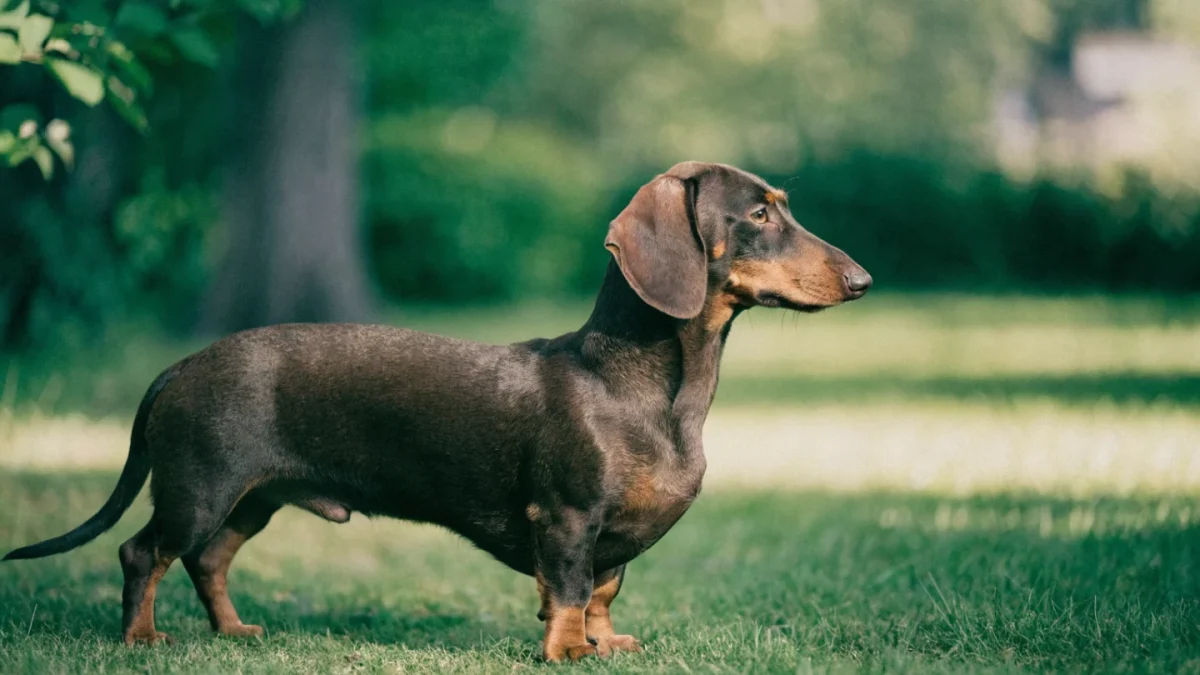
One mutation created every short-legged dog breed that has ever existed. One. A single FGF4 retrogene insertion on chromosome 18 — a fragment of a gene that copied itself into the wrong place and disrupted how cartilage develops in the long bones of the limbs. That same event is responsible for the dachshund, the corgi, the basset hound, the Skye Terrier, the Dandie Dinmont, and roughly a dozen others. We know this because all of them carry the same retrogene, not a set of similar mutations — the same one, present across breeds separated by centuries of selective breeding and geography. It happened once. Humans recognized the resulting body shape as useful, selected for it, and distributed it across dozens of breeds.
That's fascinating. What makes it complicated is what else that retrogene does. The same genetic event that shortens the limb bones also disrupts the intervertebral discs, causing them to calcify and degenerate prematurely — sometimes catastrophically. The dachshund's distinctive shape and its most serious health liability are the same thing, encoded in the same mutation. You cannot breed one without the other. That's the starting point for understanding dachshund genetics.
The FGF4 Retrogene and Chondrodystrophy
The FGF4 gene produces fibroblast growth factor 4, a protein involved in regulating cell growth and development. Under normal circumstances, FGF4 plays a time-limited role during embryonic development and then largely shuts down.
The retrogene insertion — a copy of FGF4 that was duplicated and reinserted into chromosome 18 at some point in canine evolutionary history — doesn't shut down. It continues expressing the growth factor beyond its normal window, disrupting the growth plates in the long bones of the limbs. The result is disproportionate dwarfism: the limbs are shortened while the torso retains roughly normal length and proportions.
This is chondrodystrophy, not achondroplasia — a distinction that matters for understanding the health consequences. Chondrodystrophic breeds have abnormal cartilage development that affects not just the limbs but also the intervertebral discs. The discs, which normally maintain a gel-like consistency throughout most of a dog's life, begin calcifying and losing flexibility much earlier in chondrodystrophic breeds. In dachshunds, disc calcification can begin as early as age one, decades ahead of the normal degenerative timeline.
The FGF4 retrogene on chromosome 18 is fixed in the dachshund population — every individual carries it. You cannot breed it out without fundamentally changing the breed's physical type. This is the core dilemma of dachshund genetics: the defining physical trait and the primary health risk share the same cause.
A separate FGF4 retrogene insertion on chromosome 12 has also been identified in some breeds and is associated with additional IVDD risk. Research published in 2017 in Proceedings of the National Academy of Sciences confirmed that dogs carrying retrogene insertions on both chromosomes 12 and 18 face compounded disc disease risk. Whether all dachshunds carry both insertions or only the chromosome 18 variant remains an area of active investigation.
How This Connects to IVDD
The pathway from genetics to clinical disease is relatively straightforward.
Chondrodystrophy causes premature calcification of the intervertebral discs. Calcified discs lose their cushioning function — they become brittle rather than flexible. When a brittle disc is subjected to mechanical stress — a jump, a fall, a twist, accumulated wear — it can herniate, extruding disc material into the spinal canal. That extruded material compresses the spinal cord, causing pain, nerve damage, weakness, or paralysis depending on the location and severity.
Not every calcified disc herniates. And not every dachshund with calcified discs develops clinical IVDD. The genetics create the predisposition; environmental factors — weight, activity type, physical trauma — determine whether that predisposition becomes a clinical event. This is why weight management and activity modification genuinely reduce risk even though they can't eliminate the genetic vulnerability.
The dachshund complete breed guide covers the clinical presentation and management of IVDD in practical terms for owners.
Coat Variety Genetics
Dachshund coat type is determined by a smaller number of genes than you might expect given the visual differences between the three varieties.
Smooth coat is the default — the ancestral coat type that requires no additional genetic modifiers. It's determined by the absence of the wire and long coat alleles. The smooth coat is dominant over both longhaired and wirehaired variants.
Longhaired coat is caused by a recessive allele at the FGF5 gene. Both parents must carry the longhair allele to produce longhaired puppies. Two smooth-coated dachshunds can produce longhaired offspring if both carry one copy of the recessive allele — which explains why longhaired puppies occasionally surprise breeders who haven't done genetic testing.
Wirehaired coat involves a different gene — the RSPO2 gene, which produces the characteristic rough texture and facial furnishings (the beard and eyebrows). The wirehaired coat is inherited in a dominant or incomplete dominant pattern, which is why wirehaired crosses tend to produce wire-textured offspring more readily than longhaired crosses produce longhaired offspring.
Each coat type breeds true when mated to the same variety, but crosses between varieties produce predictable outcomes based on the dominance relationships between the coat genes.
The Dapple (Merle) Genetics and Double Dapple Risk
The dapple pattern in dachshunds is caused by the SILV gene (also called PMEL17), the same gene responsible for the merle pattern in Australian Shepherds, Collies, and other breeds. One copy of the merle allele (heterozygous, Mm) produces the classic dapple pattern — a mottled mix of the base color with lighter patches.
Two copies (homozygous, MM) — the double dapple — produce excessive white markings and carry serious associated defects. The SILV gene affects melanocyte development, and when present in double dose, disrupts development in structures that depend on proper melanocyte migration during embryogenesis. The eyes and inner ear are particularly vulnerable, which is why double dapple dogs frequently exhibit:
- Microphthalmia (abnormally small eyes)
- Anophthalmia (absent eyes)
- Congenital deafness
- Iris coloboma (structural defects in the iris)
These aren't occasional risks — they're high-probability outcomes of a specific, known, and entirely preventable genetic cross. Two dapple parents should never be bred together. The genetic test to confirm merle status exists and is inexpensive. There is no defensible reason for a breeder to produce double dapple puppies.
Color Genetics Beyond Dapple
Dachshund coat color involves interactions between several loci. The E locus (MC1R) controls whether dark pigment is expressed — the recessive "ee" genotype produces cream or clear red dogs. The B locus (TYRP1) determines black versus chocolate pigment. The D locus (MLPH) controls dilution, converting black to blue and chocolate to Isabella; dilute colors are associated with color dilution alopecia in some individuals, as documented across multiple dilute-coated breeds.
The brindle and piebald patterns are inherited independently from base color. Neither carries the severe health risks of the double dapple cross, though piebald dogs with extensive white markings occasionally show congenital deafness linked to absent melanocytes in the inner ear.
What This Means for Breeding
Dachshund genetics offers both constraints and opportunities for breeders working to improve breed health.
The FGF4 retrogene cannot be eliminated without eliminating the dachshund body type. What breeders can do is select against the most extreme disc calcification phenotypes, breed from lines with lower IVDD incidence, and use emerging genetic research to identify dogs at the lower end of the risk spectrum within the breed.
The coat and color genetics offer clear, testable tools for avoiding preventable harm — particularly the double dapple cross. DNA testing for merle status, PRA carrier status, and other heritable conditions is available, affordable, and has no downside. Breeders who use it are protecting their dogs. Breeders who don't are choosing not to.
The dachshund's history and development shows how centuries of selective breeding shaped these genetic patterns. Understanding that history clarifies why certain traits are fixed in the breed and why others remain variable — and where the realistic opportunities for health improvement actually lie.